

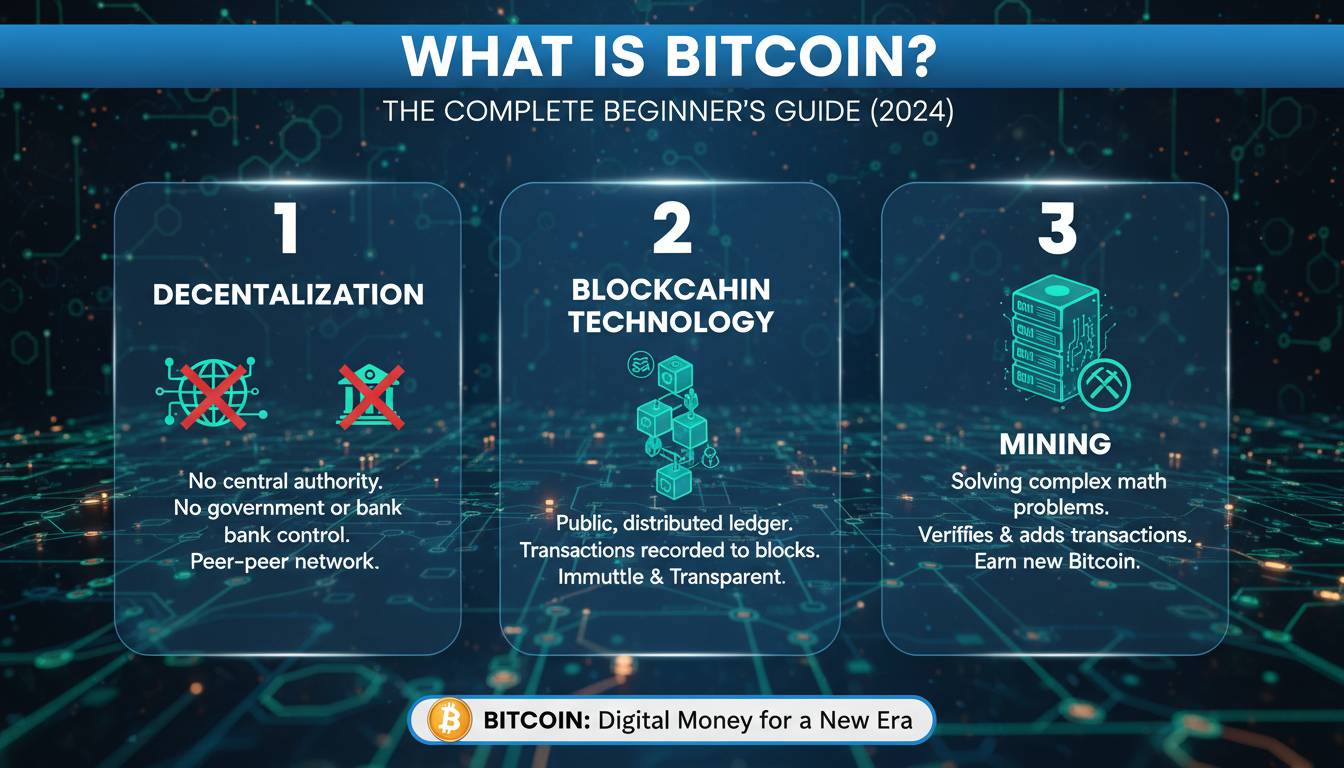
Bitcoin stands as the world’s first decentralized digital currency, operating without a central bank or single administrator. Launched in 2009 by the mysterious figure (or group) known as Satoshi Nakamoto, Bitcoin introduced a revolutionary concept: peer-to-peer electronic cash that transfers value directly between users without intermediaries like banks or payment processors. As of 2024, Bitcoin has grown from an obscure cryptographic experiment into a trillion-dollar asset class, with over 230 million users worldwide holding some form of Bitcoin.
This comprehensive guide breaks down everything you need to understand about Bitcoin—from its underlying technology to how you can acquire and store it safely.
Quick Answer
Bitcoin is a decentralized digital currency that operates on a distributed ledger called the blockchain. Unlike traditional currencies issued by governments (fiat currencies), Bitcoin has a fixed supply of 21 million coins, making it inherently deflationary. Transactions are verified through cryptographic proof rather than trusted third parties, enabling anyone with an internet connection to send or receive Bitcoin globally within minutes.
📊 STATS
• $1.3 trillion — Bitcoin’s total market capitalization
• 21 million — Maximum Bitcoin supply (hard-coded limit)
• 19.6 million — Bitcoin currently in circulation (2024)
• 10 minutes — Average time for block confirmation
• 230 million — Estimated global Bitcoin holders
Key Takeaways
• Decentralization: No single entity controls Bitcoin; the network operates across thousands of nodes globally
• Transparency: All transactions are publicly visible on the blockchain
• Scarcity: Bitcoin’s supply cap makes it similar to digital gold
• Security: Cryptographic encryption protects transactions and wallets
• Accessibility: Anyone with internet access can use Bitcoin 24/7, 365 days per year
What Is Bitcoin?
Bitcoin represents a fundamental shift in how we think about money. To understand Bitcoin fully, you need to grasp three interconnected concepts: Bitcoin as a currency, Bitcoin as a payment network, and Bitcoin as an asset.
The Currency
As a currency, Bitcoin functions similarly to the US dollar, euro, or any other medium of exchange—you can use it to purchase goods and services from merchants who accept it. Major companies including Microsoft, Overstock, and Whole Foods accept Bitcoin payments. However, Bitcoin differs fundamentally from fiat currencies in several critical ways.
Traditional currencies are inflationary by design. Central banks can print unlimited amounts of money, potentially diluting the value of existing currency units. Bitcoin, by contrast, has a strictly capped supply of 21 million coins. This programmatic scarcity means no central authority can create more Bitcoin, theoretically protecting against monetary debasement.
The supply schedule is predetermined and transparent. Approximately every four years, an event called “halving” reduces the block reward miners receive by 50%, gradually slowing new Bitcoin issuance. The most recent halving occurred in April 2024, reducing the reward from 6.25 to 3.125 Bitcoin per block. This deflationary mechanism distinguishes Bitcoin from every government-issued currency in history.
The Payment Network
Bitcoin operates as a decentralized payment network, similar to how email works as a distributed communication system. When you send Bitcoin, the transaction broadcasts to nodes worldwide, gets verified through cryptographic processes, and permanently records on the blockchain—no bank or payment processor required.
This peer-to-peer architecture offers several advantages over traditional payment systems. Cross-border payments that typically take 3-5 business days through banks clear in minutes with Bitcoin. Transaction fees, though variable, often prove lower than international wire transfer fees, particularly for larger amounts. The network never sleeps, processing transactions 24 hours daily, including weekends and holidays.
The Asset
Beyond its utility as money, Bitcoin has emerged as a significant investment asset. Institutional investors including hedge funds, pension funds, and publicly traded companies now hold Bitcoin on their balance sheets. The introduction of Bitcoin exchange-traded funds (ETFs) in 2024 made it easier for mainstream investors to gain exposure without directly managing cryptocurrency wallets.
💡 STAT: Bitcoin has outperformed the S&P 500 in 9 of the last 11 years, delivering an average annual return exceeding 50% .
How Bitcoin Works
Understanding Bitcoin’s technical foundation helps you appreciate why it functions as it does. The system combines several technologies: cryptography, distributed networking, and game theory.
The Blockchain Explained
The blockchain serves as Bitcoin’s public ledger, recording every transaction since the network’s inception. Think of it as a shared Google Doc that thousands of people can view but no single person can modify retroactively. Each “page” in this digital ledger is called a block, containing a group of transactions.
Blocks link together chronologically, forming a chain—hence the name blockchain. Once a block joins the chain, altering historical records becomes computationally impractical. To change a single transaction in an old block, an attacker would need to redo all subsequent work faster than honest miners produce new blocks—an impossible feat given Bitcoin’s network size.
This immutability creates trust without requiring you to trust any individual or organization. The math protects the system, not human promises.
Mining and Consensus
Bitcoin achieves consensus through a process called Proof of Work (PoW). Miners—participants running specialized computers—compete to solve complex mathematical puzzles. The first miner to solve the puzzle earns the right to add the next block of transactions to the blockchain and receives newly created Bitcoin as compensation.
This process serves two critical functions. First, it secures the network by making attacks economically irrational—the cost of attacking exceeds any potential reward. Second, it distributes new Bitcoin in a predictable, transparent manner according to the halving schedule.
Mining requires substantial electricity and specialized hardware, leading to debates about Bitcoin’s environmental impact. The network has increasingly shifted toward renewable energy sources, with the Bitcoin Mining Council reporting that 60% of mining in North America uses sustainable energy .
Keys and Wallets
Owning Bitcoin means controlling cryptographic keys—specifically, a private key that authorizes transactions and a public key that others use to send you Bitcoin. Your “wallet” stores these keys, essentially functioning like a combination of a bank account number (your public address) and your PIN (your private key).
Wallets come in two main varieties. Hot wallets connect to the internet, offering convenience for frequent trading but exposing keys to potential hacking. Cold wallets remain offline, providing superior security for long-term storage. Hardware wallets—small devices that store keys offline—represent the gold standard for securing significant Bitcoin holdings.
⚠️ CRITICAL: Your private key is everything. Anyone who knows your private key controls your Bitcoin. Lose your private key, and your Bitcoin becomes permanently inaccessible. There is no password reset option.
Benefits of Bitcoin
Bitcoin offers unique advantages that traditional financial systems cannot match. Understanding these benefits helps explain why millions have adopted the currency.
Financial Sovereignty
With Bitcoin, you are your own bank. Unlike bank accounts that can be frozen, seized, or limited by governments or financial institutions, Bitcoin requires only your private key. This feature proves particularly valuable in regions with unstable currencies, capital controls, or authoritarian governance.
Refugees and individuals in economically volatile countries have used Bitcoin to preserve wealth when local currencies collapse. During the 2023 banking crisis in the United States, when several regional banks failed, Bitcoin emerged as an alternative that couldn’t be subject to bank runs or regulatory seizure.
Transparency and Auditability
Every Bitcoin transaction is publicly verifiable. Organizations can prove their Bitcoin holdings through cryptographic proofs called Merkle proofs, eliminating the need for costly audits. This transparency extends to the monetary supply itself—anyone can verify that exactly 19.6 million Bitcoin exist (as of late 2024) and that no unauthorized creation has occurred.
This contrasts sharply with traditional finance, where central banks’ exact money supply figures remain estimates, and financial institutions’ reserves claims require faith in audits.
Global Accessibility
Approximately 1.4 billion adults globally lack access to traditional banking services. Bitcoin requires only an internet connection—no ID verification, no minimum balance, no bank account. This accessibility empowers the unbanked to participate in the global economy, receive international payments, and store wealth securely.
| Feature | Bitcoin | Traditional Banking |
|---|---|---|
| Minimum balance | $0 | Often $25-300 |
| Account setup | Minutes with internet | Days with documentation |
| International transfers | Minutes, ~$1-10 fee | Days, $25-50+ fees |
| Operating hours | 24/7/365 | Business hours |
| Requires ID | Optional for self-custody | Required |
Store of Value
Increasingly, investors view Bitcoin as “digital gold.” Like gold, Bitcoin is scarce, durable, portable, and divisible. It cannot be counterfeited, and its supply growth rate decreases over time. Unlike gold, Bitcoin is instantly transferable globally and easily verifiable.
Institutional adoption has accelerated this narrative. Major investment firms including BlackRock and Fidelity have launched Bitcoin products, legitimizing Bitcoin as a portfolio diversifier and potential hedge against inflation.
📈 CASE: MicroStrategy, a business intelligence company, transformed into a Bitcoin treasury company in 2020. By late 2024, the company’s Bitcoin holdings exceeded $10 billion, generating returns that significantly outperformed its original software business.
How to Get Started with Bitcoin
Acquiring Bitcoin involves several steps, each with important security considerations.
Prerequisites
- Age requirement: 18+ in most jurisdictions (varies by state/country)
- Identity verification: Required for regulated exchanges (KYC)
- Bank account or debit card: For funding purchases
- Secure storage plan: Decide between exchange holding or self-custody
- Time investment: Research to understand security practices
Steps to Buy Bitcoin
1. Choose an Exchange
Select a reputable cryptocurrency exchange operating in your jurisdiction. For US residents, Coinbase, Kraken, and Gemini offer regulated platforms with insurance protection for holdings held in hot wallets. Compare fees, as they vary significantly—some exchanges charge 0.1% per trade while others charge 1% or more.
⏱ Time: Research 2-4 hours | 💡 Tip: Start with a regulated exchange even if fees are slightly higher—security and regulatory protection matter more than tiny savings.
2. Complete Verification
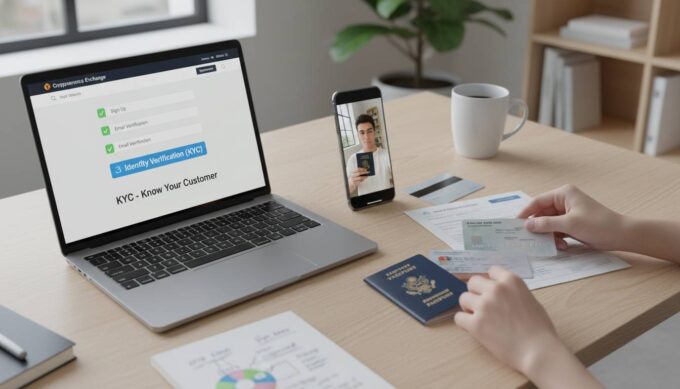
Create an account and complete identity verification (KYC). This process typically requires a government-issued ID, social security number (US), and sometimes proof of address. Verification usually completes within minutes to 24 hours.
3. Fund Your Account
Link a bank account or debit card to transfer US dollars. Bank transfers (ACH in the US) typically offer lower fees but take 3-5 business days. Debit cards provide instant funding but charge higher fees (typically 3-5%).
4. Place Your Order
Specify how much USD you want to spend or how much Bitcoin you want to buy. Market orders execute immediately at the current price. Limit orders let you set a price target and execute only if the market reaches your price.
⚠️ Avoid: Buying Bitcoin with credit cards—this typically incurs 3-5% fees plus cash advance charges from your card issuer.
5. Secure Your Bitcoin
Decide whether to keep Bitcoin on the exchange or transfer to your own wallet. For beginners holding less than $1,000, exchange holding is acceptable if you enable two-factor authentication. For larger amounts, transfer to a hardware wallet like Ledger or Trezor.
Troubleshooting
| Problem | Solution |
|---|---|
| Bank transfer pending | Wait 3-5 business days; contact bank if needed |
| Verification rejected | Upload clearer ID documents; try different exchange |
| Transaction pending | Network congestion; wait or pay higher fee for priority |
| Can’t withdraw funds | Complete full identity verification; check withdrawal limits |
Common Bitcoin Mistakes to Avoid
New Bitcoin users frequently make predictable errors that cost them money or create security vulnerabilities.
Mistake 1: Not Your Keys, Not Your Bitcoin
Beginners often leave Bitcoin on exchanges, treating it like a bank. Exchanges can be hacked (Mt. Gox in 2014 lost 850,000 Bitcoin), can freeze accounts, or can go bankrupt . When you hold Bitcoin on an exchange, you don’t actually own the Bitcoin—you own an IOU from the exchange.
Solution: For amounts exceeding a few hundred dollars, transfer to a hardware wallet you control.
Mistake 2: Losing Private Keys
Over $100 billion in Bitcoin is estimated to be permanently lost—Bitcoin sent to addresses whose private keys were forgotten, hardware wallets discarded, or hard drives destroyed. Unlike bank accounts, there’s no customer service to recover lost passwords.
Solution: Write down your recovery seed phrase on paper (not digitally), store it in multiple secure locations, and consider a metal backup designed for long-term preservation.
Mistake 3: FOMO Buying at Peaks
Inexperienced investors often buy Bitcoin after seeing dramatic price increases in news headlines, right before corrections. This “fear of missing out” buying typically leads to losses when prices subsequently drop.
Solution: Use dollar-cost averaging—invest a fixed amount monthly regardless of price. This strategy smooths volatility and removes emotional decision-making.
Mistake 4: Ignoring Security
Simple security oversights lead to theft. Phishing emails, fake websites, and social engineering attacks target cryptocurrency users constantly. Using the same password across sites, not enabling 2FA, or clicking suspicious links can result in complete loss.
Solution: Use unique, strong passwords; enable 2FA on all accounts (preferably with a hardware security key); verify all URLs before entering credentials.
⚠️ CRITICAL: No legitimate entity will ever ask for your private key or seed phrase. Anyone claiming to be “support” and asking for this information is attempting to steal your Bitcoin. Delete such messages immediately.
Bitcoin vs. Other Cryptocurrencies
Bitcoin remains the dominant cryptocurrency by market capitalization, but thousands of alternatives exist. Understanding Bitcoin’s unique position helps frame investment decisions.
| Factor | Bitcoin (BTC) | Ethereum (ETH) | Altcoins |
|---|---|---|---|
| Market Cap | ~$1.3T | ~$400B | Varies |
| Supply | Capped at 21M | Unlimited | Varies |
| Use Case | Store of value, payments | Smart contracts, DeFi | Varies |
| Transaction Speed | ~7 TPS | ~15-30 TPS | Varies |
| Energy Consumption | High (PoW) | Transitioning to PoS | Varies |
Why Bitcoin Differs
Bitcoin prioritizes decentralization, security, and scarcity above all else. Its development is deliberately conservative—changes to the core protocol require overwhelming consensus, making Bitcoin slower to innovate than newer blockchains.
This caution is a feature, not a bug. By refusing to compromise on decentralization, Bitcoin remains censorship-resistant and resistant to political capture. Altcoins frequently prioritize features over these principles, sometimes achieving better performance but risking centralization or capture.
Expert Insights
Bitcoin’s evolution has attracted attention from economists, technologists, and investors across the spectrum.
👤 Michael Saylor, Executive Chairman at MicroStrategy
“Bitcoin is the internet’s native digital property. It is a swarm of cyber hornets serving the goddess of wisdom, feeding on electrical energy, funnels it into a ledger and honey.”
👤 Nayib Bukele, President of El Salvador
“Bitcoin represents the future. It’s not about volatility—it’s about freedom from traditional financial systems that have failed millions.”
📊 BENCHMARKS
| Metric | Average | Top Performers |
|——–|———|—————-|
| Annual return (10yr) | 45% | 100%+ |
| Volatility (annualized) | 60% | Lower in later years |
| Correlation to S&P 500 | 0.35 | Decreasing over time |
| Mining hash rate | 600 EH/s | Growing |
Tools and Resources
Recommended Tools
| Tool | Cost | Purpose | Rating |
|---|---|---|---|
| Coinbase | Free (fees apply) | Buying/selling for beginners | ⭐⭐⭐⭐⭐ |
| Kraken | Free (fees apply) | Advanced trading, lower fees | ⭐⭐⭐⭐⭐ |
| Ledger | $79-250 | Hardware wallet security | ⭐⭐⭐⭐⭐ |
| Trezor | $70-200 | Hardware wallet security | ⭐⭐⭐⭐⭐ |
| Blockfolio | Free | Portfolio tracking | ⭐⭐⭐⭐ |
Top Picks:
• Coinbase: Best for beginners due to intuitive interface and strong regulatory compliance in the US
• Ledger: Best security for significant holdings—keys never touch internet-connected devices
• Kraken: Best fee structure for larger trades and advanced features
Frequently Asked Questions
What is Bitcoin in simple terms?
Bitcoin is digital money that exists only online—no physical coins or bills. You can send Bitcoin to anyone anywhere in the world without needing a bank or payment company to approve the transaction. Think of it like sending an email, but instead of a message, you’re sending value.
Is Bitcoin legal in the United States?
Yes, Bitcoin is legal in the United States. You can buy, sell, hold, and spend Bitcoin just like other assets. However, the IRS treats Bitcoin as property for tax purposes, meaning capital gains taxes apply when you sell Bitcoin for more than you paid.
How do I buy my first Bitcoin?
Open an account on a regulated US exchange like Coinbase or Kraken, complete identity verification, fund your account with a bank transfer or debit card, and place a buy order for Bitcoin. For amounts over a few hundred dollars, transfer your Bitcoin to a hardware wallet for security.
Is Bitcoin a good investment?
Bitcoin has delivered significant returns over its 15-year history but remains volatile. As a portfolio diversifier, Bitcoin offers unique characteristics different from stocks and bonds. Whether it’s appropriate for your portfolio depends on your risk tolerance, time horizon, and understanding of the asset. Always consult a financial advisor.
What determines Bitcoin’s price?
Bitcoin’s price is driven by supply and demand dynamics, with several unique factors including: scarcity (only 21 million will ever exist), institutional adoption, regulatory news, media sentiment, and macroeconomic conditions. Unlike stocks, Bitcoin has no earnings or revenue to value—it trades purely on adoption and perceived utility.
Conclusion
Bitcoin represents a profound innovation in money and financial technology—a decentralized, transparent, and scarce digital asset that operates independently of governments and banks. Whether you view it as a revolutionary technology, an investment asset, or a speculative gamble, understanding Bitcoin is increasingly essential in the modern financial landscape.
The key takeaways for beginners are straightforward: Bitcoin is not too late to understand or adopt, but education matters before investing. Start with small amounts you can afford to lose. Prioritize security by using reputable exchanges and hardware wallets for significant holdings. Think long-term rather than trying to time volatility.
The future of money is being written today, and Bitcoin sits at the center of that story. Whether you’re preparing for that future or simply curious about what makes Bitcoin significant, the fundamentals covered in this guide provide a solid foundation for further exploration.








Leave a comment