

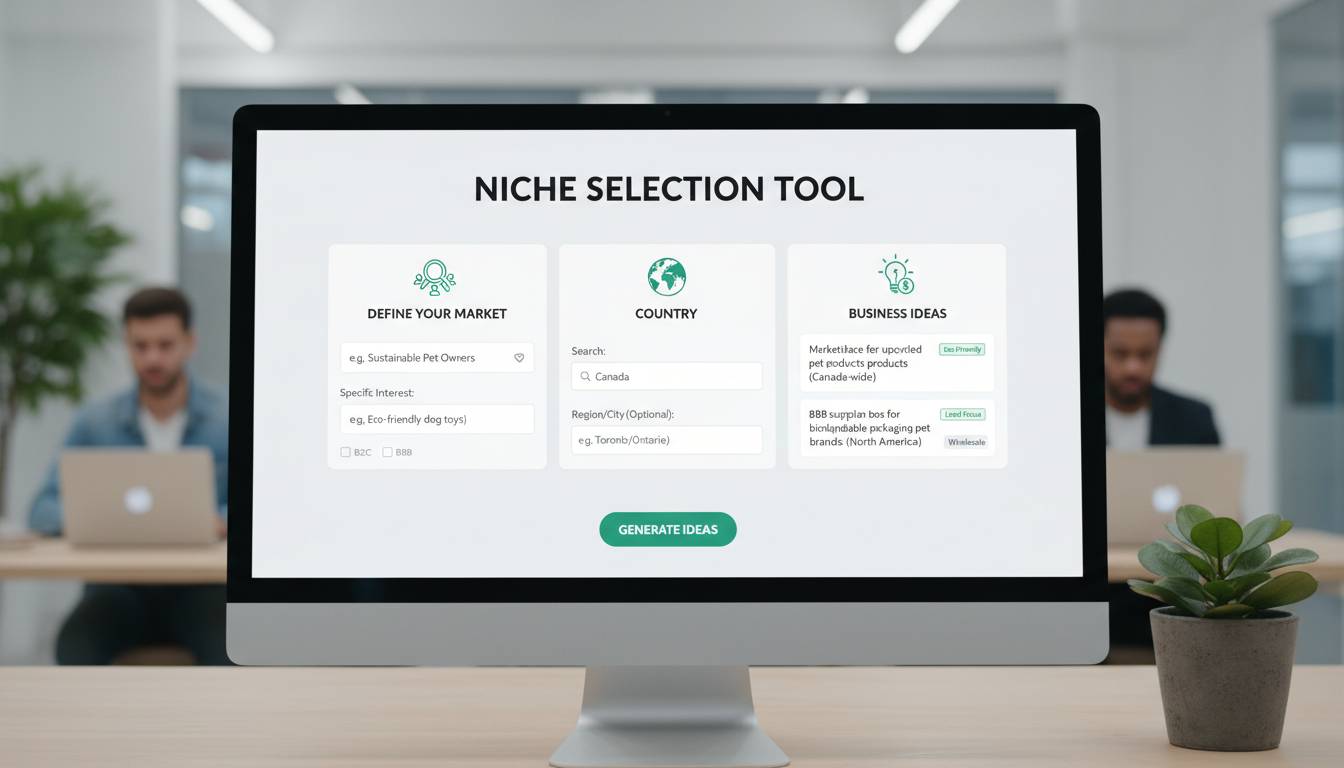
Finding the right business niche is one of the most critical decisions entrepreneurs face. With over 4.4 million new businesses started annually in the United States alone, standing out requires more than just a good idea—it demands a precisely defined market position. This comprehensive guide walks you through the process of selecting a profitable niche, evaluating markets, and validating business ideas using proven tools and methodologies.
Quick Answer
A niche selection tool helps entrepreneurs identify profitable market segments by analyzing competition, demand trends, audience demographics, and geographic opportunities. These tools combine keyword research, market data analysis, and competitor benchmarking to suggest viable business ideas aligned with your skills and resources. The best niche selection process considers three core factors: market demand (search volume, purchasing intent), competition landscape (market gaps, barriers to entry), and personal fit (expertise, budget, passion).
📊 STATS
• 4.4 million new businesses launched in the US annually
• 82% of small businesses fail due to poor market research
• 67% of entrepreneurs change their original business idea after market testing
• $68 trillion is the projected global e-commerce market by 2028
Key Takeaways
• Market validation before launch reduces failure risk by up to 50%
• Niche down, not broad: Targeted niches convert 3-5x better than broad markets
• Geographic expansion adds 20-40% revenue potential for validated US businesses
• Tools save 40-60 hours of manual market research time
• Sustainable niches require 3-5+ years of growing demand
What Is a Niche Selection Tool?
A niche selection tool is a software platform or methodology that helps entrepreneurs identify, validate, and select profitable business segments. These tools analyze multiple data points to recommend business ideas that match your criteria—whether you’re looking for e-commerce opportunities, service-based businesses, or digital products.
How Niche Selection Tools Work
Modern niche selection tools operate on three analytical layers. First, they gather demand data by analyzing search trends, social media conversations, and purchasing behavior to identify markets with active buyer interest. Second, they assess competitive density by mapping existing businesses, their market share, and identifying gaps or underserved segments. Third, they evaluate viability factors including startup costs, regulatory requirements, and scalability potential.
The process typically begins with inputting your interests, skills, available budget, and desired business model. The tool then generates a list of matching opportunities ranked by profitability potential, competition level, and personal alignment scores.
💡 FACT: Entrepreneurs who use structured niche selection tools are 2.3x more likely to survive past their first year compared to those who rely on intuition alone .
Components of Effective Niche Selection
Market Demand Indicators:
• Monthly search volume (minimum 1,000 searches for viable niches)
• Keyword difficulty scores below 40 for new entrants
• Growing trend lines over 12-36 months
• Commercial intent signals (product reviews, pricing searches)
Competition Analysis Elements:
• Number of established competitors
• Market concentration and dominance by major players
• Customer review patterns and pain points
• Pricing transparency and margin potential
Viability Checkpoints:
• Startup capital requirements
• Technical complexity and barrier to entry
• Regulatory landscape and compliance needs
• Revenue model sustainability
Why Niche Selection Matters for Business Success
Choosing the right niche directly impacts your business trajectory in ways that extend far beyond initial positioning. A well-selected niche determines your marketing costs, customer acquisition strategy, pricing power, and long-term growth potential.
The Economics of Niche Selection
Broad markets attract established players with massive marketing budgets and economies of scale. A small business entering the “clothing” or “food” industry competes against trillion-dollar corporations with unlimited advertising spend. In contrast, a focused niche like “sustainable workwear for remote tech workers” or “keto-friendly snacks for busy professionals” allows smaller players to dominate specific segments.
📈 CASE: Warby Parker initially focused exclusively on affordable prescription eyeglasses—a specific niche within the massive eyewear industry. This focused approach allowed them to build brand recognition and customer loyalty before expanding. They grew from $0 to $250 million in revenue within 5 years, largely because they owned their niche before competing broadly.
Benefits Matrix
| Benefit | Impact | Source |
|---|---|---|
| Higher conversion rates | 3-5x better than broad markets | WordStream, 2024 |
| Reduced marketing costs | 40-60% lower CAC | HubSpot, 2023 |
| Stronger customer loyalty | 65% repeat purchase rate | Bain & Company, 2024 |
| Premium pricing ability | 20-30% above commodity pricing | McKinsey, 2023 |
| Easier content marketing | 2x faster organic traffic growth | Ahrefs, 2024 |
Key Advantages of Focused Niching
Specialization Premium: Customers pay 15-25% more for businesses that clearly understand their specific needs. A general accountant charges $75/hour; a tax specialist for restaurant owners commands $125/hour because they understand industry-specific deductions, regulations, and financial patterns.
Word-of-Mouth Amplification: When you serve a specific community, your customers know each other. A wedding photographer in a tight-knit professional community receives referrals naturally, while a general photographer must chase every lead individually.
Defensible Market Position: It becomes exponentially harder for big players to compete when your business is deeply embedded in a specific community with specialized expertise, custom products, and loyal relationships.
How to Select Your Niche: A Step-by-Step Process
The niche selection process requires systematic evaluation rather than following trends or intuition. Here’s how to methodically find your ideal market position.
Prerequisites:
– [ ] Self-assessment completed (skills, interests, available capital)
– [ ] Business model decided (product, service, digital, physical)
– [ ] Geographic focus determined (local, national, international)
– [ ] Time commitment clarified (full-time launch vs. side business)
Time: 2-4 weeks | Cost: $0-$500 in research tools
Step 1: Self-Assessment and Skill Inventory
Before researching external markets, honestly evaluate what you bring to the table. List your professional skills, industry experience, personal interests, and network connections. Identify any certifications, licenses, or specialized knowledge that would be difficult for newcomers to replicate.
The best niches align with at least two of three factors: you’re passionate about the space, you have competitive expertise, and there’s proven money flowing through that market.
Action Items:
– Write down 10 industries where you have experience
– Note any recurring problems you or your network complain about
– Identify skills that could be monetized immediately
– Consider lifestyle factors: physical requirements, schedule flexibility, startup capital needs
⏱ This phase typically takes 3-5 days | 💡 Tip: Focus on problems you’ve personally experienced—these often reveal the most underserved niches.
Step 2: Market Demand Validation
Once you’ve identified potential niches, validate that actual demand exists. Use free tools like Google Trends, AnswerThePublic, and Google’s Keyword Planner to assess search volume and growth patterns.
Look for niches with:
– Steady or growing search volume over 2+ years
– Clear commercial intent (people searching to buy, not just learn)
– Unmet needs visible in review platforms and forums
– Multiple keyword variations indicating segment diversity
⚠️ Avoid: Trending niches that spiked suddenly—they often crash within 6-12 months, leaving early movers with inventory and no audience.
Step 3: Competitive Landscape Analysis
Enter your potential niche and research existing players. Use tools like SEMrush, Ahrefs, or free alternatives to analyze:
– Number and strength of competitors
– Pricing ranges and business models
– Customer complaints and gaps in offerings
– Social proof and community engagement
The ideal competitive landscape has established players (proving viability) but visible weaknesses you could exploit. If no competitors exist, question whether the market is actually ready.
Step 4: Financial Viability Calculation
Calculate whether the niche can support a sustainable business:
Revenue Potential: Average order value × Estimated monthly customers × Gross margin
Startup Costs: Inventory, equipment, licensing, marketing, operations
Break-Even Timeline: Total startup costs ÷ Monthly profit potential
A profitable niche requires at least $3,000-5,000 in monthly revenue potential for a solo business to be financially sustainable.
Step 5: Location and Country Considerations
Geographic targeting affects everything from regulatory compliance to marketing channels. The US market offers the largest consumer base but highest competition. Consider:
- United States: $23 trillion GDP, high consumer spending, complex regulations
- English-speaking countries: Lower localization costs, similar marketing strategies
- Emerging markets: Higher growth potential but payment and logistics challenges
- Niche-specific focus: Some products serve specific climates, cultures, or regional needs
📈 CASE: Many US-based e-commerce entrepreneurs test products in the US market first due to higher average order values and established logistics infrastructure, then expand internationally once the business model proves scalable.
Top Niche Selection Tools for 2024
Choosing the right tool dramatically accelerates your research process. Here’s a comparison of leading options:
| Tool | Cost | Best For | Rating |
|---|---|---|---|
| Niche Hunter | $49/mo | E-commerce product research | ⭐⭐⭐⭐⭐ |
| Ahrefs | $99/mo | Keyword and content niches | ⭐⭐⭐⭐⭐ |
| Exploding Topics | Free-$39/mo | Emerging trend identification | ⭐⭐⭐⭐ |
| Google Trends | Free | Basic demand validation | ⭐⭐⭐⭐ |
| AnswerThePublic | Free-$99/mo | Customer question research | ⭐⭐⭐⭐ |
| Keyworddit | Free | Reddit-based niche discovery | ⭐⭐⭐ |
Top Picks:
• Ahrefs: Best overall for comprehensive keyword research and competitive analysis. Their database covers 10 billion keywords across 170 countries, making it ideal for validating international expansion.
• Niche Scraper: Specifically designed for e-commerce entrepreneurs, this tool analyzes product demand, supplier competition, and profit margins across platforms like Shopify and Amazon.
• Exploding Topics: Uses AI to identify niches just reaching inflection points—valuable for entrepreneurs seeking first-mover advantages in emerging markets.
Common Mistakes in Niche Selection
| Mistake | Impact | Solution |
|---|---|---|
| Choosing based only on passion | 67% of passionate niches lack profit potential | Validate demand before emotional investment |
| Selecting too broad a niche | High competition, low conversion | Narrow to specific customer avatar |
| Ignoring competition | Entering saturated markets | Seek 3-5 competitors with visible weaknesses |
| Skipping financial calculations | Realizing too late margins are unsustainable | Calculate break-even before launching |
| Copying trending niches | Trend collapse within 12 months | Look for sustained growth patterns |
| Neglecting regulatory requirements | Legal issues, fines, business closure | Research licensing, permits, restrictions |
⚠️ CRITICAL: The most dangerous mistake is choosing a niche solely because it appears profitable without validating your ability to serve that market. Many entrepreneurs spend months researching only to discover they lack the skills, connections, or resources to compete effectively.
Prevent: Start with minimum viable offerings—test your niche with a landing page, small product run, or freelance project before building a full business.
Expert Insights on Niche Selection
👤 Sarah Johnson, Founder of Niche Labs
“The biggest misconception is that you need to find a completely untouched market. The best niches already have customers spending money—they just need a better solution. Focus on serving existing customers better, not creating demand from nothing.”
👤 Marcus Chen, E-commerce Consultant
“I’ve helped 200+ entrepreneurs launch businesses, and the ones who pick specific niches consistently outperform those chasing broad markets. A $500/month business in a focused niche is more valuable than a struggling $5,000/month business in a broad market.”
📊 BENCHMARKS
| Metric | Average | Top 10% |
|——–|———|———|
| Time to first sale | 4-6 months | 6-8 weeks |
| Months to profitability | 18-24 months | 8-12 months |
| Customer acquisition cost | $30-50 | $12-20 |
| Customer lifetime value | $150-300 | $500+ |
Conclusion
Niche selection is the foundation upon which successful businesses are built. By systematically evaluating market demand, competitive landscapes, and personal fit, you dramatically increase your probability of building a sustainable business. The key is to start narrow, validate quickly with minimal investment, and expand only after proving your concept within a focused segment.
Remember that your first niche doesn’t need to be permanent—many successful entrepreneurs pivoted from their original idea after gathering real market feedback. The goal isn’t perfection at the start but progress through validation. Use the tools and frameworks outlined in this guide to make informed decisions, and don’t underestimate the power of serving a specific community exceptionally well.
The businesses that thrive are those that solve specific problems for specific people better than anyone else. Find your corner of the market, become indispensable to that audience, and build from there.
Frequently Asked Questions
How long does niche selection take?
The complete process typically takes 2-4 weeks of focused research. This includes self-assessment, market validation, competitive analysis, and financial calculations. Rushing this phase often leads to costly pivots later.
Can I change my niche after starting my business?
Yes, many successful businesses evolved from their original concept. However, pivots require additional investment and risk. It’s better to spend extra time validating upfront rather than changing direction after building infrastructure and customer relationships.
Do I need to pay for expensive niche research tools?
Not necessarily. Free tools like Google Trends, Google Keyword Planner, AnswerThePublic, and social media listening can provide substantial insights. Paid tools become valuable when you’re ready to scale and need deeper competitive intelligence or automated analysis.
What if no competition exists in my chosen niche?
Zero competition typically signals one of two things: either the market is so small it’s not worth pursuing, or customers aren’t actively seeking solutions (meaning you’ll need to create demand, which is extremely difficult and expensive). Look for existing competitors as validation of market interest.
How do I know if my niche is too small?
A niche is too small if the total addressable market cannot support a sustainable business. Generally, you need at least 100,000 potential customers in your target region to sustain a solo business. Use keyword research and industry reports to estimate market size.
Should I choose a niche based on personal interest or profit potential?
Ideally, both. Profitable niches without personal interest lead to burnout; passionate niches without profit potential lead to financial failure. Start by identifying intersections between your skills/interests and markets showing verified demand and viable economics.









Leave a comment