

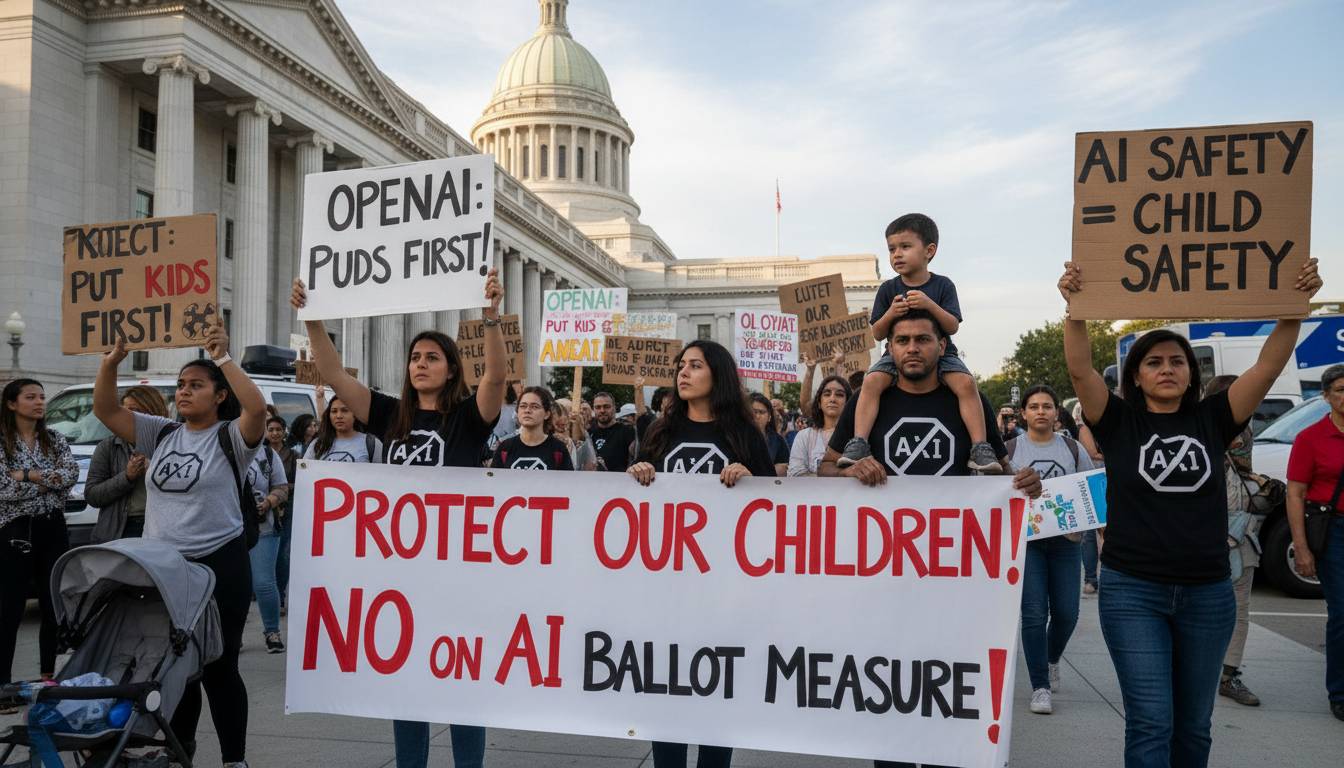
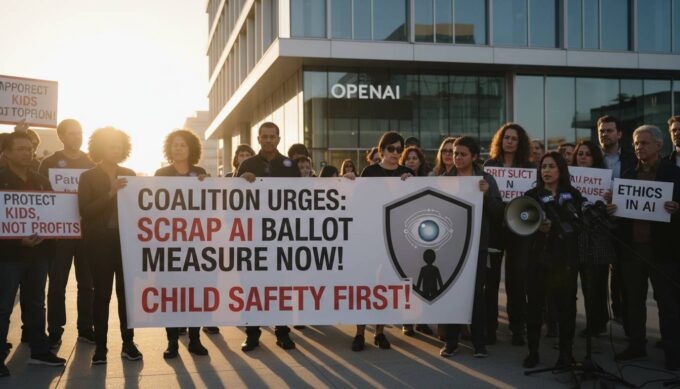
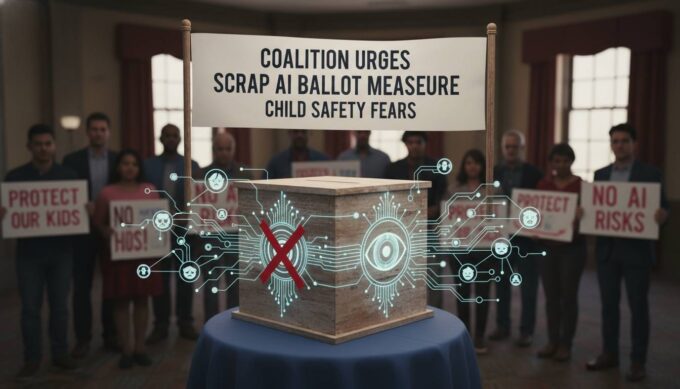
A coalition of advocacy groups and child-safety organizations is pressing California lawmakers to reject OpenAI’s proposed AI ballot measure, arguing the plan would narrow protections for minors and weaken accountability for harmful chatbot interactions. The push intensified after Common Cause published its response on February 25, 2026, and after a coalition letter to state Sen. Christopher Cabaldon warned that the proposal could leave major gaps in safeguards for children if it reaches voters this fall, according to Common Cause and the publicly posted letter.
⚠️Core dispute: The coalition says OpenAI’s proposed ballot measure limits child protections to a narrow category of “severe harms,” creating what signatories describe as a significant safety gap for minors interacting with AI systems. Sources: Common Cause materials published February 25, 2026, and the coalition letter posted by Common Cause.
Documented Pressure Points in the Dispute
Feb. 25, 2026
Common Cause publication date
Child safety carve-outs
Protections described as too limited
2 state AGs
California and Delaware previously raised child-safety concerns about OpenAI
Sources: Common Cause, AP, OpenAI.
February 25, 2026 response puts OpenAI’s proposal under a child-safety lens
Common Cause’s published response frames the fight as more than a procedural disagreement over AI governance. Its position is that OpenAI’s proposed ballot measure would reshape the legal boundaries around AI harms in a way that is especially consequential for children and teenagers. The organization says its AI watchdog group, CITED, is “sounding the alarm” over the proposal and the risks it poses to children’s safety, according to the group’s February 25, 2026 post.
The coalition letter hosted by Common Cause adds more detail. Addressed to California state Sen. Christopher Cabaldon, the document urges lawmakers to oppose the measure if it appears on the ballot in fall 2026. The signatories argue that the proposal applies child protections only to a limited set of “severe harms,” which they say leaves a broader range of harmful AI interactions outside meaningful protection. The letter describes that limitation as a “critical gap” in protecting children’s safety.
That language matters because ballot measures can lock policy choices into voter-approved text that is harder to revise than ordinary legislation. In practical terms, the coalition is warning that if a narrower liability or safety standard is adopted through a statewide vote, California could end up with a more restrictive framework for child-related AI harms than advocates want. That is the central policy dispute visible in the public documents reviewed here.
What the coalition says is at stake
| Issue | Coalition position | Why it matters |
|---|---|---|
| Child protections | Too narrowly defined | Could exclude harmful but non-“severe” interactions |
| Ballot route | Should be rejected | Voter-approved rules can be harder to amend |
| National implications | Potentially broad | California policy often influences other jurisdictions |
Source: Coalition letter posted by Common Cause | Published February 2026.
Why child safety became the measurable fault line in OpenAI oversight
The coalition’s argument lands in a policy environment where child safety has already become a documented concern for OpenAI regulators and critics. In September 2025, the attorneys general of California and Delaware warned OpenAI that they had “serious concerns” about the safety of ChatGPT, especially for children and teens, according to the Associated Press. The AP reported that the officials cited troubling reports of dangerous chatbot interactions, including a California teen suicide and a Connecticut murder-suicide case referenced in their warning.
That earlier intervention is important context because those two attorneys general also hold unusual authority over nonprofit entities such as OpenAI. Their review of OpenAI’s structure and safety mission had already been underway when they raised concerns about harms to minors. In other words, the child-safety issue did not emerge in isolation in 2026; it followed months of scrutiny from state officials with direct oversight relevance.
OpenAI, for its part, has publicly emphasized child-safety measures in other contexts. The company said in an earlier policy statement that it had committed to Safety by Design principles with other industry participants and had worked to minimize the potential for models to generate content that harms children, while also setting age restrictions for ChatGPT and engaging with child-protection groups including NCMEC and the Tech Coalition. OpenAI also introduced a “Teen Safety Blueprint” in November 2025 as a policy roadmap for teen AI standards.
The tension, then, is not whether child safety is relevant. All sides publicly say it is. The dispute is over whether OpenAI’s ballot proposal would codify protections that are strong enough, broad enough, and enforceable enough for minors. The coalition says no. The public materials surfaced in search results do not show a detailed OpenAI rebuttal on the specific coalition claims in the same documents reviewed here.
How the conflict built over time
Ex-employees ask California and Delaware attorneys general to block OpenAI’s planned restructuring, citing concerns about control and safety mission accountability.
OpenAI announces that its nonprofit will continue to control the business, after discussions with civic leaders and the offices of both attorneys general.
California and Delaware attorneys general say they have serious concerns about chatbot safety, especially for children and teens.
Common Cause publishes its response to OpenAI’s proposed ballot measure, centering risks to children’s safety.
OpenAI’s 2025 restructuring reversal still shapes the 2026 ballot fight
To understand why a ballot measure would attract this level of scrutiny, it helps to look at OpenAI’s structural debate in 2025. In May 2025, OpenAI said it was reversing course on a plan to convert itself into a for-profit business and that its nonprofit would continue to control the company. CEO Sam Altman said the decision followed feedback from civic leaders and discussions with the offices of the California and Delaware attorneys general, according to AP reporting.
OpenAI’s own statement on its evolving structure similarly said the nonprofit was founded to oversee and control the organization and would remain central to its mission. The company later described a recapitalization path involving a public benefit corporation while keeping nonprofit control in place. Those statements matter because they show OpenAI has already been navigating pressure from regulators, civil society groups, and governance critics over how commercial incentives interact with safety obligations.
The coalition’s 2026 objection appears to fit into that broader pattern. The concern is not only about one policy clause affecting children. It is also about whether OpenAI is trying to shape the legal environment around AI accountability through a ballot initiative rather than through a legislative process that advocacy groups may see as more adaptable and more open to amendment. The coalition letter explicitly flags possible national implications if California voters are asked to approve the measure.
California’s role amplifies the stakes. State-level AI rules often influence compliance strategies beyond state borders because companies prefer unified product standards over fragmented ones. That is an inference from how large technology firms typically respond to major state regulation, and it helps explain why advocacy groups are treating the proposal as a precedent-setting fight rather than a narrow Sacramento dispute. The coalition itself explicitly references potential national implications.
ℹ️Why the ballot route matters: The coalition’s public letter does not just criticize the substance of OpenAI’s proposal. It also warns against putting the measure before voters, signaling concern that a statewide initiative could entrench narrower protections than advocates want.
How OpenAI’s public child-safety commitments compare with the coalition’s objections
OpenAI has made several public statements that position the company as supportive of stronger child protections. In a memo supporting New York legislation on AI-generated child sexual abuse material, OpenAI said it strongly supported Assembly Bill 3997 and Senate Bill 3174 and described ongoing work with NCMEC, the Tech Coalition, and other stakeholders on child protection. Separately, the company’s child-safety statement says it adopted Safety by Design principles with other AI firms.
Those positions show that OpenAI has not publicly argued against child safety as a policy goal. Instead, the conflict appears to center on scope and legal design. Advocacy groups are saying that whatever OpenAI supports in principle, the ballot measure they are criticizing would not protect children broadly enough in practice. That distinction is central to the story because it separates public safety messaging from the narrower legal architecture being challenged by the coalition.
There is also a political credibility issue. When a company publicly promotes teen-safety frameworks and child-protection principles while advocacy groups simultaneously accuse it of backing a measure with loopholes, lawmakers and voters are left to judge whether the legal text matches the public commitments. The documents surfaced here show that the coalition is trying to force that comparison into the open.
What is not yet visible in the materials reviewed is a complete public text of the ballot measure hosted on an official state election page, or a detailed point-by-point OpenAI response to the coalition’s February 2026 critique. Because of that, the most supportable framing is narrow: a coalition has publicly urged lawmakers to reject the proposal over child-safety concerns, and those concerns align with a broader pattern of official scrutiny over AI harms to minors.
What the February 2026 coalition letter signals for California’s AI policy path
The coalition letter suggests three immediate implications for California’s AI policy debate. First, child safety is becoming a decisive test for whether AI governance proposals are seen as credible. Second, nonprofit governance and product safety are no longer separate conversations in OpenAI’s case; critics and regulators are linking them directly. Third, ballot initiatives are emerging as a contested route for setting AI rules, especially when the text could define liability or duty-of-care standards.
For lawmakers, the practical question is whether to let a voter initiative become the vehicle for AI safety standards affecting minors, or whether those standards should be refined through the legislative process. For advocacy groups, the strategy is clear from the public documents: stop the measure before it gains momentum. For OpenAI, the challenge is to show that any policy it backs is consistent with its repeated public claims about safety, democratic governance, and responsible deployment.
The broader significance extends beyond one company. If California ends up debating AI child-safety standards through a high-profile ballot fight involving OpenAI, the outcome could influence how other states, advocacy groups, and AI developers approach future regulation. That is partly because California often functions as a policy bellwether, and partly because OpenAI remains one of the most visible companies in the generative AI sector. The coalition’s own letter explicitly points to possible national implications.
For now, the verified public record supports a straightforward conclusion: the backlash is real, it is organized, and it is focused on whether OpenAI’s proposed ballot measure would leave children with weaker protections than advocates believe California should require.
Conclusion
OpenAI’s proposed ballot measure is facing a concentrated challenge from advocacy groups that say the initiative falls short on one of the most politically sensitive issues in AI policy: protecting children from harmful interactions and unsafe product design. Publicly available documents from Common Cause and the coalition letter show a clear demand to stop the measure before it reaches voters, while prior reporting from the Associated Press shows that concerns about OpenAI and child safety were already on the radar of California and Delaware regulators in 2025.
Whether the proposal advances or is revised, the dispute has already clarified the terms of the next phase of AI regulation in California. Child safety is no longer a side issue. It is becoming the standard by which governance proposals are judged.
Frequently Asked Questions
What is the coalition asking California lawmakers to do?
The coalition is urging lawmakers to reject OpenAI’s proposed AI ballot measure if it appears on the fall 2026 ballot. In the public letter posted by Common Cause, signatories argue that the proposal creates inadequate protections for children by limiting coverage to a narrow set of harms.
Why are child safety concerns central to the backlash?
Child safety is central because the coalition says the measure protects minors only against a limited category of “severe harms,” leaving other dangerous AI interactions insufficiently covered. That concern follows earlier warnings from the California and Delaware attorneys general about chatbot safety risks for children and teens in September 2025.
Did regulators previously raise concerns about OpenAI and minors?
Yes. The Associated Press reported on September 5, 2025, that the attorneys general of California and Delaware warned OpenAI they had serious concerns about ChatGPT safety, especially for children and teens. Their review took place in the context of broader oversight of OpenAI’s nonprofit-linked structure and safety mission.
What has OpenAI said publicly about child safety?
OpenAI has said it adopted Safety by Design principles with other AI companies, has age restrictions for ChatGPT, and works with child-protection stakeholders including NCMEC. It also introduced a Teen Safety Blueprint in November 2025 as a policy framework for teen AI standards.
How does this connect to OpenAI’s earlier restructuring debate?
OpenAI’s governance and safety debates have overlapped for months. In May 2025, OpenAI said its nonprofit would continue to control the business after discussions with civic leaders and the offices of the California and Delaware attorneys general. Critics have argued that governance choices affect how safety commitments are enforced.
Is the full ballot measure text publicly confirmed in the materials reviewed here?
Not in the sources reviewed for this article. The verified public materials clearly show the coalition’s objections and the themes of its critique, but they do not provide a complete official state-hosted ballot text in the search results examined here. That limits what can be stated with certainty about the proposal’s full wording.
Disclaimer: This article is for informational purposes only and is not legal advice. Readers should review official legislative, regulatory, and company documents for the most complete and current information.






Leave a comment