

Cryptocurrency wallets have processed over $10 trillion in transactions globally, yet security remains the primary concern for both new and experienced crypto holders. The answer to whether crypto wallets are safe isn’t simple—they’re as secure as the practices you follow. Hardware wallets have near-zero successful hack rates when properly used, while poorly secured hot wallets account for approximately 97% of all cryptocurrency thefts. This guide examines how crypto wallet security actually works, what protections are built into different wallet types, and the specific steps you can take to safeguard your digital assets against evolving threats.
Understanding How Crypto Wallets Work
A cryptocurrency wallet doesn’t store your coins or tokens in the traditional sense. Instead, it holds your private keys—the cryptographic codes that prove ownership of your cryptocurrency and authorize transactions on the blockchain. When someone asks whether a crypto wallet is safe, they’re really asking whether their private keys remain secure and under their control.
The security architecture of crypto wallets centers on two fundamental concepts: private key protection and transaction authorization. Your public address functions like a bank account number that others can see and use to send you funds. Your private key functions like your password—anyone who obtains it can transfer your funds. This distinction explains why wallet security focuses primarily on private key protection rather than preventing unauthorized access to an interface.
Key Components of Wallet Security:
- Private keys: 256-bit cryptographic strings that authorize all transactions
- Seed phrases: 12 or 24-word backups that reconstruct your private keys
- Signing mechanism: The process that validates and broadcasts transactions
- Node communication: How your wallet connects to the blockchain network
Modern wallets implement multiple security layers, including encryption at rest, two-factor authentication requirements, and secure enclaves in hardware devices. However, these protections only work when users follow established security protocols. The majority of crypto thefts result from user error—phishing attacks, insecure storage of seed phrases, or interaction with malicious contracts—rather than failures in the underlying cryptographic security.
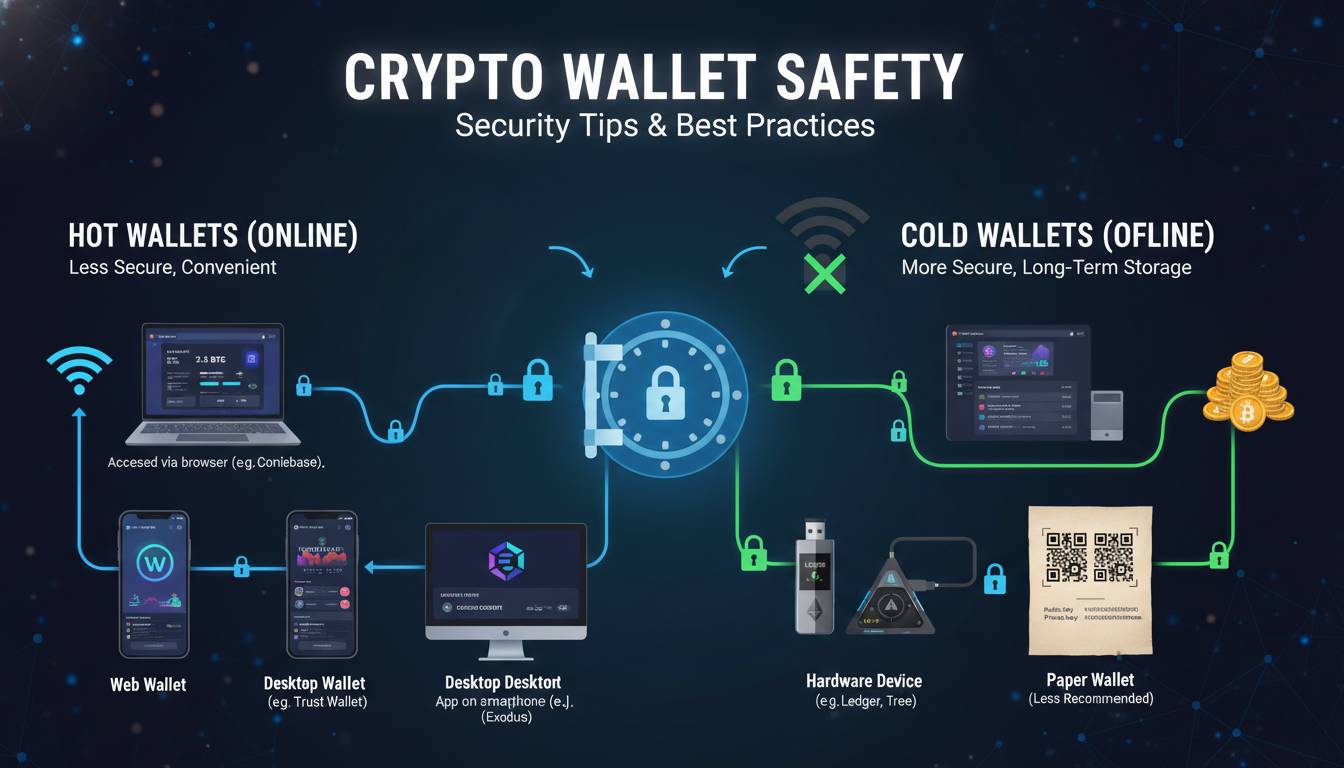
Types of Crypto Wallets: Security Comparison
Wallet architecture fundamentally determines your security posture. Understanding the differences between wallet types helps you choose the appropriate solution for your specific needs and risk tolerance.
Hot Wallets (Software Wallets)
Hot wallets connect to the internet and include mobile apps, browser extensions, and desktop applications. They’re convenient for frequent trading and transactions but carry inherent security risks due to their constant internet connectivity.
| Feature | Mobile Wallet | Browser Extension | Desktop Wallet |
|---|---|---|---|
| Security Level | Basic | Basic to Moderate | Moderate |
| Convenience | Very High | High | Moderate |
| Best For | Small amounts, daily use | DeFi interactions | Medium-term storage |
| Vulnerability | Device theft, malware | Phishing, malicious sites | Malware, keyloggers |
Popular hot wallets like MetaMask, Coinbase Wallet, and Trust Wallet implement security features including biometric authentication, encrypted local storage, and transaction simulation. However, their security ultimately depends on the device they’re installed on. Sophisticated malware can capture screenshots, log keystrokes, or inject malicious code that compromises these protections.
Cold Wallets (Hardware Wallets)
Hardware wallets store private keys in dedicated devices that never expose your keys to internet-connected computers. They sign transactions internally, transmitting only the signed transaction data to your computer or phone.
Leading hardware wallets like Ledger, Trezor, and Tangem use secure element chips designed to resist physical and logical attacks. These devices cost between $79 and $350 but provide substantially stronger security than software-only solutions. Industry data indicates hardware wallet users experience theft rates approximately 80% lower than hot wallet users, though exact figures vary by source and methodology.
Hardware Wallet Advantages:
- Private keys never leave the device
- Resistant to remote malware attacks
- Require physical button confirmation for transactions
- Support multiple cryptocurrencies
- Provide seed phrase backup options
The primary vulnerabilities with hardware wallets involve physical security (device theft), supply chain attacks (tampered devices), and user error in seed phrase management. These risks are manageable with proper protocols but require active attention.
Custodial vs. Non-Custodial Wallets
Custodial wallets—provided by exchanges like Coinbase, Binance, or Kraken—hold your private keys on your behalf. This arrangement mirrors traditional banking: you can access your funds through the platform’s interface, but you don’t actually control the underlying private keys.
Custodial wallets offer convenient recovery options (you can reset your password through standard identity verification) and typically include insurance coverage for platform-side breaches. However, they create counterparty risk—you’re trusting the exchange to secure your funds, and history shows this trust isn’t always warranted. The FTX collapse in 2022 stranded billions in customer funds, and numerous exchange hacks have resulted in permanent losses.
Non-custodial wallets give you complete control over your private keys but also complete responsibility. If you lose your seed phrase, no customer support representative can recover your funds. This trade-off represents a fundamental philosophical divide in the crypto ecosystem.
Essential Security Practices for Any Wallet Type
Regardless of which wallet type you choose, certain practices significantly reduce your risk of loss. Security expert recommendations have evolved based on analyzing thousands of theft cases, revealing consistent patterns in how users compromise their own protection.
Seed Phrase Protection
Your recovery seed phrase represents both your greatest security asset and your most significant vulnerability. Anyone who obtains your seed phrase can recreate your private keys and drain your wallet. Best practices for seed phrase management include:
Physical Security:
– Write seed phrases on acid-free paper or engrave on metal plates
– Store copies in physically separate locations (at least two)
– Avoid digital storage entirely—photos, password managers, and cloud backups have all been compromised
– Consider safety deposit boxes for primary backups
– Never share your seed phrase with anyone, including support representatives
Distribution Strategies:
– Divide seed phrases into fragments stored in different locations
– Use secret sharing schemes that require multiple fragments for reconstruction
– Store separately from your primary residence if possible
– Inform trusted family members about location in case of emergency
Device and Access Security
Your wallet interacts with devices that must themselves be secured. Malware on your computer or phone can capture passwords, hijack browser sessions, or manipulate transaction details.
Computer Security:
– Use dedicated devices for significant crypto activities when possible
– Keep operating systems and security software updated
– Utilize hardware wallets for signing all transactions
– Verify website URLs carefully—phishing sites use nearly identical domains
– Enable firewall and antivirus protection
– Consider using a separate browser profile exclusively for crypto activities
Mobile Security:
– Enable biometric authentication (fingerprint or face recognition)
– Use strong device passcodes
– Install apps only from official app stores
– Review app permissions regularly
– Avoid conducting transactions over public WiFi
– Consider using a dedicated phone for significant holdings
Common Security Mistakes and How to Avoid Them
Analysis of cryptocurrency theft cases reveals consistent patterns where users inadvertently compromise their security. Understanding these mistakes helps you avoid them.
The Most Frequent Errors
| Mistake | Consequence | Prevention |
|---|---|---|
| Storing seed phrases digitally | Complete loss via hacking | Physical storage only |
| Interacting with suspicious links | Wallet drain via approval mining | Always verify URLs independently |
| Sharing seed phrase “for support” | Immediate theft | Legitimate support never asks this |
| Using public WiFi for transactions | Man-in-the-middle attacks | Use VPN or wait for secure connection |
| Not verifying transaction details | Sending to wrong address | Always confirm recipient address |
| Keeping all funds in one wallet | Single point of failure | Distribute across multiple wallets |
Phishing and Social Engineering
Phishing attacks have become increasingly sophisticated, with attackers creating convincing replicas of legitimate websites, emails, and social media accounts. The 2022 year saw over $200 million lost to phishing attacks targeting DeFi users, according to various blockchain security firms.
Legitimate services will never:
– Ask for your seed phrase
– Request your password via email
– Ask you to “verify” your wallet by connecting to a specific address
– Pressure you to act quickly with threats of account closure
When in doubt, navigate to websites directly through your browser rather than clicking links in emails or messages. Bookmarked URLs eliminate the risk of typing a convincing phishing domain.
Smart Contract Interactions
Interacting with decentralized applications introduces additional risks beyond simple transactions. Malicious contracts can request excessive permissions that allow future draining of your wallet, even if the initial transaction appears harmless.
Protective Practices:
– Use tools like revoke.cash to audit and remove unnecessary token approvals
– Limit approvals to minimum necessary amounts
– Review permissions before signing any contract interaction
– Use hardware wallets for all contract interactions
– Research contracts and their security audits before engaging
Advanced Security Measures
For users holding significant cryptocurrency values, additional security layers provide defense-in-depth protection beyond standard practices.
Multi-Signature Wallers
Multi-sig (multi-signature) wallets require multiple private keys to authorize transactions. A 2-of-3 setup, for example, needs any two of three designated keys to approve a transaction. This configuration protects against single points of failure—whether from theft, loss, or user error.
Services like Gnosis Safe and Coinbase Custody offer multi-sig solutions for various use cases. Corporate treasuries and significant personal holdings benefit substantially from this approach, as attackers must compromise multiple devices or individuals simultaneously.
Time-Locks and Spending Limits
Certain wallet implementations allow you to set time delays before large transactions execute or impose monthly withdrawal limits. These features provide recovery windows—if an attacker compromises your wallet, you can notice the pending transaction and move remaining funds to a secure backup before the theft completes.
Hardware Wallet Best Practices
When using hardware wallets, additional protocols strengthen your security posture:
- Verify the package: Check for tampered seals and verify purchase from authorized retailers
- Initialize the device yourself: Don’t accept pre-configured devices from third parties
- Enable PIN protection: Use a strong PIN different from other accounts
- Label your device: But avoid obvious markers that identify it as a crypto wallet
- Update firmware: But verify update authenticity through official channels
Building Your Personal Security Strategy
The appropriate security level depends on your holdings, technical comfort, and risk tolerance. A reasonable framework helps you make informed decisions without overcomplicating your setup.
For Beginners (Under $1,000):
Start with a reputable non-custodial mobile wallet. Focus on learning security fundamentals: protecting your seed phrase, avoiding phishing, and verifying transactions. This amount justifies hardware wallet investment but not yet the operational complexity.
For Intermediate Holders ($1,000-$10,000):
Consider acquiring a hardware wallet for primary holdings. Use the hardware wallet for long-term storage while maintaining a hot wallet for active trading with smaller amounts. This tier warrants serious seed phrase protection, including metal backup and secure off-site storage.
For Significant Holdings (Over $10,000):
Hardware wallets become essential. Implement multi-sig for substantial portions. Consider professional custody solutions for portions of your portfolio. Invest time in understanding the specific threats relevant to your holdings and use patterns.
For Institutions and Large Holdings:
Comprehensive security programs include hardware security modules, distributed key management, insurance coverage, formal incident response procedures, and regular security audits. Professional consultation typically proves cost-effective at this level.
Frequently Asked Questions
Are hardware wallets 100% secure?
No technology provides absolute security, but hardware wallets come closest for individual users. They’ve never been compromised through remote attacks when used correctly. The primary risks involve physical theft (mitigated by PINs), supply chain tampering (mitigated by purchasing directly from manufacturers), and user error in seed phrase handling. For most users, hardware wallets represent the strongest available security.
Can crypto wallets be hacked?
Yes, though the specific attack vectors vary by wallet type. Hot wallets have been compromised through malware, phishing, exchange breaches, and vulnerable mobile apps. Hardware wallets remain secure against remote attacks but can be compromised through physical access if PIN protection isn’t enabled. Software vulnerabilities in wallet applications have historically allowed thefts, though major wallet providers now maintain active security teams and rapid patching processes.
What happens if I lose my hardware wallet?
If you’ve properly backed up your seed phrase, you can recover your funds using any compatible wallet. Purchase a new hardware wallet (or use compatible software), enter your seed phrase during setup, and your balances restore automatically. Without your seed phrase, the cryptocurrency becomes permanently inaccessible—this is by design and reflects the decentralized nature of crypto.
Should I keep all my crypto in one wallet?
Distributing holdings across multiple wallets reduces your risk exposure. If a single wallet is compromised, your total holdings aren’t affected. A common approach uses separate wallets for different purposes: a hardware wallet for long-term holding, a software wallet for active trading, and a small amount in mobile wallets for daily transactions. This separation limits potential damage from any single security breach.
Are custodial wallets safe enough for beginners?
Custodial wallets offered by regulated exchanges like Coinbase provide reasonable security for small amounts and offer convenient recovery options. The trade-off involves counterparty risk—you depend on the exchange’s security and solvency. For beginners learning crypto, using a reputable exchange wallet initially makes sense, with plans to migrate to self-custody once you understand the security implications.
How do I know if a crypto wallet is legitimate?
Verify legitimacy through multiple channels: check the official website directly (not through search results or links), review security audits and code repositories, check community discussions and any reported incidents, verify the developer team when possible, and start with small test transactions before transferring significant amounts. Established wallets with track records provide more assurance than newly released options.
Conclusion
Crypto wallets can be remarkably secure when you understand and implement appropriate protections. The technology underlying cryptocurrency—public-key cryptography—has proven essentially unbreakable through decades of mathematical and computational attack. Your security depends primarily on how you implement and maintain the human elements: seed phrase protection, device security, and vigilance against social engineering.
Start with a realistic assessment of what you’re protecting. Match your security investments to your holdings and risk profile. Learn proper practices before accumulating significant assets. The crypto ecosystem offers unprecedented financial freedom, but that freedom requires taking responsibility for your own security in ways traditional finance never demanded.
Your cryptocurrency is only as secure as your weakest practice. Commit to continuous learning, implement layered defenses, and never stop questioning whether your current protections match today’s threat landscape.






Leave a comment