

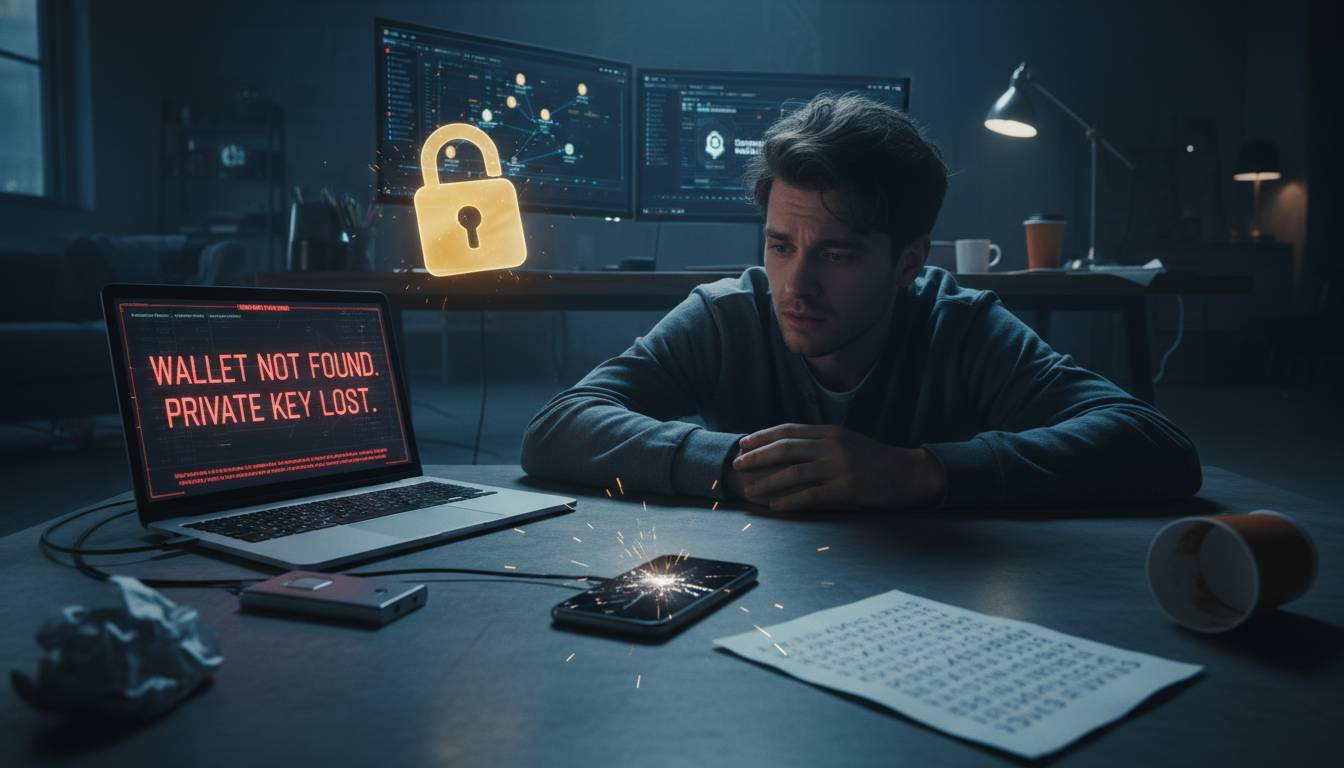
Losing your Bitcoin wallet means permanent loss of your funds—with no customer support to call and no way to reverse the transaction. Unlike a bank account where fraud can be disputed or a password reset via email, Bitcoin operates on a decentralized system where you are your own bank. If you lose access to your private keys, your Bitcoin becomes irretrievable forever. This isn’t a technical limitation that might be solved tomorrow; it’s an architectural feature of how Bitcoin was designed. Understanding this fundamental reality is essential for anyone holding cryptocurrency, whether you own 0.001 BTC or hundreds of coins.
Key Insights
– Approximately 20% of all Bitcoin in circulation—worth billions at current prices—has been permanently lost due to lost wallets
– There is no central authority capable of recovering lost private keys
– Prevention through proper backup strategies is the only reliable protection
– Recovery is possible only under specific, limited circumstances
Understanding Bitcoin Wallets and Private Keys
A Bitcoin wallet doesn’t actually store Bitcoin in the way a traditional wallet stores cash. Instead, a wallet stores your private keys—cryptographic strings of numbers and letters that prove ownership of your Bitcoin and authorize transactions. The Bitcoin network itself keeps a complete record of all balances on the blockchain, but access to those balances requires the corresponding private key. Without that key, the Bitcoin is mathematically inaccessible.
Your private key generates a public key, which in turn creates a Bitcoin address. You can share your address freely to receive Bitcoin, but your private key must remain secret. Anyone who obtains your private key can transfer all associated Bitcoin to another address, effectively stealing your funds. Conversely, if you lose your private key with no backup, no power on Earth can generate a duplicate—the mathematics of cryptographic hashing make this impossible.
The confusion often arises because people think of their “wallet” as an app on their phone or a hardware device. These are simply interfaces for storing and managing your keys. The actual “wallet” is the private key itself. When someone says they lost their Bitcoin wallet, they typically mean they lost access to their private keys—whether through a lost hardware device, corrupted hard drive, forgotten password, or a deceased family member who never shared access information.
There are several types of wallets, each with different risk profiles for loss. Hot wallets (software wallets connected to the internet) are convenient but vulnerable to hacking. Cold wallets (hardware devices or paper wallets kept offline) are more secure but require physical保管. Custodial wallets (held by exchanges) introduce counterparty risk—the exchange could be hacked, go bankrupt, or freeze your account.
What Actually Happens When You Lose Your Wallet
When you lose access to your Bitcoin wallet, nothing happens to the Bitcoin on the blockchain. The coins remain exactly where they are, recorded in the distributed ledger, forever. What changes is that no one can now move those coins. The Bitcoin becomes effectively removed from the circulating supply—not destroyed in a technical sense, but permanently inaccessible from a practical standpoint.
The blockchain doesn’t know you’ve lost your keys. It continues operating normally, with your Bitcoin showing as an unspent transaction output (UTXO) tied to an address. The coins are still there, visible to anyone who looks at the blockchain, but they cannot be spent. Economists refer to this as “economic destruction” of the currency—the money still exists in the ledger but has been removed from the money supply.
This differs dramatically from traditional financial losses. If you lose access to a bank account, the bank maintains records and can verify your identity. If you lose a credit card, the issuer can freeze the account. If someone steals from your account, regulations often protect consumers. With Bitcoin, none of these safety nets exist. The system was designed explicitly to remove third-party control, which means self-custody comes with full personal responsibility.
The loss becomes permanent after a specific period if no recovery attempt succeeds. While technically your Bitcoin could remain frozen at that address indefinitely, practically speaking, once you exhaust all recovery options and accept the loss, those coins are gone from your financial life. They’re not gone from existence—they’ll sit at that blockchain address forever, a digital monument to lost keys. Some people find poetic meaning in this: your lost Bitcoin becomes part of the most secure vault ever built, one that even you cannot crack.
Can You Recover a Lost Bitcoin Wallet?
Recovery is possible only in specific circumstances, and the odds decrease dramatically depending on how you lost access. Understanding these scenarios helps set realistic expectations.
If you have a backup of your seed phrase: Most modern wallets generate a 12 or 24-word seed phrase during setup. This phrase can regenerate your private keys. If you’ve written down this phrase and kept it safely, recovery is straightforward—simply install wallet software and input the seed phrase. This is why cryptocurrency experts consistently emphasize writing down seed phrases and storing them securely.
If your device was lost or damaged but your keys were encrypted: Some users encrypt their wallets with passwords or store keys in password managers. If you remember the password, specialized recovery services or software might extract the keys. However, strong encryption makes this extremely difficult, and weak encryption offers little protection.
If you used a custodial wallet: If you held Bitcoin on an exchange like Coinbase, Kraken, or Binance, you haven’t lost your wallet—you’ve lost access to your exchange account. These platforms maintain their own wallets and hold keys on your behalf. Contact the exchange’s support team with proper identification. Recovery is possible but subject to the platform’s policies and might require extensive verification.
If the wallet was small and you remember partial information: Some recovery services use powerful computers to attempt key reconstruction. This is expensive, time-consuming, and generally only economical for substantial sums. For amounts under a few thousand dollars, recovery costs typically exceed the value of recovered Bitcoin.
If you lost keys with no backup: This is the worst-case scenario. No recovery method exists. No customer service number will help. The Bitcoin is permanently inaccessible. Scammers frequently target people in this situation, claiming they can “hack” the blockchain or use advanced technology to recover keys. These are always scams—the mathematics of Bitcoin’s cryptography prevents this.
How to Prevent Losing Your Bitcoin
Prevention is the only reliable strategy for protecting Bitcoin holdings. The cryptocurrency community has developed best practices through years of experience and painful losses.
Write down your seed phrase physically: Never store seed phrases digitally. Write them on paper, metal plates, or other durable materials. Store in multiple secure locations—safe deposit boxes, home safes, with trusted family members. Consider splitting the phrase and storing parts in different locations for added security against theft while maintaining recoverability.
Use hardware wallets for significant holdings: Devices like Ledger, Trezor, or Coldcard store keys offline, protecting against malware and hacking. They generate seed phrases that you write down. The hardware device itself can break or be lost, but as long as you have the seed phrase, you can recover your funds on a new device.
Use reputable wallet software with strong security features: Leading wallets include built-in encryption, multi-signature options, and clear backup procedures. Research before choosing—some wallets have poor security histories or may no longer be actively maintained.
Never store seed phrases digitally: This cannot be overstated. Photos of seed phrases, cloud storage, email drafts, and password managers have all been hacked. Digital storage creates vulnerability that defeats the entire purpose of cold storage.
Create a recovery plan with family members: If something happens to you, your Bitcoin dies with you unless you’ve made arrangements. Discuss with family members or legal representatives how to access your holdings. Some estate planning attorneys now specialize in cryptocurrency inheritance.
Test your backups: Before storing large amounts, test that your backup method actually works. Transfer a small amount to a new wallet, delete the wallet, recover from your backup, and verify the funds appear. This ensures your backup process is correct.
The Scale of Lost Bitcoin: By the Numbers
The extent of lost Bitcoin might surprise those new to cryptocurrency. Understanding the scale helps contextualize why this topic matters.
| Metric | Data | Source |
|---|---|---|
| Bitcoin lost forever | ~20% of supply (~4.2 million BTC) | Chainalysis, 2024 |
| Value of lost Bitcoin | ~$170 billion (at $65,000/BTC) | Glassnode, 2024 |
| Daily transactions on blockchain | ~300,000-500,000 | Blockchain.com, 2024 |
| Exchange-traded Bitcoin | ~10% of supply | Bitwise, 2024 |
The distribution of lost Bitcoin spans from early mining in 2009-2010, when Bitcoin had no monetary value, to forgotten wallets from people who bought during the 2017 bull run and lost access during the subsequent crash. Some early coins remain lost because their owners never anticipated Bitcoin becoming valuable—thousands of BTC discarded on old hard drives now worth millions.
Not all “lost” Bitcoin is truly gone. Some wallet owners are waiting for higher prices before moving coins, creating what economists call “hoarded” supply rather than lost supply. Distinguishing between lost and simply unmoved coins is difficult, which is why estimates vary. Chainalysis specializes in blockchain analysis and provides some of the most rigorous estimates, though precise figures remain elusive.
Real Examples of Lost Bitcoin
Understanding real cases helps illustrate how losses occur and why prevention matters.
The Sardinia story: In 2023, an Italian man discovered 6,000 BTC on an old laptop he had discarded years prior. After searching through garbage, he recovered the hard drive—but the Bitcoin had been transferred in 2019, likely by someone who found the wallet. This illustrates how lost devices can be found by others who then access the funds.
Mt. Gox bankruptcy: The largest Bitcoin exchange collapse in history occurred in 2014 when Mt. Gox lost approximately 850,000 BTC (worth billions today). Most was lost to hackers, but some was also lost through poor security practices. Creditors have waited over a decade for partial recovery through bankruptcy proceedings.
Early mining losses: Many early Bitcoin miners generated coins using addresses whose private keys have been lost. Some estimate that Satoshi Nakamoto themselves holds approximately 1 million BTC that have never moved—likely permanently inaccessible. These coins, if moved, would signal the identity of Bitcoin’s creator, which is why their inaccessibility is almost certain.
Forgotten hardware wallets: Reddit forums contain numerous posts from people who bought hardware wallets, recorded seed phrases, then could not find the seed phrase years later when trying to access substantial gains. Hardware wallet companies cannot help—there’s no way to regenerate keys from the device itself.
The Economics and Implications of Lost Bitcoin
Lost Bitcoin creates interesting economic effects that extend beyond individual losses.
Deflationary pressure: Lost Bitcoin reduces effective circulating supply, potentially increasing the value of remaining coins. This is built into Bitcoin’s design—max supply is capped at 21 million, and lost coins are effectively removed from circulation, making remaining coins more scarce.
Wealth transfer: When Bitcoin is lost, it never moves again. Unlike traditional wealth that might be inherited or taxed, lost Bitcoin simply disappears. This creates an invisible wealth transfer from the loss victim to all other Bitcoin holders, whose percentage ownership increases proportionally.
Exchange listing implications: Exchanges have delisted Bitcoin for various reasons, and some worry about delisting causing losses. However, users can typically withdraw to personal wallets before delisting. The larger risk is exchange hacks or insolvency, which has caused far greater losses than delistings.
Environmental considerations: Some argue that lost Bitcoin effectively “wastes” the electricity used to secure those coins initially. However, the mining difficulty adjusts automatically, and lost coins don’t require ongoing energy expenditure. The security model remains intact regardless of whether specific coins are accessible.
Frequently Asked Questions
Can the Bitcoin network recover my lost wallet?
No. The Bitcoin network has no administrator, no customer support, and no recovery mechanism. Once private keys are lost with no backup, the associated Bitcoin is mathematically impossible to access. This is by design—there’s no central authority that could be compromised or coerced.
What if my Bitcoin was on an exchange that got hacked?
If your Bitcoin was held on a centralized exchange that was hacked, your recovery depends on the exchange’s response. Some exchanges have reimbursed users from their own reserves (like Binance after the 2019 hack). Others, like Mt. Gox, have been in bankruptcy for years with partial creditor recovery. Using exchanges means accepting counterparty risk—never store more on exchanges than you’re willing to lose.
How much Bitcoin is actually lost forever?
Estimates suggest approximately 20% of all Bitcoin (around 4.2 million BTC) is permanently lost, worth roughly $170 billion at recent prices. This includes early coins from when Bitcoin was worthless, coins lost in hardware failures with no backup, and coins abandoned during market crashes. The exact figure is impossible to know precisely.
Is there any way to brute-force recover a lost private key?
No practical method exists. The number of possible private keys is approximately 2^256—a number larger than the number of atoms in the observable universe. Even if all the world’s computers worked for the age of the universe, they could not meaningfully reduce the search space. Any service claiming to offer this is definitively a scam.
What happens to Bitcoin if the owner dies with no inheritance plan?
The Bitcoin remains at its blockchain address forever, unspent. Without passing seed phrases or access information to heirs, there’s no mechanism for recovery. This is increasingly relevant as early adopters age. Estate planning for cryptocurrency is now a recognized specialty, and enthusiasts are encouraged to create clear succession plans.
Can malware or hackers cause me to lose my wallet?
Yes. Malware can scan for wallet files, seed phrases stored digitally, or intercept clipboard contents when copying addresses. Phishing attacks trick users into entering seed phrases on fake websites. Ransomware can encrypt wallet files. Using hardware wallets, keeping seed phrases offline, and maintaining good computer security practices protect against these threats.
Conclusion
Losing your Bitcoin wallet means permanent, irreversible loss—with no customer support to call and no technical solution to recover your funds. This isn’t a flaw in Bitcoin; it’s the trade-off for a system that removes third-party control. Understanding this fundamental reality is essential for anyone holding cryptocurrency.
The solution is straightforward but requires discipline: back up your seed phrase in multiple secure locations, use hardware wallets for significant holdings, test your backups, and create a plan for what happens to your Bitcoin if something happens to you. Approximately $170 billion in Bitcoin is already permanently lost, demonstrating that this isn’t a hypothetical concern—it’s an ongoing reality affecting thousands of holders.
Your Bitcoin is only as secure as your backup strategy. Take the time to implement proper security now, because when a wallet is lost without a backup, the most powerful computer network in human history cannot help you. There’s no reset button, no customer service line, and no appeal process. You’re truly your own bank—and that means you’re also responsible for your own security.






Leave a comment