

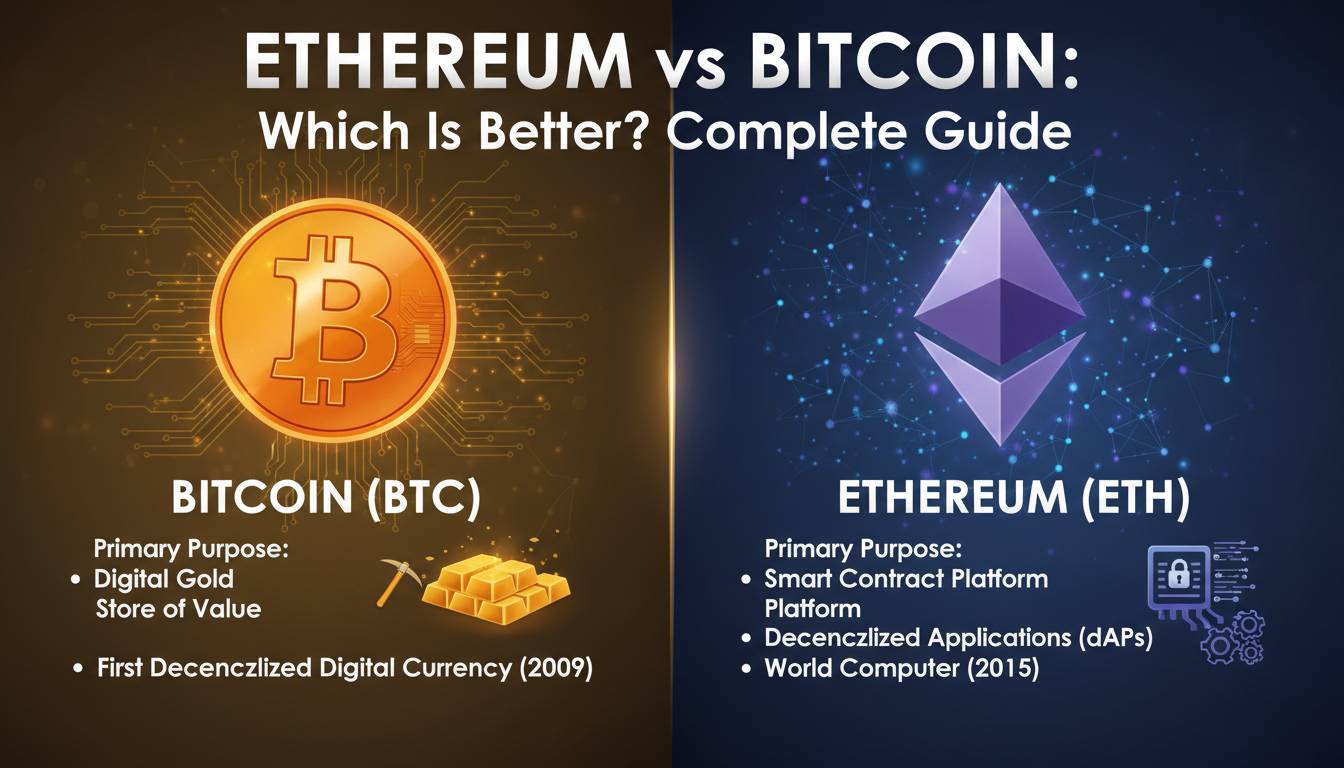
The short answer depends entirely on your goals: Bitcoin functions primarily as a store of value and digital gold, while Ethereum serves as a programmable platform for decentralized applications. Neither is universally “better”—each excels in different domains. This comprehensive guide breaks down every meaningful difference to help you make an informed decision based on your specific needs, whether you’re an investor, developer, or simply curious about cryptocurrency fundamentals.
Understanding the Fundamental Differences
Bitcoin and Ethereum represent two distinct philosophies within the cryptocurrency space, and understanding their core architectural differences is essential before any comparison.
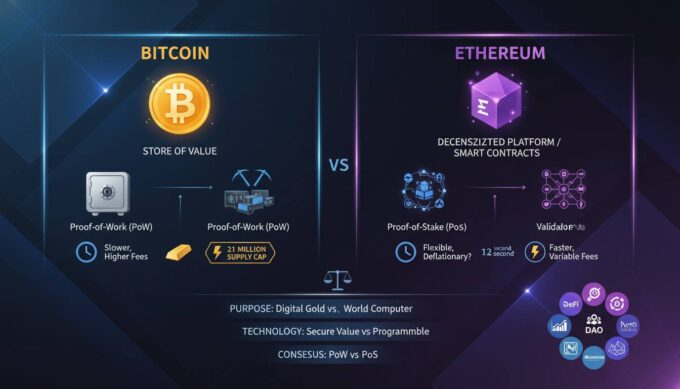
Bitcoin launched in 2009 as the first cryptocurrency, created by the pseudonymous Satoshi Nakamoto. Its primary purpose was establishing a decentralized, peer-to-peer digital currency that could function without intermediaries like banks. The Bitcoin network processes transactions using proof-of-work consensus, with a capped supply of 21 million coins that will never be exceeded—this scarcity is foundational to Bitcoin’s “digital gold” narrative.
Ethereum launched in 2015 conceived by Vitalik Buterin and a team of co-founders. Rather than simply transferring value, Ethereum was designed as a programmable blockchain where developers can build applications, execute smart contracts, and create decentralized finance (DeFi) protocols. Ethereum’s supply is uncapped, and it has undergone significant technical evolution, including the transition from proof-of-work to proof-of-stake consensus in 2022.
| Aspect | Bitcoin | Ethereum |
|---|---|---|
| Launch Year | 2009 | 2015 |
| Founder | Satoshi Nakamoto | Vitalik Buterin |
| Consensus | Proof-of-Work (PoW) → Proof-of-Stake (PoS) | Proof-of-Stake (PoS) |
| Max Supply | 21 million (capped) | Unlimited (no fixed cap) |
| Block Time | ~10 minutes | ~12-14 seconds |
| Primary Function | Digital currency, store of value | Smart contracts, dApps, DeFi |
| Transaction Capacity | ~7 TPS | ~15-30 TPS (varies) |
These foundational distinctions shape virtually every other difference between the two platforms, from investment characteristics to real-world utility.
Technical Architecture and How They Work
The technical underlying mechanisms of Bitcoin and Ethereum differ substantially, and these differences directly impact performance, security, and use cases.
Bitcoin’s UTXO Model and Scripting
Bitcoin operates on an Unspent Transaction Output (UTXO) model—essentially a digital ledger tracking which addresses hold which unspent coins. When you send Bitcoin, the network consumes previous outputs and creates new ones. Bitcoin’s scripting language is intentionally limited, designed primarily to verify transaction signatures rather than execute complex logic. This deliberate simplicity enhances security but restricts what applications can be built on Bitcoin.
The Bitcoin network achieves security through massive proof-of-work computational power. As of early 2025, Bitcoin’s hash rate exceeds 600 exahashes per second, making it the most secure blockchain network globally. This security model requires substantial energy consumption, though Bitcoin advocates argue this energy expenditure secures real economic value.
Ethereum’s Account Model and EVM
Ethereum uses an account-based model where each address maintains a balance, code, and storage. Every transaction simply updates these account states rather than tracking discrete outputs. Ethereum’s programming language, Solidity, enables developers to write smart contracts—self-executing programs that automatically enforce agreement terms when conditions are met.
The Ethereum Virtual Machine (EVM) serves as a runtime environment for executing smart contracts across all Ethereum nodes. This standardization means any developer can build applications that interoperate seamlessly on the network. Following Ethereum’s “Merge” upgrade in September 2022, the network transitioned to proof-of-stake, reducing energy consumption by approximately 99.95% while requiring validators to stake 32 ETH as collateral against malicious behavior.
Investment Characteristics and Store of Value Debate
Investors often frame the Bitcoin vs. Ethereum debate in terms of returns, but each asset exhibits fundamentally different investment properties and market narratives.
Bitcoin as Digital Gold
Bitcoin’s primary investment thesis centers on becoming a global store of value—digital gold with advantages over its physical counterpart. These advantages include divisibility, portability, verifiable scarcity, and resistance to seizure. Institutional adoption has accelerated significantly, with major corporations and investment funds allocating portions of their treasuries to Bitcoin.
As of late 2024, Bitcoin’s market capitalization exceeds $1.5 trillion, representing approximately 50% of the total cryptocurrency market capitalization. Its dominance, combined with capped supply, creates predictable scarcity dynamics that appeal to long-term holders. Bitcoin’s volatility has decreased progressively over its history, though it remains substantially more volatile than traditional assets like gold or bonds.
Ethereum’s Investment Thesis
Ethereum functions more like “digital oil” or programmable infrastructure—the fuel powering a vast ecosystem of applications. Ethereum’s investment case rests on network growth, adoption of decentralized applications, and the accumulation of value captured through transaction fees (ETH burned through EIP-1559 mechanism).
Ethereum’s supply dynamics shifted meaningfully post-merge. The transition to proof-of-stake, combined with the EIP-1559 upgrade that burns base transaction fees, has resulted in Ethereum becoming deflationary during periods of high network activity. This creates a potentially compelling supply-demand dynamic where increased usage theoretically reduces circulating supply.
Historically, Ethereum has generated higher percentage returns than Bitcoin, though with correspondingly higher volatility. The opening of Bitcoin ETFs in early 2024 created new institutional access to Bitcoin specifically, while Ethereum awaits similar product approvals.
Use Cases and Real-World Applications
The practical applications of Bitcoin and Ethereum diverge significantly, and understanding these use cases clarifies which asset serves which purposes.
Bitcoin’s Primary Use Cases
Payments and Remittances: Bitcoin enables borderless transactions with relatively low fees for large transfers, making it attractive for international remittances and cross-border payments. The Lightning Network, a second-layer solution, has significantly improved Bitcoin’s transaction throughput for smaller payments, enabling instant, near-zero-fee transactions.
Store of Value: The dominant use case for Bitcoin in 2025 is wealth preservation. Countries experiencing hyperinflation, individuals seeking capital flight, and institutions building cryptocurrency allocations all utilize Bitcoin primarily for its store-of-value properties.
Financial Products: The approval of Bitcoin spot ETFs in the United States created entirely new investor access points. These products allow traditional investors to gain Bitcoin exposure through brokerage accounts, 401(k)s, and other conventional investment vehicles without managing private keys or cryptocurrency wallets.
Ethereum’s Primary Use Cases
Decentralized Finance (DeFi): Ethereum hosts the vast majority of DeFi protocols, including lending platforms (Aave, Compound), decentralized exchanges (Uniswap, Curve), and yield farming systems. Total value locked in Ethereum DeFi protocols exceeds $100 billion, representing the vast majority of all DeFi activity across blockchains.
Non-Fungible Tokens (NFTs): The NFT explosion of 2021-2022 predominantly occurred on Ethereum, with standards like ERC-721 and ERC-1155 becoming industry conventions. Digital art, collectibles, gaming items, and tokenized real-world assets all leverage Ethereum’s smart contract capabilities.
Decentralized Applications: Beyond finance, Ethereum powers thousands of applications including decentralized social media platforms, prediction markets, gaming economies, and identity systems. The diversity of applications on Ethereum far exceeds Bitcoin’s more focused utility.
Environmental and Sustainability Considerations
Environmental impact has become a significant factor in cryptocurrency adoption discussions, and the Bitcoin-Ethereum comparison reveals dramatic differences.
Bitcoin’s proof-of-work consensus requires substantial electrical energy, primarily from mining operations worldwide. Critics argue this consumption contributes to carbon emissions, particularly in regions reliant on fossil fuels. However, Bitcoin mining has increasingly gravitated toward renewable energy sources, with some analyses suggesting over 50% of Bitcoin mining utilizes sustainable energy.
Ethereum’s transition to proof-of-stake dramatically reduced its environmental footprint. The energy reduction of approximately 99.95% makes Ethereum’s per-transaction energy consumption negligible compared to Bitcoin. This shift positioned Ethereum favorably among environmentally-conscious investors and institutions, though critics note that proof-of-stake introduces different centralization concerns.
Which Should You Choose? A Decision Framework
The “better” question ultimately depends on your objectives, risk tolerance, and conviction about each asset’s use case.
Choose Bitcoin if your primary goal is:
– Preserving wealth in a scarce, decentralized asset
– Portfolio diversification with potentially lower volatility over time
– Access to institutional-grade financial products
– Exposure to the most recognized cryptocurrency globally
Choose Ethereum if your primary goal is:
– Participating in DeFi ecosystems and earning yield
– Building or using decentralized applications
– Potential exposure to innovation in programmable money
– Supporting the evolution of Web3 infrastructure
Many investors choose both, allocating to Bitcoin for stability and store-of-value properties while maintaining Ethereum positions for growth potential and utility exposure. Portfolio allocation decisions should reflect your risk tolerance, investment timeline, and conviction in each asset’s long-term narrative.
Future Outlook and Development Trajectories
Both Bitcoin and Ethereum continue evolving, though their development roadmaps reflect different priorities.
Bitcoin’s Evolution: The Bitcoin network focuses primarily on security, decentralization, and the Lightning Network’s growth. Proposed upgrades include BitVM (enabling Turing-complete computations on Bitcoin), Schnorr signatures for improved privacy, and continued Lightning Network maturation for payment scalability.
Ethereum’s Evolution: Ethereum’s roadmap emphasizes scalability through layer-2 solutions (Arbitrum, Optimism, Base), data availability improvements, and further reductions in transaction costs. The Cancun upgrade in early 2024 introduced blob transactions significantly reducing L2 costs, while future upgrades will continue enhancing the network’s capabilities.
Both networks face competitive pressures from alternative blockchains (Solana, Avalanche, Cardano), but their first-mover advantages and network effects remain substantial.
Frequently Asked Questions
Is Ethereum better than Bitcoin for investment?
Neither is universally better—the answer depends on your investment goals. Bitcoin offers stronger store-of-value characteristics with institutional adoption and capped supply. Ethereum provides more growth potential through DeFi and application ecosystems but carries higher risk. Many portfolios benefit from holding both assets.
Can Ethereum overtake Bitcoin in market cap?
While theoretically possible, Bitcoin’s brand recognition, institutional adoption, and network effects create substantial barriers. Ethereum would need massive DeFi and application growth to close the gap, while Bitcoin would need to significantly underperform. Most analysts view both as serving different portfolio roles rather than direct competitors.
Which is better for everyday transactions?
Ethereum typically processes transactions faster than Bitcoin’s base layer, but both networks can experience congestion during high-demand periods. For everyday transactions, Bitcoin’s Lightning Network offers near-instant, low-cost payments, while Ethereum’s layer-2 solutions (like Arbitrum or Optimism) provide similar benefits for Ethereum transactions.
Is Bitcoin more secure than Ethereum?
Bitcoin’s proof-of-work consensus with its massive hash rate makes it extraordinarily secure against attacks. Ethereum’s proof-of-stake offers different security properties, requiring validators to stake capital rather than computational power. Both networks have remained secure throughout their histories, though their security models operate on fundamentally different principles.
Which has lower fees?
Ethereum typically has higher base-layer transaction fees than Bitcoin, though both networks’ fees fluctuate with demand. For cost-effective transactions, both networks offer layer-2 solutions that dramatically reduce costs—Lightning Network for Bitcoin and various rollup solutions for Ethereum.
Should I buy Bitcoin or Ethereum first?
If you’re new to cryptocurrency, starting with Bitcoin is generally recommended due to its simpler value proposition, broader recognition, and access to regulated financial products. Once you understand Bitcoin’s fundamentals, adding Ethereum exposure allows participation in the broader crypto ecosystem while maintaining the stability anchor that Bitcoin provides.
Conclusion
The Bitcoin vs. Ethereum debate ultimately reflects two different visions for cryptocurrency’s role in the global economy. Bitcoin represents a focused attempt to create sound, scarce digital money—a goal it has largely achieved after 15 years of operation. Ethereum pursues far more ambitious territory: programmable infrastructure that could reshape finance, governance, and digital ownership.
Neither outcome is guaranteed, and both assets carry substantial risk alongside their potential rewards. The optimal approach for most investors involves understanding each asset’s distinct properties and strategic value, then constructing a portfolio that aligns with individual goals and risk tolerance. Rather than viewing this as a binary choice, sophisticated investors increasingly recognize the value of both Bitcoin’s stability narrative and Ethereum’s innovation potential within a diversified cryptocurrency allocation.







Leave a comment