

Blockchain technology powers cryptocurrencies like Bitcoin and Ethereum, but its applications extend far beyond digital money. At its core, blockchain is a revolutionary way to store and transfer information without relying on traditional intermediaries like banks or governments.
Key Insights
– Blockchain is a distributed ledger that records transactions across thousands of computers
– Once data is recorded, it’s nearly impossible to alter, making blockchain highly secure
– The technology processes over 1 million transactions daily across major networks
– Global blockchain spending is projected to reach $199 billion by 2027
This guide breaks down blockchain technology into simple terms, explaining how it works, why it matters, and how it’s being used today.
What Exactly is Blockchain?
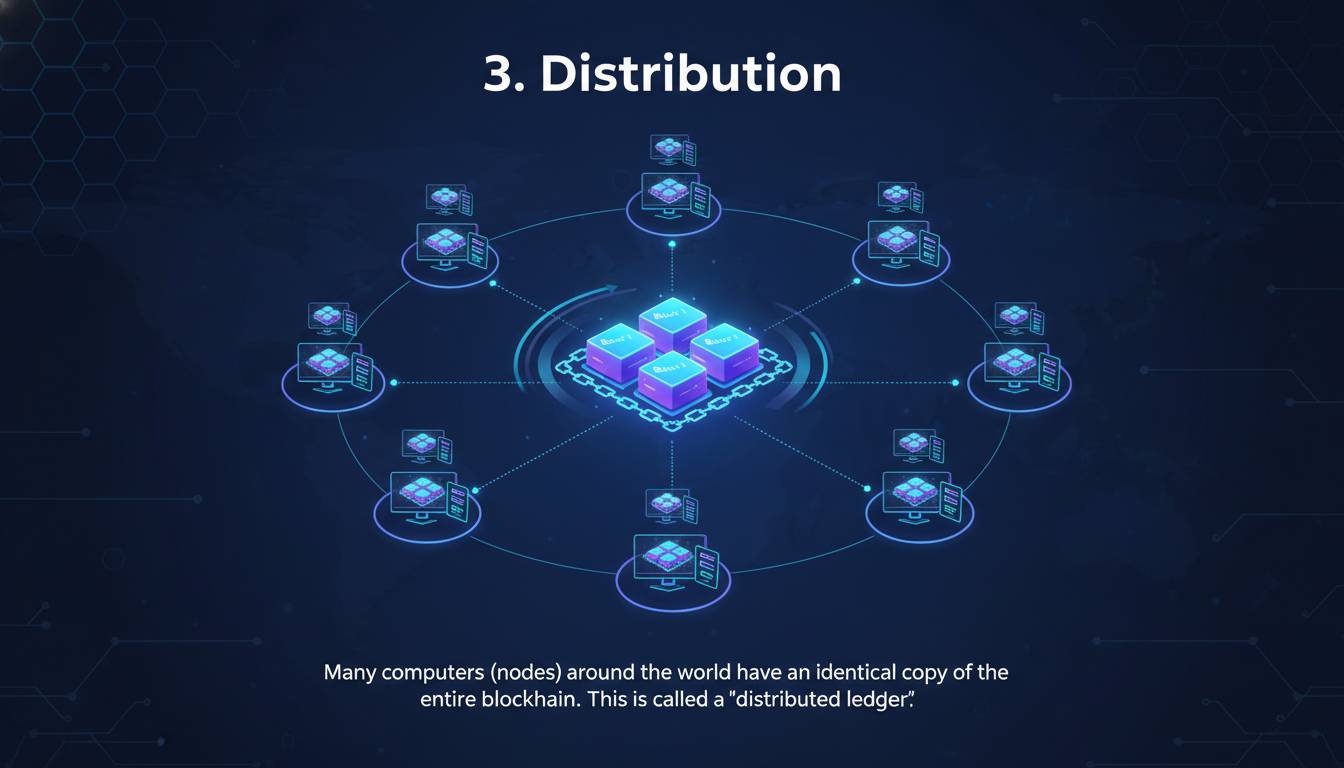
Blockchain is a digital ledger—a database that stores information—distributed across a network of computers. Unlike traditional databases managed by a single entity, blockchain operates on a decentralized model where multiple participants maintain the system.
The Core Concept
Think of a Google Document that everyone in a team can view simultaneously. When one person makes a change, everyone sees it instantly, and no single person can secretly modify the history. Blockchain works on a similar principle, but with cryptographic security that makes tampering virtually impossible.
Each “block” contains three elements: data, a hash (a unique digital fingerprint), and the previous block’s hash. This creates a “chain” of blocks—hence the name blockchain. When anyone attempts to alter past data, the hash changes, breaking the chain and alerting the entire network to the tampering.
📊 NETWORK STATS
| Metric | Value |
|——–|——-|
| Bitcoin nodes worldwide | ~17,000+ |
| Ethereum validators | 900,000+ |
| Daily active blockchain users | 4.2 million+ |
The technology emerged in 2008 when an unknown person (or group) named Satoshi Nakamoto published the Bitcoin whitepaper, introducing the first blockchain as a solution to digital double-spending problems without requiring a trusted intermediary.
How Transactions Get Recorded: The Step-by-Step Process
Understanding blockchain requires knowing how a single transaction moves through the system. Here’s what happens when you send cryptocurrency to a friend:
Step 1: Transaction Initiation
When you decide to send digital coins to someone, your wallet creates a transaction request. This includes your digital signature—proof that you actually own the funds you’re sending. Your private key (a secret password) generates this signature mathematically, making it impossible to forge.
Step 2: Broadcasting to the Network
Instead of sending money through a bank, your transaction goes directly to a network of computers called nodes. These nodes are scattered globally, each maintaining a copy of the blockchain. Within seconds, thousands of computers receive your transaction request.
Step 3: Validation and Verification
Nodes verify the transaction is legitimate by checking several factors: Do you have enough balance? Is your digital signature valid? Is this transaction following the rules? This process happens automatically through cryptographic algorithms—no human bank teller required.
Step 4: Block Creation
Once verified, your transaction joins a pool of other pending transactions. Miners (or validators, depending on the blockchain) group these transactions into a block. On Bitcoin, this happens approximately every 10 minutes. On Ethereum, new blocks are created roughly every 12 seconds.
Step 5: Adding to the Chain
The block is then added to the existing blockchain through consensus. On Bitcoin, miners compete to solve complex mathematical puzzles—the first to solve it gets to add the block and receives Bitcoin as a reward. On Ethereum, validators are randomly selected to propose blocks. Both methods ensure no single entity controls the process.
Step 6: Confirmation
After a block is added, transactions within it are considered confirmed. The recipient can see the funds in their wallet. Most exchanges require multiple block confirmations before considering a transaction final—a security measure against potential reversals.
⚠️ Important Note: While blockchain is extremely secure, it’s not completely immune to attacks. Smaller networks with fewer nodes have experienced hacks. Bitcoin and Ethereum remain secure due to their massive, decentralized networks.
Understanding Blocks, Nodes, and Consensus Mechanisms
What Exactly is a Block?
A block is a container that holds transaction data. Each block typically contains:
- Transaction data: Sender, recipient, amount, timestamp
- Previous hash: The digital fingerprint of the preceding block
- Merkle root: A summary of all transactions in the block (stored as a hash tree)
- Nonce: A random number used in the mining process (for proof-of-work blockchains)
When combined, these elements create a secure, interconnected chain. If someone tries to change even one transaction in an old block, the hash changes, breaking the link to all subsequent blocks.
What Are Nodes?
Nodes are computers connected to the blockchain network. They perform several critical functions:
- Store a complete copy of the blockchain history
- Validate transactions according to network rules
- Relay verified transactions to other nodes
- Participate in consensus decisions about blockchain changes
There are different types of nodes. Full nodes store the entire blockchain and enforce all rules. Light nodes store only block headers, allowing mobile wallets to function without downloading gigabytes of data.
Consensus Mechanisms: How the Network Agrees
Consensus mechanisms are the rules that determine how the network agrees on which blocks to add. The two most common are:
Proof of Work (PoW)
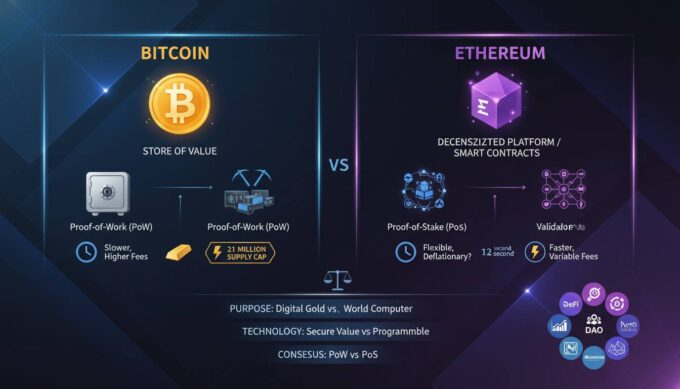
Used by Bitcoin, PoW requires miners to solve complex mathematical puzzles. This process consumes significant electricity but creates enormous security through computational power. The theory is simple: an attacker would need more computing power than the entire network combined to control the blockchain.
👤 Satoshi Nakamoto wrote in the Bitcoin whitepaper: “The proof-of-work chain is the solution to the Byzantine Generals’ Problem.”
Proof of Stake (PoS)
Ethereum switched to PoS in 2022, reducing energy consumption by approximately 99.95%. Instead of mining, validators “stake” (lock up) their cryptocurrency as collateral. If they behave dishonestly, the network takes their stake. This approach is far more energy-efficient while maintaining security.
| Mechanism | Energy Use | Example Networks | Block Time |
|---|---|---|---|
| Proof of Work | High | Bitcoin, Dogecoin | ~10 min |
| Proof of Stake | Very Low | Ethereum, Solana | 12 sec |
| Delegated PoS | Low | EOS, Tron | 3 sec |
Types of Blockchain Networks
Not all blockchains operate the same way. There are four primary types:
Public Blockchains
Public blockchains are open networks where anyone can participate. No permission is needed to join, validate transactions, or read the ledger. Bitcoin and Ethereum are the largest public blockchains. They’re fully decentralized and offer maximum transparency, but often sacrifice speed for security.
Private Blockchains
Private blockchains restrict participation to invited members only. A single organization typically controls these networks. They’re faster and more private than public blockchains but sacrifice decentralization. Many enterprises use private blockchains for internal record-keeping.
Consortium Blockchains
Consortium blockchains are governed by a group of organizations rather than a single entity. Multiple companies share responsibility for validating transactions. These are popular in industries like banking and supply chain where multiple parties need to share data trustlessly.
Hybrid Blockchains
Hybrid blockchains combine elements of public and private systems. Some data remains public for transparency while other data stays private for business sensitivity. This approach aims to balance openness with privacy requirements.
Real-World Applications Beyond Cryptocurrency
While cryptocurrency remains blockchain’s most visible application, the technology is transforming numerous industries:
Supply Chain Management
Walmart uses IBM’s Food Trust blockchain to track food products from farm to shelf. When a food safety outbreak occurs, they can now trace contaminated items to their source in seconds rather than days.
Healthcare Records
Medical institutions are exploring blockchain to give patients control over their health records. Patients can grant temporary access to doctors without compromising data security or portability.
Voting Systems
Several countries, including Estonia and South Korea, have experimented with blockchain voting to enhance election security and transparency while reducing fraud.
Digital Identity
Blockchain could replace passwords with cryptographic identities. Users would control their personal data and choose what to share with services requiring verification.
DeFi (Decentralized Finance)
Ethereum powers financial services like lending, borrowing, and trading without traditional banks. Users can earn interest on crypto holdings or obtain loans using crypto as collateral—without credit checks or bank approval.
📈 ADOPTION METRICS
– Over 400 million people worldwide own cryptocurrency
– Major companies investing in blockchain: IBM, Microsoft, Amazon, JPMorgan
– Central banks in 130+ countries exploring digital currencies
Benefits and Limitations
Advantages of Blockchain
Immutability
Once recorded, data cannot be easily altered. This creates permanent, auditable records—valuable for legal contracts, land titles, and medical records.
Transparency
Public blockchains allow anyone to verify transactions. This transparency reduces fraud and builds trust in systems where parties don’t know each other.
Security
Cryptographic protection and distributed validation make blockchain resistant to hacking. Attacking Bitcoin would require controlling 51% of the network’s computing power—an astronomical expense.
Efficiency
Cross-border payments that traditionally take 3-5 business days can settle in minutes on blockchain networks. Smart contracts automate processes that normally require intermediaries.
Financial Inclusion
Approximately 1.4 billion adults lack access to traditional banking . Blockchain only requires internet access, potentially bringing financial services to the unbanked.
Challenges and Limitations
Scalability
Public blockchains can only process limited transactions per second compared to Visa’s 65,000 TPS. Bitcoin handles about 7 TPS; Ethereum handles around 15-30 TPS. Solutions like “Layer 2” networks are being developed to address this.
Energy Consumption
Bitcoin’s proof-of-work system consumes approximately 150+ terawatt-hours annually—comparable to some small countries. However, the network is shifting toward renewable energy sources, and Ethereum’s switch to proof-of-stake dramatically reduced consumption.
Regulation
Governments worldwide are still determining how to regulate blockchain. Unclear rules create uncertainty for businesses and users alike.
User Experience
Managing private keys, understanding gas fees, and navigating blockchain wallets remain challenging for non-technical users. Improving usability is an ongoing priority for developers.
Irreversibility
While immutability is usually an advantage, it becomes problematic when errors occur. There’s no “reset button” if someone sends funds to the wrong address.
The Future of Blockchain Technology
Blockchain continues evolving rapidly. Here are key trends shaping its future:
Interoperability
Future blockchains will communicate seamlessly. Projects like Polkadot and Cosmos enable different blockchain networks to share data and assets, creating a connected ecosystem rather than isolated chains.
Central Bank Digital Currencies (CBDCs)
Over 130 countries are exploring government-backed digital currencies. China’s digital yuan has processed over $14 billion in transactions. The U.S. Federal Reserve continues researching a potential digital dollar.
Web3 and Decentralization
The concept of Web3 envisions a decentralized internet where users own their data and digital assets. Blockchain forms its foundation, enabling ownership through NFTs and decentralized applications.
Enterprise Adoption
Major corporations are moving beyond experimentation to production deployments. JPMorgan’s Onyx, Goldman Sachs’ tokenization platforms, and Microsoft’s Azure Blockchain Service indicate growing enterprise confidence.
Frequently Asked Questions
How long does a Bitcoin transaction take?
Bitcoin transactions typically take 10-60 minutes to confirm. This includes the time to create a block (approximately 10 minutes) plus waiting for additional confirmations for security. Network congestion can increase times significantly.
Can blockchain be hacked?
While blockchain itself is highly secure, individual platforms and exchanges have been hacked. The 2016 DAO hack and numerous exchange breaches resulted from smart contract vulnerabilities, not blockchain technology itself. Major blockchains like Bitcoin remain unhacked.
Do I need technical knowledge to use blockchain?
No. Modern wallets and exchanges handle the technical complexity. You can buy cryptocurrency through apps like Coinbase or use blockchain-based apps without understanding the underlying technology—just like using online banking without knowing how bank networks operate.
Is blockchain the same as cryptocurrency?
No. Cryptocurrency is a digital currency that uses blockchain technology. Blockchain is the underlying technology that records transactions securely. Think of blockchain as the operating system and cryptocurrency as an application running on it.
How does blockchain ensure data privacy?
Public blockchains show transaction data openly but don’t reveal real-world identities without additional information. Private blockchains control who can see data. Users hold cryptographic keys that control access to their information rather than giving data to companies.
What is a smart contract?
A smart contract is a self-executing program stored on blockchain that automatically enforces agreements when conditions are met. For example, an insurance payout could trigger automatically when weather data confirms a covered event—no claims adjusters required.
Conclusion
Blockchain technology represents a fundamental shift in how we store, validate, and transfer value. By removing central authorities and replacing them with cryptographic consensus, blockchain creates systems that are more transparent, secure, and accessible.
For beginners, the key takeaways are straightforward: blockchain is a distributed ledger where transactions are grouped into blocks, secured through cryptography, and validated by a decentralized network. Once added, records become nearly impossible to alter.
While challenges like scalability and regulation remain, blockchain’s potential to transform finance, supply chains, healthcare, and beyond is undeniable. Whether you’re investing in cryptocurrency, building applications, or simply watching technological evolution, understanding blockchain provides insight into one of the most significant innovations of our time.
The technology is still maturing—much like the internet in the early 1990s. The blockchain revolution is just beginning, and its full impact on society may take decades to fully realize.






Leave a comment