

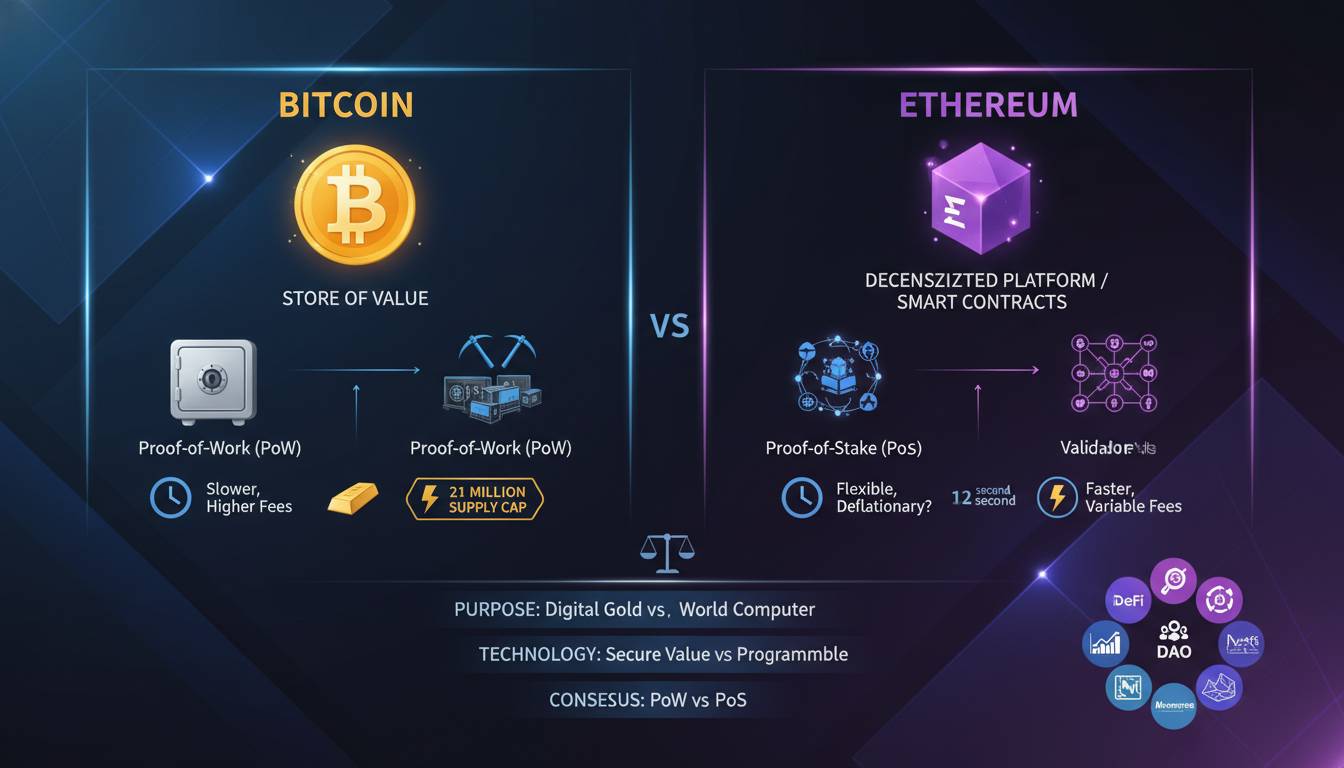
Bitcoin and Ethereum represent the two largest cryptocurrencies by market capitalization, but they serve fundamentally different purposes in the digital asset ecosystem. While Bitcoin functions primarily as a store of value and decentralized money system, Ethereum operates as a programmable blockchain platform enabling decentralized applications, smart contracts, and the broader Web3 infrastructure. Understanding these differences is essential for anyone looking to invest in, build on, or simply comprehend the evolving cryptocurrency landscape.
This comprehensive guide breaks down the technical, economic, and philosophical distinctions between Bitcoin and Ethereum, providing the clarity needed to navigate these revolutionary technologies.
What Is Bitcoin?
Bitcoin, created by the pseudonymous entity Satoshi Nakamoto in 2009, was the first cryptocurrency to achieve widespread adoption. It emerged as a response to the 2008 financial crisis, offering a decentralized alternative to traditional fiat currencies and banking systems.
The Digital Money Protocol
Bitcoin operates as a peer-to-peer digital cash system that allows users to send and receive value without intermediaries like banks or payment processors. The Bitcoin network uses a distributed ledger called a blockchain to record all transactions, ensuring transparency and security through cryptographic validation.
The cryptocurrency has earned the nickname “digital gold” due to its fixed supply of 21 million coins, scarcity mechanism, and increasingly recognized role as a hedge against inflation. Unlike traditional currencies that central banks can print at will, Bitcoin’s supply is algorithmically capped, creating predictable issuance that users can verify independently.
Proof-of-Work Consensus
Bitcoin secures its network through a proof-of-work (PoW) consensus mechanism, often called mining. Miners compete to solve complex mathematical puzzles, and the first to find a valid solution gets to add the next block to the blockchain and receives newly minted Bitcoin as reward. This process consumes significant computational energy but creates an extremely secure and censorship-resistant network.
The PoW mechanism ensures that no single entity can control the network or alter historical transactions. As of 2024, Bitcoin’s network remains the most secure blockchain in existence, with combined hash rate reaching unprecedented levels that make 51% attacks virtually impossible.
What Is Ethereum?
Ethereum was proposed in 2013 by programmer Vitalik Buterin and launched in 2015. While Bitcoin focused on creating digital money, Ethereum aimed to build a generalized platform for decentralized applications and programmable money.
The Programmable Blockchain
Ethereum describes itself as “the world’s programmable blockchain.” Beyond simple value transfer, Ethereum allows developers to deploy smart contracts—self-executing programs that automatically enforce agreements when predefined conditions are met. This capability opened the door to decentralized finance (DeFi), non-fungible tokens (NFTs), decentralized autonomous organizations (DAOs), and thousands of other blockchain-based applications.
The Ethereum Virtual Machine (EVM) serves as a runtime environment for executing smart contracts, ensuring consistent behavior across all nodes in the network. This standardization has made Ethereum the dominant platform for blockchain development, with the largest ecosystem of developers, projects, and users.
Transition to Proof-of-Stake
Ethereum completed a major network upgrade called “The Merge” in September 2022, transitioning from proof-of-work to proof-of-stake (PoS) consensus. Under PoS, validators lock up (stake) 32 ETH to participate in block production rather than solving computational puzzles. This change reduced Ethereum’s energy consumption by approximately 99.95%, addressing longstanding environmental criticisms.
The transition also laid groundwork for future improvements, including sharding to enhance scalability. However, PoS has sparked ongoing debates about centralization risks, as stake-based rewards favor larger holders.
Key Technical Differences
Understanding the technical distinctions between Bitcoin and Ethereum reveals why these platforms serve such different functions.
Supply and Monetary Policy
Bitcoin has a hard cap of 21 million coins, with new Bitcoin created approximately every 10 minutes through block rewards that halve every four years. This deflationary model is explicitly coded into the protocol, making Bitcoin’s monetary policy more predictable than any government currency. The final Bitcoin will be mined around the year 2140, after which miners will rely solely on transaction fees.
Ethereum does not have a fixed supply cap. Initially, ETH had no supply limit, but Ethereum Improvement Proposal (EIP) 1559 introduced a base fee burn mechanism that partially offsets new issuance. The network currently has no set maximum supply, though issuance rates are significantly lower post-Merge. This difference reflects Ethereum’s role as a utility token rather than a “sound money” asset.
Block Time and Transaction Capacity
Bitcoin’s average block time is approximately 10 minutes, with the network processing around 7 transactions per second. Ethereum’s block time averages 12 seconds, enabling faster confirmation and higher throughput for transactions. However, during periods of high demand, both networks can experience congestion and elevated fees.
Ethereum’s architecture allows for more complex transaction types, including smart contract interactions that can involve multiple operations in a single transaction. Bitcoin’s scripting language is intentionally limited to maintain security and simplicity.
Privacy Features
Both blockchains are public, meaning all transactions are visible on the network. However, Ethereum has seen more rapid development of privacy-focused solutions like zero-knowledge proofs (zkSNARKs), which allow transaction verification without revealing underlying data. Privacy remains an active area of research and development across both platforms.
Use Cases and Applications
The fundamental design philosophies behind Bitcoin and Ethereum translate into distinct real-world applications.
Bitcoin’s Primary Use Cases
Bitcoin excels as a store of value and medium of exchange in specific contexts. Major institutions including Tesla, MicroStrategy, and various sovereign wealth funds have added Bitcoin to their balance sheets as an inflation hedge. Countries like El Salvador have adopted Bitcoin as legal tender, enabling faster remittances and financial inclusion for unbanked populations.
The Lightning Network, a layer-2 solution built on Bitcoin, addresses scalability limitations by enabling instant, low-cost micropayments. This development has expanded Bitcoin’s potential for everyday transactions while maintaining the security of the main blockchain.
Ethereum’s Ecosystem
Ethereum’s programmable nature has enabled an expansive ecosystem of applications. Decentralized finance protocols like Uniswap, Aave, and Compound allow users to lend, borrow, and trade without traditional financial intermediaries. NFT marketplaces including OpenSea and Blur have facilitated billions in digital collectible trading.
Enterprise blockchain adoption often favors Ethereum for supply chain tracking, digital identity management, and asset tokenization. Major corporations including JPMorgan, Microsoft, and Amazon have developed Ethereum-based solutions, leveraging its mature developer tools and established standards.
Investment Considerations
Investors often debate whether Bitcoin or Ethereum represents the better investment opportunity, but the answer depends heavily on individual goals and risk tolerance.
Bitcoin as Digital Gold
Bitcoin’s primary investment thesis centers on scarcity, institutional adoption, and monetary independence. Its established brand recognition, limited supply, and proven track record make it the most conservative cryptocurrency investment. Many analysts recommend allocating a portion of a diversified portfolio to Bitcoin as a potential inflation hedge, though volatility remains significant.
Ethereum and Network Value
Ethereum’s investment case rests on capturing value from the growth of decentralized applications and Web3. As usage of DeFi, NFTs, and other Ethereum-based services increases, demand for ETH theoretically rises. The transition to proof-of-stake has also made ETH attractive to investors seeking yield through staking rewards.
However, Ethereum faces competitive threats from alternative layer-1 blockchains like Solana, Avalanche, and Polygon that offer lower fees and faster transactions. Whether Ethereum maintains its dominant market position remains uncertain.
Common Misconceptions
Several persistent myths about Bitcoin and Ethereum deserve clarification.
Myth: Ethereum will replace Bitcoin. The networks serve fundamentally different purposes. Bitcoin focuses on becoming sound money, while Ethereum provides infrastructure for decentralized applications. Many portfolios include both assets for complementary exposure.
Myth: PoS makes Ethereum centralized. While proof-of-stake has different centralization risks than proof-of-work, Ethereum’s validator set remains distributed across thousands of participants. No single entity controls the network, though concentration among large staking providers exists.
Myth: Bitcoin has no real utility. Beyond store of value, Bitcoin enables censorship-resistant transactions, cross-border payments, and financial sovereignty. The Lightning Network continues expanding its utility for micropayments and merchant adoption.
Myth: Ethereum is environmentally unfriendly. The Merge reduced Ethereum’s energy consumption by approximately 99.95%, making it one of the most energy-efficient major blockchains. Environmental concerns primarily applied to the pre-Merge proof-of-work era.
Frequently Asked Questions
Is Ethereum better than Bitcoin?
The answer depends on your objectives. If you seek a store of value and digital gold, Bitcoin’s fixed supply and proven track record make it the better choice. If you’re interested in DeFi, NFTs, or building applications, Ethereum’s programmability offers significantly more utility. Many investors hold both for diversified exposure.
Can Ethereum overtake Bitcoin in market capitalization?
While theoretically possible, Bitcoin’s first-mover advantage, institutional adoption, and brand recognition create substantial barriers. Ethereum would need to capture significantly more enterprise and institutional interest while Bitcoin maintains its position. Market predictions vary widely, and both assets have experienced substantial volatility.
Which is more energy efficient?
Post-Merge Ethereum is dramatically more energy efficient than Bitcoin’s proof-of-work network. However, comparing energy consumption requires nuance—Bitcoin’s energy expenditure secures the most valuable blockchain, while Ethereum’s efficiency enables a different range of applications.
Should I invest in Bitcoin or Ethereum?
Both assets serve different portfolio purposes. Conservative crypto investors often favor Bitcoin for its lower volatility relative to the broader market and store-of-value narrative. Those seeking growth potential and ecosystem participation may allocate to Ethereum. Financial advisors typically recommend understanding each asset’s risks and conducting personal research before investing.
What are the tax differences between Bitcoin and Ethereum?
Both Bitcoin and Ethereum are treated as property for U.S. tax purposes, meaning capital gains apply to any profit from sales. The IRS requires reporting cryptocurrency transactions, and both assets follow the same general tax treatment. Specific circumstances may vary, so consulting a tax professional is advisable.
Which blockchain has more developers?
Ethereum has historically attracted more developers due to its programmable platform and larger ecosystem of DeFi and Web3 projects. However, Bitcoin development remains active, particularly around layer-2 solutions and privacy features. Developer activity fluctuates with market conditions and funding availability across both ecosystems.
Conclusion
Bitcoin and Ethereum represent two distinct visions for blockchain technology—one focused on creating sound digital money, the other on building a programmable platform for decentralized applications. Understanding these differences is crucial for navigating the cryptocurrency space effectively.
Bitcoin offers simplicity, scarcity, and a proven monetary narrative that has attracted institutional adoption and mainstream recognition. Ethereum provides flexibility and innovation through smart contracts, enabling an entire ecosystem of DeFi, NFTs, and Web3 applications that continue reshaping digital infrastructure.
Rather than viewing these as competing investments, many participants choose to understand both assets’ roles within a broader portfolio strategy. The cryptocurrency market continues evolving rapidly, and staying informed about fundamental differences helps investors make decisions aligned with their financial objectives and risk tolerance.









Leave a comment