

The global cryptocurrency market encompasses over 10,000 distinct digital assets, each designed with specific functionalities, governance structures, and use cases. From Bitcoin’s emergence as digital gold to Ethereum’s revolutionary smart contracts, understanding these different types is essential for anyone navigating the modern financial landscape.
Quick Answer: Cryptocurrencies are typically categorized by their primary function: store of value (Bitcoin), smart contract platforms (Ethereum, Solana), stablecoins (USDC, USDT), utility tokens, DeFi tokens, and privacy coins. Each category serves distinct purposes in payments, decentralized applications, staking, governance, and investment strategies.
Major Cryptocurrency Categories
The cryptocurrency ecosystem has evolved far beyond a single digital currency. Today, digital assets serve as infrastructure for financial applications, governance mechanisms, and entirely new economic models. Understanding these categories helps investors, developers, and users make informed decisions about which assets align with their goals.
📊 MARKET OVERVIEW
| Category | Primary Function | Top Examples | Market Role |
|---|---|---|---|
| Store of Value | Digital scarcity | Bitcoin (BTC) | Reserve asset |
| Smart Contracts | Decentralized apps | Ethereum (ETH), Solana | Platform infrastructure |
| Stablecoins | Price stability | USDC, USDT | Payments,DeFi |
| Utility Tokens | Access/Discounts | BNB, UNI | Platform tokens |
| Privacy | Anonymity | Monero (XMR), Zcash | Confidential transactions |
Store of Value Cryptocurrencies
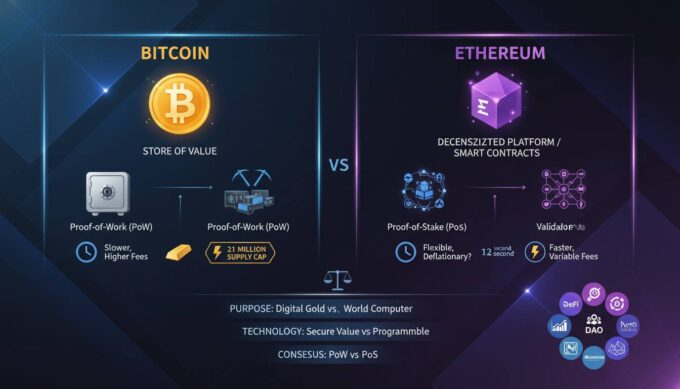
Bitcoin remains the dominant store of value cryptocurrency, designed with a fixed supply of 21 million coins to combat inflation. Created in 2009 by the pseudonymous Satoshi Nakamoto, Bitcoin introduced blockchain technology as a decentralized ledger system. Its consensus mechanism, Proof of Work, secures the network through computational mining while establishing scarcity through halving events that reduce new issuance every four years.
Bitcoin’s primary use cases include:
- Digital gold alternative: Institutional investors increasingly allocate to Bitcoin as an inflation hedge, with companies like MicroStrategy and various sovereign nations adding Bitcoin to treasury reserves.
- Cross-border payments: Bitcoin enables peer-to-peer transactions without intermediaries, settlement within 10-60 minutes (or near-instant with Layer 2 solutions like Lightning Network).
- Financial inclusion: Approximately 1.4 billion people globally lack access to traditional banking but possess mobile connectivity, making Bitcoin a viable alternative for financial participation.
Other cryptocurrencies have attempted store of value functionality, including Litecoin (faster transactions) and Bitcoin Cash (larger block sizes). However, Bitcoin’s network effect, institutional adoption, and brand recognition continue to position it as the primary digital store of value asset.
Smart Contract Platforms
Smart contract platforms represent the infrastructure layer of cryptocurrency, enabling developers to build decentralized applications (dApps), launch new tokens, and create automated financial protocols. These blockchains provide programmable money and decentralized computing environments.
Ethereum
Ethereum, launched in 2015 by Vitalik Buterin, pioneered smart contract functionality. Its native token, Ether (ETH), serves multiple purposes: paying for transaction fees (gas), securing the network through staking (after The Merge upgrade), and acting as collateral in DeFi applications. Ethereum’s ecosystem hosts the majority of DeFi protocols, NFT marketplaces, and decentralized exchanges.
Key Ethereum characteristics:
- Token standard (ERC-20): Enabled the 2017 ICO boom and standardized token creation
- Gas fees: Dynamic pricing based on network demand, sometimes reaching $100+ during congestion
- Transition to Proof of Stake: Reduced energy consumption by approximately 99.95%
Competing Smart Contract Platforms
Solana offers higher throughput (65,000 transactions per second vs. Ethereum’s ~15-30) with lower fees, attracting users frustrated by Ethereum’s congestion. Its Proof of History mechanism provides faster finality but at the cost of some decentralization.
Cardano takes a research-first approach, emphasizing peer-reviewed development and academic rigor. Its Ouroboros proof-of-stake protocol prioritizes energy efficiency and formal verification for smart contracts.
Avalanche distinguishes itself with its unique consensus mechanism (Avalanche), enabling sub-second finality and supporting multiple custom blockchains within its ecosystem.
| Platform | TPS | Avg. Transaction Fee | Consensus |
|---|---|---|---|
| Ethereum | 15-30 | $1-50 (variable) | PoS |
| Solana | 65,000 | $0.001-0.10 | PoH + PoS |
| Cardano | 250-1,000 | $0.15-0.30 | PoS |
| Avalanche | 4,500 | $0.01-0.05 | DAG-based |
Stablecoins
Stablecoins maintain a fixed value, typically pegged to the US dollar at a 1:1 ratio. They bridge the gap between volatile cryptocurrencies and traditional finance, enabling users to avoid market swings while remaining within the crypto ecosystem.
Types of Stablecoins
Fiat-collateralized stablecoins hold traditional currency reserves equal to issued tokens. USDC (USD Coin) maintains full transparency with monthly reserve attestations and bank account verifications. USDT (Tether) remains the largest by market cap but has faced ongoing scrutiny regarding reserve transparency.
Crypto-collateralized stablecoins use other cryptocurrencies as collateral, often requiring over-collateralization to absorb price volatility. DAI, created by MakerDAO, maintains its peg through a system of collateralized debt positions, accepting ETH and other assets as collateral.
Algorithmic stablecoins attempt to maintain pegs through algorithmically adjusted supply, though several high-profile failures (including TerraUSD in 2022) have demonstrated the risks of unbacked designs.
Practical uses for stablecoins include:
- DeFi yield generation: Lending stablecoins through protocols like Aave or Compound often yields 3-8% APY
- Remittances: Cross-border payments settle in minutes with minimal fees compared to traditional wire transfers
- Trading buffer: Traders convert crypto holdings to stablecoins during market uncertainty without exiting the ecosystem
Utility Tokens and Platform Tokens
Utility tokens provide access to specific platform services, often offering discounts or governance rights within their ecosystems. Unlike security tokens, which represent investment contracts, utility tokens function as access keys or loyalty points.
Major Platform Tokens
BNB (Binance Coin) powers the Binance ecosystem, providing trading fee discounts (up to 25%), access to token sales, and transaction fee payment on BNB Smart Chain. The token undergoes quarterly burns, reducing total supply over time.
UNI (Uniswap) serves as the governance token for the Uniswap decentralized exchange, allowing holders to vote on protocol upgrades and treasury allocations. Uniswap itself processes billions in daily trading volume across its automated market maker pools.
LINK (Chainlink) functions as the critical infrastructure for external data integration with smart contracts. Chainlink’s oracle networks connect real-world data—prices, sports scores, weather—to blockchain applications requiring off-chain information.
Practical considerations for utility tokens:
- Token value often correlates with platform usage and adoption
- Staking requirements may lock tokens for specified periods
- Governance participation requires significant token holdings for meaningful influence
DeFi and Governance Tokens
Decentralized Finance (DeFi) tokens power permissionless financial protocols, enabling lending, borrowing, trading, and yield generation without traditional intermediaries. These tokens often combine utility functions with governance rights.
DeFi Token Economics
AAVE operates as a decentralized lending protocol where users supply assets to liquidity pools and borrow against collateral. The AAVE token provides governance rights and security deposit functions, with holders earning reduced protocol fees.
COMP (Compound) pioneered the governance token model, distributing tokens to users who supply or borrow assets. This user distribution mechanism created immediate utility and network effects for the protocol.
MKR (MakerDAO) governs the DAI stablecoin system, with token holders responsible for risk parameters, collateral types, and emergency responses. MakerDAO represents one of the longest-running DeFi protocols, having maintained DAI’s peg through multiple market cycles.
Yield farming tokens incentivize liquidity provision by distributing additional tokens to users who supply capital to protocols. While potentially lucrative, these strategies carry smart contract risk, impermanent loss, and token inflation risks.
Privacy Cryptocurrencies
Privacy coins like Monero (XMR) and Zcash (ZEC) offer enhanced transaction anonymity through cryptographic techniques that obscure sender, recipient, and amount information. These features address cryptocurrency’s pseudonymous (not anonymous) nature, where transactions can potentially be traced through blockchain analysis.
Privacy Technologies
Monero uses ring signatures (mixing transactions with decoy inputs), stealth addresses (one-time recipient addresses), and RingCT (confidential transaction amounts) to provide strong privacy by default.
Zcash offers both transparent and shielded transactions, allowing users to choose between transparent addresses (like Bitcoin) and shielded addresses (using zk-SNARKs zero-knowledge proofs). This optional privacy approach balances regulatory concerns with user choice.
Regulatory considerations significantly impact privacy coins. Japan has banned anonymous cryptocurrencies, and exchanges globally have delisted privacy-focused assets due to anti-money laundering concerns. Users should understand local regulations before acquiring privacy coins.
Practical Applications and Use Cases
Understanding cryptocurrency types enables better decision-making for specific use cases:
Investment and Speculation
Bitcoin and Ethereum dominate institutional investment allocations due to their liquidity, brand recognition, and established track records. Altcoin investments carry higher risk-reward profiles, with smaller caps offering greater upside potential but increased volatility and lower liquidity.
Payments and Remittances
Stablecoins excel for payments due to price stability, settling in seconds rather than days with fees often below 1% compared to traditional remittance costs of 5-10%. Bitcoin serves as a viable payment method for large cross-border transactions, though its volatility creates settlement risk for merchants.
DeFi Participation
Yield generation through lending protocols offers returns significantly exceeding traditional savings accounts, though smart contract risk, smart contract failure, and liquidation events require careful management. Liquidity provision to decentralized exchanges generates trading fees plus token incentives but exposes providers to impermanent loss.
NFT and Digital Ownership
Ethereum-based NFTs (ERC-721 tokens) enable verifiable ownership of digital art, gaming assets, and domain names. The speculative nature of NFT markets has produced both significant gains and losses, with liquidity concerns making exit strategies critical.
Choosing the Right Cryptocurrency
Selecting appropriate cryptocurrencies depends on individual goals, risk tolerance, and technical understanding:
For beginners: Start with Bitcoin or Ethereum—the two largest assets by market cap with established track records. Consider dollar-cost averaging to reduce timing risk.
For yield optimization: Stablecoin lending provides lower volatility returns, though protocol risks remain. Research audit reports, insurance coverage, and track records before committing capital.
For technical users: DeFi protocols offer sophisticated strategies but require understanding of wallet security, gas optimization, and smart contract risks. Start with small positions while learning.
For long-term holders: Bitcoin and Ethereum have demonstrated resilience through multiple market cycles. Hardware wallet storage provides security for significant holdings.
Conclusion
The cryptocurrency ecosystem offers diverse asset types serving distinct purposes, from Bitcoin’s digital scarcity to Ethereum’s programmable applications and stablecoins’ price-stable payments infrastructure. Understanding these categories—store of value, smart contracts, stablecoins, utility tokens, DeFi tokens, and privacy coins—enables informed participation in this evolving financial landscape.
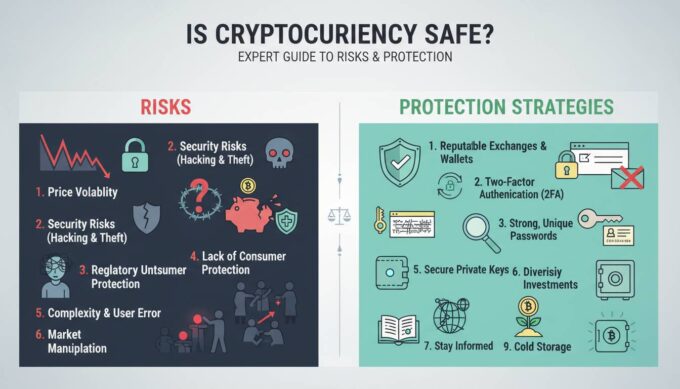
Successful cryptocurrency engagement requires matching asset types to specific goals while managing inherent risks: volatility, regulatory uncertainty, and technological complexity. Whether seeking investment returns, payment efficiency, or DeFi yield, selecting appropriate cryptocurrency categories forms the foundation for sustainable participation in the digital asset economy.
Frequently Asked Questions
What are the main types of cryptocurrencies?
The main categories include: store of value cryptocurrencies (Bitcoin), smart contract platforms (Ethereum, Solana), stablecoins (USDC, USDT), utility tokens (BNB, UNI), DeFi tokens (AAVE, COMP), and privacy coins (Monero, Zcash). Each serves distinct functions within the broader ecosystem.
Which cryptocurrency is best for beginners?
Bitcoin and Ethereum are recommended for beginners due to their established track records, high liquidity, extensive exchange support, and abundant educational resources. Both have survived multiple market cycles and maintain the largest institutional adoption.
What are stablecoins used for?
Stablecoins primarily facilitate: DeFi lending (earning 3-8% yield), cross-border payments (fast settlement, low fees), trading buffers (avoiding volatility without exiting crypto), and price anchoring during market uncertainty.
Are all cryptocurrencies volatile?
Most cryptocurrencies exhibit significant price volatility. Stablecoins maintain fixed values through fiat or crypto collateralization, though algorithmic stablecoins have failed during market stress. Even Bitcoin and Ethereum can move 20-50% over short periods.
What is the difference between utility tokens and security tokens?
Utility tokens provide access to platform services (trading fee discounts, governance voting, product access). Security tokens represent investment contracts with profit-sharing, dividends, or ownership claims. Regulatory frameworks treat them differently, with securities requiring registration or exemption compliance.





Leave a comment