

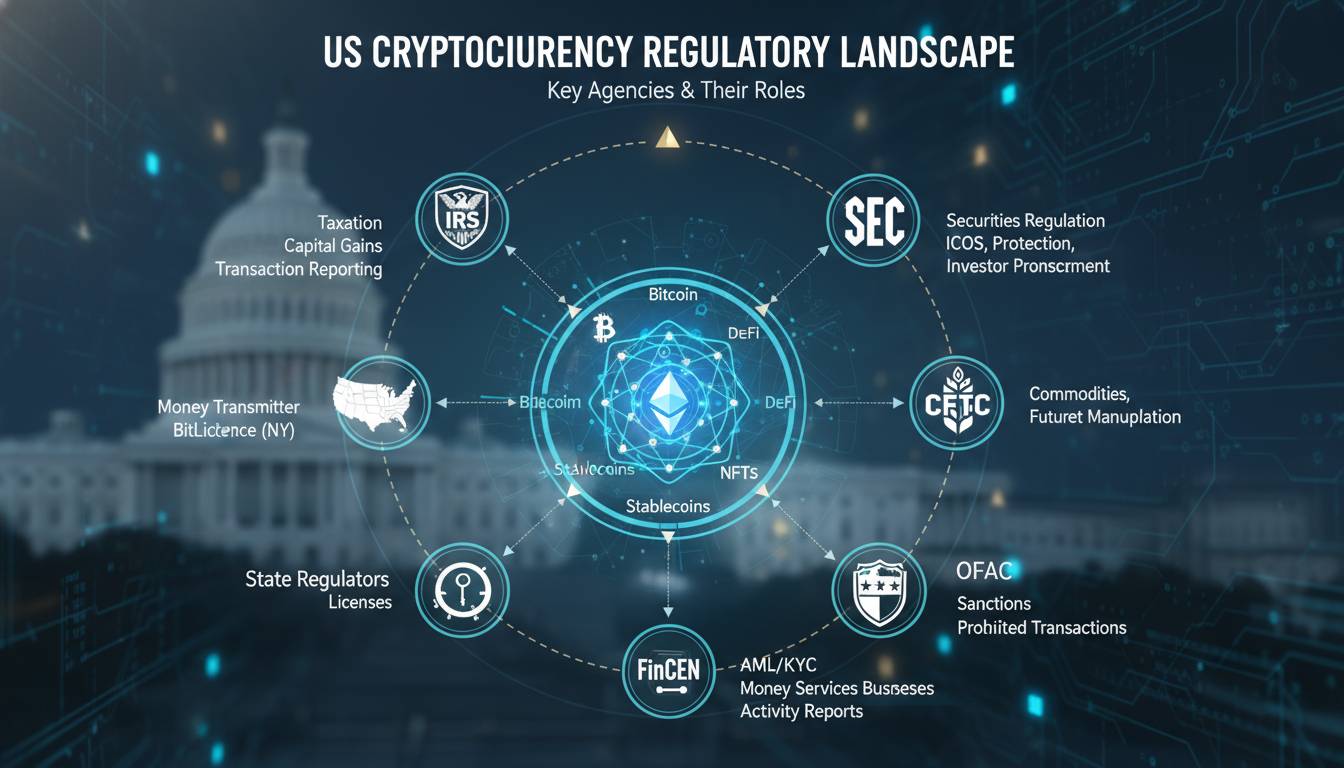
The short answer: Yes, cryptocurrency is legal in the United States. There is no federal law prohibiting the purchase, sale, or holding of cryptocurrencies like Bitcoin, Ethereum, or thousands of other digital assets. However, the legal landscape is remarkably complex, involving multiple federal agencies, 50 state regulatory frameworks, and evolving guidance that creates a patchwork of rules cryptocurrency users and businesses must navigate carefully.
Unlike some countries that have banned cryptocurrency outright—such as China, which has cracked down on mining operations and trading—America’s approach has been to regulate existing financial laws to cover digital assets. This means you can legally buy cryptocurrency through licensed exchanges, hold it in personal wallets, and even spend it at participating merchants. What you cannot do is operate outside the established regulatory framework without potential legal consequences.
This guide breaks down exactly how US cryptocurrency regulation works, which agencies have authority over different aspects of the market, what state laws mean for residents, and where uncertainty remains despite years of enforcement actions and rulemaking.
The Federal Regulatory Framework: Who Controls What
The United States lacks comprehensive cryptocurrency legislation, meaning no single law definitively regulates all digital assets. Instead, multiple federal agencies apply existing laws to cryptocurrency activities, often with overlapping or occasionally conflicting interpretations.
The primary federal regulators include the Securities and Exchange Commission (SEC), the Commodity Futures Trading Commission (CFTC), the Financial Crimes Enforcement Network (FinCEN), the Office of the Comptroller of the Currency (OCC), and the Consumer Financial Protection Bureau (CFPB). Each agency claims jurisdiction over different aspects of the crypto market based on how a particular digital asset or activity is classified.
The most consequential classification distinction is whether a cryptocurrency qualifies as a security or a commodity. This determination dictates which federal agency primarily regulates that asset and what registration and compliance requirements apply to exchanges, issuers, and service providers.
Securities vs. Commodities: The Critical Classification
How the SEC Defines Securities
The SEC applies the Howey Test, originally developed in 1946 for investment contracts in orange groves, to determine whether a digital asset qualifies as a security requiring registration. Under this test, an investment of money in a common enterprise with an expectation of profits derived from the efforts of others typically triggers securities classification.
Using this framework, the SEC has taken enforcement action against numerous cryptocurrency issuers and exchanges. The agency’s position has been that most tokens sold in initial coin offerings (ICOs) or through token sales qualify as securities because purchasers invest with the expectation of profit from the developer’s efforts to build the ecosystem and increase token value.
The SEC’s aggressive stance led to years of enforcement actions, including landmark cases against Block.one (EOS), Telegram, and others. The agency has repeatedly rejected industry arguments that cryptocurrency tokens are fundamentally different from traditional securities.
How the CFTC Defines Commodities
The CFTC, which regulates derivatives markets, has asserted that Bitcoin and Ethereum are commodities rather than securities. This classification stems from the Commodities Exchange Act’s broad definition of commodities, which includes “all other goods and articles” except onions and certain agricultural products.
When the CFTC designated Bitcoin and Ethereum as commodities, it established that futures, options, and derivatives based on these cryptocurrencies fall squarely within the agency’s regulatory authority. This distinction matters significantly because it determines whether the SEC or CFTC has primary oversight responsibility.
The Ongoing Regulatory Tension
The securities-versus-commodity debate has created genuine confusion for businesses and consumers. A cryptocurrency that the SEC considers a security cannot legally be offered or sold to US investors without proper registration or an exemption. Meanwhile, commodities can be traded more freely on CFTC-regulated exchanges.
This regulatory ambiguity has been a consistent source of friction. SEC Chair Gary Gensler, who served from 2021 to 2024, frequently stated his view that the vast majority of cryptocurrency tokens represent securities. Industry advocates countered that this interpretation was overly broad and threatened innovation.
The Ripple case (SEC v. Ripple Labs) became the most significant legal test of these competing interpretations. The SEC sued Ripple in 2020, alleging that its XRP token was an unregistered security. In 2023, a federal judge ruled that XRP was not a security when sold to retail investors on exchanges, though the SEC’s case against Ripple’s institutional sales continued. This partial victory for Ripple did not provide comprehensive clarity but suggested courts may be willing to push back against the SEC’s broadest interpretations.
State-Level Regulation: A Patchwork of Rules
While federal agencies set the overarching regulatory framework, individual states have implemented their own cryptocurrency rules, creating a complex compliance landscape for crypto businesses operating nationally.
New York’s BitLicense
New York became the first state to impose specific cryptocurrency business regulations through its BitLicense framework, implemented in 2015. Companies must obtain a BitLicense from the New York Department of Financial Services to conduct virtual currency business with New York residents, including operating exchanges, storing or holding cryptocurrency, and controlling customer funds.
The BitLicense requirements are extensive, including cybersecurity programs, capital requirements, customer protection measures, and compliance with anti-money-laundering rules. The rigorous application process and ongoing compliance costs have been criticized for effectively limiting cryptocurrency services available to New Yorkers.
Money Transmitter Laws
Beyond explicit cryptocurrency regulations, most states require money transmitter licenses for businesses that transmit value, including cryptocurrency. These laws, designed originally for traditional money transfer services like Western Union, apply to cryptocurrency exchanges that hold or transfer user funds.
States vary significantly in how they interpret and enforce these requirements. Some states have created specific cryptocurrency-friendly regulatory frameworks, while others have taken more restrictive approaches or provided limited guidance.
States Leading the Way
Several states have developed more supportive regulatory environments. Wyoming, for example, created a special purpose depository institution charter specifically for cryptocurrency companies, allowing them to operate with more regulatory clarity. This approach attracted numerous crypto businesses to the state.
Other states, including Texas, Florida, and Colorado, have generally taken more permissive approaches, passing laws that clarify cryptocurrency is not illegal and establishing regulatory sandboxes for fintech companies including crypto businesses.
Cryptocurrency and Banking
Federal Banking Regulator Guidance
The Office of the Comptroller of the Currency (OCC), which charters national banks, issued interpretive letters in 2020 and 2021 clarifying that national banks can provide cryptocurrency custody services and process stablecoin payments. This guidance gave traditional banks clearer authority to enter the cryptocurrency space.
However, the relationship between cryptocurrency companies and the traditional banking system remains complicated. numerous banks have closed accounts belonging to cryptocurrency businesses, citing regulatory concerns and reputational risk. This “de-banking” issue has been particularly challenging for crypto companies, which struggle to find banking partners willing to work with them.
Stablecoin Regulation
Stablecoins—cryptocurrencies designed to maintain a fixed value, typically pegged to the US dollar—have attracted particular regulatory attention. The primary concern is that stablecoins must actually be backed by sufficient reserves, as the collapse of algorithmic stablecoin TerraUSD demonstrated in 2022.
Legislative proposals for stablecoin regulation have circulated in Congress, though comprehensive legislation has not yet passed. The collapse of FTX also intensified focus on cryptocurrency company solvency and customer protection.
Cryptocurrency Taxation in the United States
The Internal Revenue Service (IRS) treats cryptocurrency as property for federal tax purposes, meaning transactions involving cryptocurrency can trigger capital gains or losses.
Key Tax Implications
When you sell cryptocurrency for more than you paid, you realize a capital gain subject to taxation. Similarly, using cryptocurrency to purchase goods or services triggers a taxable event if the cryptocurrency has appreciated in value. Mining rewards, staking income, and cryptocurrency received as payment are also treated as taxable income at their fair market value on the date received.
The IRS has increased enforcement focus on cryptocurrency tax compliance, requiring exchanges to report certain transactions through Form 109-DA (Digital Asset Transactions) for tax years 2023 and beyond. This reporting requirement brings cryptocurrency transactions more in line with traditional securities reporting.
What This Means for You
If you hold cryptocurrency as a long-term investment and do not sell or trade it, you generally do not owe tax until a taxable disposition occurs. However, tracking your cost basis across multiple transactions becomes essential for accurate tax reporting, particularly if you have traded extensively or moved assets between wallets.
Enforcement Actions and Legal Precedent
The US government has taken numerous enforcement actions against cryptocurrency companies and individuals, establishing important legal precedents while demonstrating that cryptocurrency does not place users beyond the law.
Major SEC Enforcement Cases
The SEC has brought hundreds of enforcement actions related to cryptocurrency since 2017. These cases have targeted unregistered token offerings, exchange operations without proper registration, and fraudulent schemes exploiting cryptocurrency enthusiasm.
The SEC’s case against Coinbase and Binance in 2023 represented the most significant federal enforcement action against major cryptocurrency exchanges. The SEC alleged that these platforms operated as unregistered securities exchanges, brokers, and clearing agencies. Both companies contested these allegations, with the cases ongoing as of early 2025.
Anti-Money Laundering Compliance
FinCEN requires cryptocurrency exchanges to implement anti-money-laundering (AML) programs, including customer identification procedures, suspicious activity reporting, and compliance with the Bank Secrecy Act. Failure to implement adequate AML controls has resulted in significant enforcement actions and fines.
The founders of cryptocurrency mixer Tornado Cash were charged with money laundering and sanctions violations in 2023, demonstrating that anonymity-enhancing tools do not protect users from criminal liability when used to facilitate money laundering.
What Remains Uncertain
Despite years of enforcement and rulemaking, significant regulatory questions remain unresolved.
No Comprehensive Federal Legislation
Congress has debated multiple cryptocurrency bills, but no comprehensive federal legislation establishing clear regulatory frameworks has passed into law. Proposals have ranged from creating dedicated regulatory bodies for digital assets to establishing clear definitions for when digital assets are securities versus commodities.
The lack of clear legislation means businesses must navigate existing regulations designed for traditional financial instruments, creating uncertainty about compliance requirements and future regulatory direction.
DeFi and Decentralization
Decentralized finance (DeFi) protocols present particular regulatory challenges. These platforms operate through smart contracts without traditional corporate structures, raising questions about who bears legal responsibility for compliance. Regulators have signaled that the parties involved in launching and operating DeFi protocols—even if the protocols themselves are decentralized—may bear liability for violations.
Conclusion
Cryptocurrency is definitively legal in the United States, and millions of Americans participate in the cryptocurrency economy. However, this legality comes with substantial regulatory complexity. The absence of comprehensive federal legislation means participants must navigate overlapping state and federal regulations, uncertain asset classifications, and evolving enforcement priorities.
For individual cryptocurrency holders, the primary legal considerations involve tax compliance and ensuring exchanges and service providers operate within appropriate regulatory frameworks. For businesses entering the cryptocurrency space, compliance with securities laws, money transmitter regulations, anti-money-laundering requirements, and state-specific rules demands careful legal analysis and ongoing attention to regulatory developments.
The regulatory landscape continues to evolve. Court cases are establishing precedent, federal agencies are refining their approaches, and Congress may eventually pass comprehensive cryptocurrency legislation. For now, participants in the US cryptocurrency market operate within a framework that permits significant activity while imposing substantial compliance obligations.
Frequently Asked Questions
Can I get in trouble for owning cryptocurrency in the US?
No, owning cryptocurrency is completely legal for US residents. There is no law against purchasing, holding, or personally owning cryptocurrency. You should ensure you obtain cryptocurrency through legitimate exchanges and maintain records for tax purposes.
Do I need to pay taxes on cryptocurrency gains?
Yes, the IRS treats cryptocurrency as property. Selling, trading, or using cryptocurrency to make purchases can trigger capital gains taxes. Even converting one cryptocurrency to another is a taxable event. Income from mining, staking, or receiving cryptocurrency as payment is also taxable.
Which federal agency regulates cryptocurrency?
Multiple agencies have jurisdiction. The SEC typically regulates cryptocurrency tokens classified as securities. The CFTC oversees cryptocurrency commodities and derivatives. FinCEN regulates cryptocurrency money transmission. The OCC and CFPB also have roles in banking and consumer protection.
Are all cryptocurrency exchanges legal in the US?
Not all exchanges operate legally. Legitimate US exchanges must comply with federal and state regulations, including obtaining appropriate licenses and implementing anti-money-laundering programs. Using offshore exchanges that do not comply with US regulations can expose users to legal risk.
What is the difference between a security and a commodity in cryptocurrency?
Securities are regulated by the SEC and must be registered or qualify for an exemption. Most tokens sold in ICOs have been classified as securities. Commodities like Bitcoin and Ethereum fall under CFTC oversight and can be traded more freely. The classification depends on how the asset was sold and the economic substance of the investment.
Will cryptocurrency be regulated more strictly in the future?
Regulatory clarity is expected to improve as legislation is considered and court cases establish precedent. However, the direction of future regulation remains uncertain and will depend on Congressional action, administrative agency decisions, and ongoing legal battles.








Leave a comment