

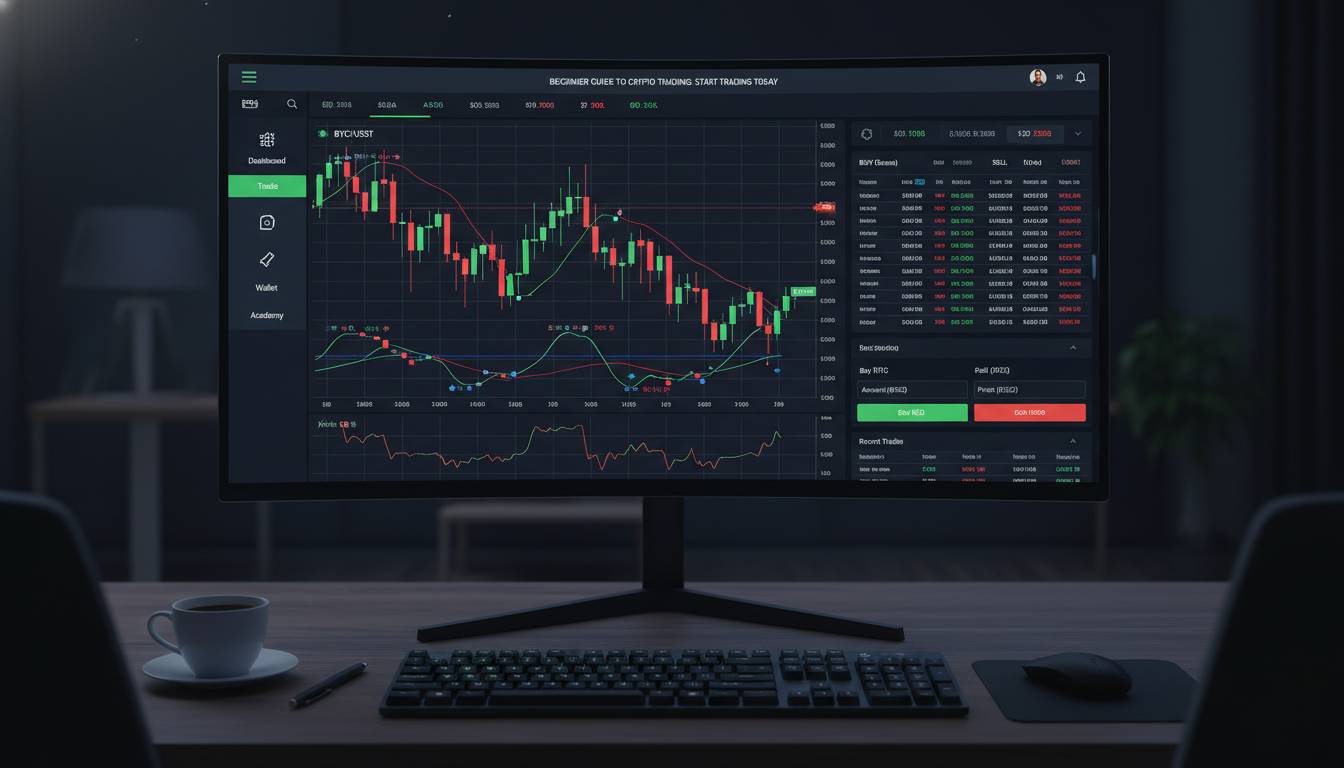
Cryptocurrency trading involves buying and selling digital assets like Bitcoin, Ethereum, and thousands of other tokens through online exchanges. Unlike traditional stock markets, crypto markets operate 24 hours a day, seven days a week, allowing traders to react to price movements at any time. In the United States alone, approximately 18% of adults have invested in or traded cryptocurrency, according to a 2023 Pew Research Center study. This guide walks you through everything you need to know to start trading cryptocurrencies with confidence, from understanding fundamental concepts to executing your first trade and managing risk effectively.
Key Insights
– The global cryptocurrency market exceeds $1 trillion in total value
– Bitcoin remains the dominant cryptocurrency, accounting for approximately 50% of total crypto market capitalization
– Most beginners lose money due to lack of risk management rather than market unpredictability
– Federal regulations in the US classify cryptocurrency as property, requiring capital gains tax reporting
– Demo trading platforms allow practice without risking real money
What Is Cryptocurrency and How Does Trading Work
Cryptocurrency represents a digital or virtual currency secured by cryptography, making it nearly impossible to counterfeit. Most cryptocurrencies operate on decentralized networks based on blockchain technology—a distributed ledger that records all transactions across many computers. This decentralization means no central authority like a bank or government controls cryptocurrency, giving users greater control over their funds.
Trading cryptocurrency differs from simply buying and holding it as an investment. Active trading involves profiting from price fluctuations in shorter timeframes, ranging from minutes to months. Traders buy when they believe prices will rise and sell when they anticipate declines. The goal is to buy low and sell high, though the opposite happens when traders make poor decisions.
The crypto market operates through exchanges—online platforms where buyers and sellers meet to trade. Major US exchanges include Coinbase, Kraken, and Gemini, each offering different fee structures, available cryptocurrencies, and security features. When you trade on an exchange, you’re not directly trading with the platform; you’re trading with other users whose orders appear in the order book. The exchange matches buyers with sellers and takes a small fee for facilitating transactions.
Understanding market mechanics requires knowing bid and ask prices. The bid price represents what buyers are willing to pay, while the ask price represents what sellers accept. The difference between these prices is called the spread. Liquidity refers to how easily you can buy or sell an asset without significantly affecting its price—high-liquidity assets like Bitcoin can be traded quickly with minimal price impact, while smaller altcoins may experience substantial price changes when traded in larger volumes.
Essential Cryptocurrency Trading Concepts
Before executing your first trade, you must understand several fundamental concepts that drive crypto markets. These terms appear constantly in trading discussions, analysis, and educational resources, so familiarity will help you navigate the space more effectively.
Market capitalization calculates a cryptocurrency’s total value by multiplying its current price by the number of coins in circulation. Bitcoin’s market cap consistently reaches into the hundreds of billions of dollars, making it the largest cryptocurrency by this metric. Market cap helps investors understand a crypto asset’s relative size and stability compared to alternatives.
Volatility measures how dramatically a cryptocurrency’s price changes over time. Crypto markets are notoriously volatile—Bitcoin can swing 10% or more in a single day, while more established assets like stocks typically move 1-2% daily. This volatility creates both significant profit opportunities and substantial risks for traders.
Liquidity indicates how easily an asset can be bought or sold without causing major price disruptions. High-liquidity assets like Bitcoin and Ethereum have many buyers and sellers, narrow spreads, and stable pricing. Low-liquidity assets may experience “slippage,” where your trade executes at a worse price than expected because insufficient market depth exists at your desired price.
Order types determine how your trade executes. A market order buys or sells immediately at the best available price. A limit order only executes when the price reaches your specified level, giving you more control but no guarantee of execution. Stop-loss orders automatically sell when prices drop to a predetermined level, helping limit potential losses.
Leverage allows traders to borrow funds to increase their trading position beyond their actual capital. While leverage can amplify profits, it equally amplifies losses and can result in losing more than your initial investment. Beginners should avoid leverage entirely until they gain substantial experience.
Types of Crypto Trading Strategies
Successful traders develop strategies suited to their goals, risk tolerance, and time availability. Understanding different approaches helps you choose the method that aligns with your circumstances.
Day trading involves opening and closing positions within a single trading day. Day traders exploit small price movements, often making dozens of trades daily. This strategy requires significant time dedication, rapid decision-making, and tolerance for stress. Studies suggest that 70-90% of retail day traders lose money, making this approach particularly challenging for beginners.
Swing trading captures price movements over days to weeks. Swing traders identify trends and enter positions when they believe prices will move in their anticipated direction. This strategy requires less time than day trading while still demanding technical analysis skills and patience.
Position trading takes a long-term approach, holding assets for months or years based on fundamental analysis. Position traders ignore short-term price fluctuations, focusing instead on underlying project quality and long-term potential. This strategy suits beginners because it requires less time and emotional energy than active trading.
Scalping represents the most aggressive approach, holding positions for seconds to minutes to capture tiny price differences. Scalpers execute hundreds of trades daily, with profits accumulating from small gains. This strategy demands sophisticated tools, deep market knowledge, and high tolerance for stress and losses.
| Strategy | Time Commitment | Risk Level | Potential Returns | Best For |
|---|---|---|---|---|
| Scalping | Very High | Very High | Variable | Experienced traders |
| Day Trading | High | High | Variable | Full-time traders |
| Swing Trading | Medium | Medium | Moderate | Part-time traders |
| Position Trading | Low | Lower | Long-term growth | Beginners |
Choosing a Cryptocurrency Exchange
Selecting the right exchange forms the foundation of your trading experience. US-based traders must consider regulatory compliance, security features, fee structures, and available assets when making this decision.
Coinbase serves as the largest US cryptocurrency exchange, offering a user-friendly interface ideal for beginners. The platform supports over 200 cryptocurrencies and provides educational content that rewards users with free crypto for learning. However, Coinbase charges higher fees than competitors, with transaction fees ranging from 0.5% to 4.5% depending on transaction size and payment method.
Kraken offers more advanced trading features with lower fees, making it popular among intermediate traders. The platform provides robust security, a wide range of supported cryptocurrencies, and advanced charting tools. Kraken’s fee structure starts at 0.16% for makers and 0.26% for takers, significantly lower than Coinbase for active traders.
Gemini emphasizes regulatory compliance and security, operating under strict New York banking laws. The platform offers both a simple interface for beginners and an ActiveTrader platform for advanced users. Gemini charges flat fees ranging from 0.35% to 0.25% depending on transaction volume.
When evaluating exchanges, consider the following factors:
- Security track record: Look for exchanges with proven security histories and evidence of proper asset custody
- Insurance coverage: Some exchanges offer insurance against hacking losses
- Withdrawal limits: Check daily and monthly withdrawal limits that may affect your trading
- Customer support: Responsive support becomes crucial when technical issues arise
- Payment methods: Ensure the exchange supports your preferred funding method (bank transfer, debit card, wire transfer)
Risk Management: Protecting Your Capital
Risk management distinguishes successful traders from those who lose their capital quickly. No strategy guarantees profits, but proper risk management ensures you survive losses long enough to become profitable.
Never invest more than you can afford to lose. This principle sounds obvious, yet greed and fear drive beginners to invest savings they desperately need. Cryptocurrency’s volatility means prices can drop 50% or more in weeks. Only use discretionary income—money you won’t need for rent, food, or emergencies—for trading.
Position sizing determines how much capital you risk on any single trade. Most professional traders risk no more than 1-2% of their total portfolio on a single trade. If you have a $1,000 trading account and risk 2%, your maximum loss per trade is $20. This approach ensures that even a string of losing trades won’t devastate your account.
Stop-loss orders automatically exit positions when prices fall to predetermined levels. A stop-loss at 10% below your purchase price means your maximum loss per trade caps at 10%, regardless of how far prices ultimately drop. Setting appropriate stop-losses prevents emotional decision-making during market downturns.
Diversification spreads risk across multiple assets rather than concentrating all capital in one cryptocurrency. While Bitcoin and Ethereum should form the core of most portfolios due to their liquidity and stability, allocating smaller amounts to other assets reduces the impact of any single asset’s poor performance.
Avoid revenge trading after losses. The emotional urge to immediately recoup losses often leads to larger, riskier positions that compound losses. Accept that losses are part of trading, step away after significant losses, and return with a clear head.
Common Mistakes Beginner Traders Make
Learning from others’ mistakes proves far cheaper than making them yourself. Understanding these common errors helps you avoid falling into the same traps.
FOMO (Fear of Missing Out) drives buyers to purchase at market tops when prices have already risen dramatically. Social media amplifies this effect, with viral posts about massive gains creating urgency to buy. Successful traders buy when others are fearful and sell when others are greedy—a counter-intuitive approach that requires emotional discipline.
Investing without research leads to buying “meme coins” or trending tokens based purely on social media hype rather than fundamentals. Before investing in any cryptocurrency, understand what the project does, who the developers are, and whether the token serves a genuine purpose. Many worthless tokens command billions in market cap purely through marketing and speculation.
Ignoring fees silently erodes trading profits. Every trade incurs fees, and frequent trading multiplies these costs. A trader making 50 trades monthly with 1% average fees pays 50% of their account value annually just in transaction costs—a massive headwind to overcome.
Overtrading stems from the false belief that more trades mean more profits. In reality, each trade carries risk, and excessive trading typically results from emotional decision-making rather than sound strategy. Quality trades based on thorough analysis outperform quantity of trades.
Not securing assets leads to catastrophic losses through hacks, scams, or simple forgetting. Cryptocurrency held on exchanges remains vulnerable to platform breaches. Hardware wallets provide the most secure storage for significant holdings, requiring physical access to authorize transactions.
Getting Started: Your First Trades
With foundational knowledge established, you’re ready to begin trading. Follow this step-by-step approach to start safely.
Step 1: Educate yourself further. Before investing real money, complete exchange-provided educational modules and practice with paper trading. Most exchanges offer demo accounts or testnet environments where you can execute simulated trades without risking capital.
Step 2: Choose your exchange and complete verification. Select an exchange based on the criteria discussed earlier, then complete identity verification (required by US law). This process typically takes minutes to hours but may extend longer during high-demand periods.
3: Fund your account with a small amount. Start with money you can afford to lose entirely. Many experts recommend beginning with $100-500—enough to experience real market movements without devastating losses if things go wrong.
4: Make your first purchase. Start with Bitcoin or Ethereum due to their liquidity and stability. Execute a small market order to experience how the process works. Note the price, fees, and time required for the trade to settle.
5: Monitor your position. After purchasing, watch how the price moves. Keep a trading journal recording your analysis, the reasoning behind your trade, and your emotional state. This documentation helps identify patterns in your decision-making.
6: Set stop-losses and take-profit targets. Before walking away, establish automatic exit points. A stop-loss prevents unlimited downside, while a take-profit locks in gains when prices reach your target.
Tax Implications for US Crypto Traders
The Internal Revenue Service (IRS) classifies cryptocurrency as property, not currency. This classification means every taxable event triggers capital gains or losses reporting requirements.
Taxable events include selling cryptocurrency for fiat currency (US dollars), trading one cryptocurrency for another, and using crypto to purchase goods or services. Simply holding cryptocurrency in your wallet does not create a taxable event.
Capital gains calculate the difference between your purchase price (cost basis) and sale price. Short-term capital gains apply to assets held less than one year and are taxed at ordinary income rates ranging from 10% to 37%. Long-term capital gains apply to assets held over one year, taxed at preferential rates of 0%, 15%, or 20%.
Record-keeping proves essential for accurate tax reporting. Maintain detailed records of every transaction including date, amount, value in USD at time of transaction, and purpose. Specialized crypto tax software can automate much of this tracking by connecting to your exchanges.
Consult a tax professional familiar with cryptocurrency regulations before filing. The rules continue evolving, and professional guidance ensures compliance while potentially identifying tax-saving strategies.
Frequently Asked Questions
Do I need a lot of money to start trading cryptocurrency?
No, you can start with very small amounts. Many exchanges allow purchases starting at $1 or less. However, you should only use discretionary income you can afford to lose entirely, as cryptocurrency markets are highly volatile and prices can drop significantly.
Is cryptocurrency trading legal in the United States?
Yes, cryptocurrency trading is legal in the US. However, exchanges must comply with federal and state regulations, including anti-money laundering (AML) requirements and securities laws. The Commodity Futures Trading Commission (CFTC) regulates Bitcoin and Ethereum as commodities, while the Securities and Exchange Commission (SEC) has taken enforcement action against certain tokens it classifies as securities.
How do I know which cryptocurrency to buy?
Research before buying any cryptocurrency. Understand the project’s purpose, the team behind it, its tokenomics (supply and distribution), and real-world use cases. For beginners, Bitcoin and Ethereum offer the best combination of liquidity, stability, and long-term adoption. Avoid buying tokens purely based on social media hype or influencer recommendations.
Can I lose more money than I invest in cryptocurrency?
Yes, particularly when using leverage or trading derivatives. With spot trading (buying actual cryptocurrency), you can lose your entire investment if the price goes to zero, but you cannot lose more than you invested. However, margin trading and futures contracts can result in losses exceeding your initial investment.
How do I keep my cryptocurrency secure?
Use hardware wallets for storing significant amounts, enable two-factor authentication on all exchange accounts, never share your private keys, and be cautious of phishing attempts. Never keep large amounts on exchanges, as they remain vulnerable to hacks. Write down recovery phrases on paper and store them securely—never digitally.
What’s the difference between buying and trading?
Buying (or “HODLing”) means purchasing cryptocurrency with the expectation that it will increase in value over time—typically months or years. Trading involves more active buying and selling to profit from price fluctuations, often within shorter timeframes. Trading requires more time, knowledge, and risk tolerance than simply buying and holding.
Conclusion
Cryptocurrency trading offers genuine opportunities for profit but demands respect for its risks. Success requires more than enthusiasm—it demands continuous learning, emotional discipline, and rigorous risk management. Start with small amounts, focus on understanding market mechanics before seeking profits, and never invest money you cannot afford to lose entirely.
The journey from beginner to profitable trader spans months or years of practice, mistakes, and incremental learning. Rather than seeking quick wealth, approach crypto trading as a skill to develop gradually. Master the fundamentals, document your experiences, and remain patient through inevitable setbacks. Those who treat trading as a serious undertaking rather than a gambling opportunity are far more likely to achieve sustainable results.




Leave a comment