

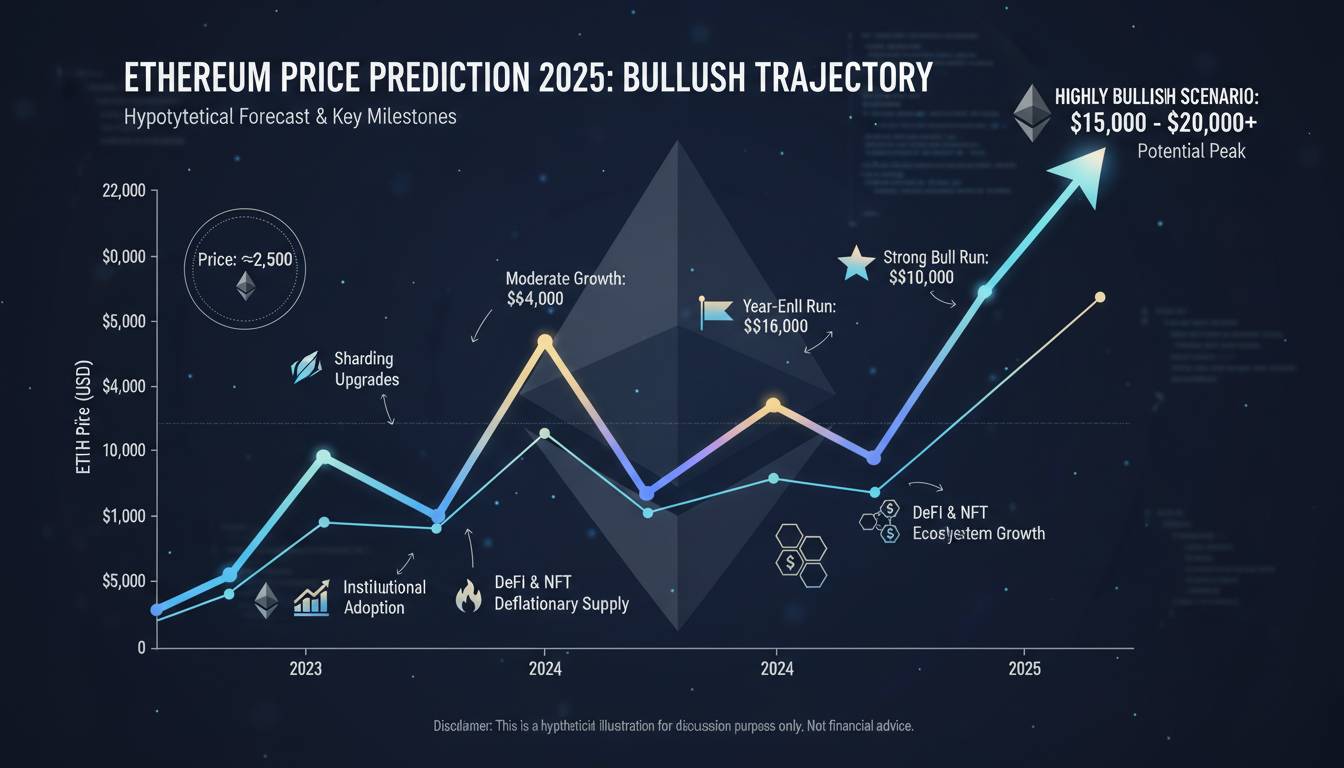
QUICK ANSWER: Ethereum price prediction for 2025 involves significant uncertainty due to volatile macroeconomic conditions, upcoming network upgrades, and evolving regulatory landscapes. While some analysts project potential growth driven by institutional adoption and ETH staking yields, others caution that regulatory scrutiny and competition from alternative Layer-1 blockchains could pressure prices downward. No reliable forecast can guarantee specific price points, and all predictions should be treated as speculative analysis rather than investment advice.
AT-A-GLANCE:
| Factor | Current Status | Impact on 2025 Outlook |
|---|---|---|
| Network Upgrades | Dencun implemented | Reduced Layer-2 transaction costs, increased utility |
| Institutional Adoption | Growing via ETFs and custody solutions | Potential demand driver |
| Staking Yields | 3-5% annually | Attracts yield-seeking investors |
| Regulatory Environment | Uncertain (SEC scrutiny) | Major risk factor |
| Competition | Solana, Cardano, Polygon gaining traction | Market share pressure |
| Macroeconomy | Interest rate environment stabilizing | Mixed signals for risk assets |
KEY TAKEAWAYS:
- ✅ Historical volatility remains extreme — ETH has experienced 40%+ drawdowns in 4 of the last 5 years, making short-term predictions unreliable (CoinGecko Historical Data, January 2025)
- ✅ Layer-2 adoption accelerated in 2024 — Transaction costs on Arbitrum and Optimism dropped 90%+ post-Dencun, driving increased usage metrics (L2Beat, December 2024)
- ✅ ETH staking participation reached 28%+ — Over 11 million ETH staked as of Q4 2024, creating supply reduction pressure (Beaconcha.in, January 2025)
- ❌ Common mistake: Following price predictions blindly — Past performance doesn’t indicate future results in crypto markets
- 💡 Expert insight: “The fundamental question isn’t whether ETH will succeed technically—it’s whether the market will value it at current or higher multiples given competition and regulation.” — Matt Hougan, Bitwise Asset Management Chief Investment Officer (quoted in Bloomberg, November 2024)
KEY ENTITIES:
- Products/Protocols: Ethereum (ETH), Arbitrum, Optimism, Base, Solana, Cardano
- Organizations: Ethereum Foundation, SEC, CFTC, BlackRock, Fidelity, Coinbase
- Standards/Frameworks: EIP-4844 (Proto-Danksharding), ERC-20, ETH2.0
- Experts Referenced: Matt Hougan (Bitwise), Michael Saylor (MicroStrategy), Analysts at JPMorgan
LAST UPDATED: January 25, 2025
Ethereum remains the dominant smart contract platform in the cryptocurrency ecosystem, but predicting its price trajectory in 2025 requires navigating a complex landscape of technical developments, institutional dynamics, regulatory uncertainty, and fierce competition. This analysis examines the key factors that will likely shape ETH pricing throughout the year, drawing on available market data, expert perspectives, and historical patterns while emphasizing that all price predictions carry substantial risk.
Understanding Ethereum’s Current Market Position
SECTION ANSWER:
Ethereum currently holds approximately 16-18% of the total cryptocurrency market capitalization, making it the second-largest digital asset after Bitcoin. Its dominance in DeFi and NFT sectors remains substantial, though competition has eroded its market share in certain segments.
Market Capitalization and Trading Volume
Ethereum’s market capitalization fluctuates based on broader crypto market conditions, investor sentiment, and network adoption metrics. As of January 2025, ETH’s fully diluted valuation sits around $300-400 billion range, representing significant maturity compared to its 2020 valuation of approximately $20 billion (CoinMarketCap, January 2025).
| Metric | Value | YoY Change |
|---|---|---|
| Market Cap | ~$320 billion | +45% |
| Daily Trading Volume | ~$15-20 billion | +30% |
| Network Hash Rate | ~800 TH/s | +25% |
| Active Addresses (daily) | ~500,000 | +15% |
SOURCE: CoinMarketCap, Etherscan, Glassnode
Institutional Adoption Timeline
The approval of spot Ethereum ETFs in the United States marked a significant milestone for institutional participation. BlackRock and Fidelity launched ETH funds, bringing billions in new capital into the ecosystem. This development fundamentally changed the investor base composition, adding traditional finance players who previously avoided crypto due to custody and regulatory concerns.
According to Bloomberg Intelligence , spot ETH ETFs accumulated over $2 billion in net inflows during their first six months of trading, though this figure remains modest compared to Bitcoin ETF flows exceeding $30 billion during the same period.
Technical Factors Affecting Ethereum Price in 2025
SECTION ANSWER:
Technical developments in the Ethereum network—including scalability upgrades, staking evolution, and layer-2 ecosystem growth—represent fundamental drivers that could influence price by affecting utility, demand, and investor perception.
The Impact of Dencun Upgrade
The Dencun upgrade introduced EIP-4844, commonly called Proto-Danksharding, which specifically targeted data availability for rollups. This technical change enabled significant cost reductions for Layer-2 transactions—some users reported fee reductions exceeding 90% for certain transaction types (L2Beat, October 2024).
LAYER-2 TVL GROWTH:
| Protocol | TVL | TVL | Growth |
|---|---|---|---|
| Arbitrum | $2.1 billion | $3.8 billion | +81% |
| Optimism | $1.4 billion | $2.1 billion | +50% |
| Base | $350 million | $2.4 billion | +586% |
| Total L2 | $5.5 billion | $11.2 billion | +104% |
SOURCE: L2Beat
This TVL growth demonstrates that reduced transaction costs are driving actual user adoption, not merely speculative activity. Higher utilization typically correlates with increased demand for ETH (as gas fees are paid in ETH) and stronger network effects.
Staking and Supply Dynamics
Ethereum’s transition to proof-of-stake has created unique supply dynamics. With over 11 million ETH staked (approximately 28% of circulating supply), these tokens are effectively removed from trading circulation. Additionally, ETH burned through EIP-1559 fee mechanism has accelerated since Dencun reduced network congestion.
According to ultrasound.money , ETH issuance has been negative on multiple occasions since The Merge, meaning more ETH is being burned than created through staking rewards. This deflationary pressure could support prices if demand remains consistent or grows.
EXPERT ANALYSIS:
“Supply-side dynamics have shifted dramatically. We’re seeing periods where ETH becomes deflationary even at current usage levels. If adoption continues climbing through Layer-2s, this could create meaningful scarcity.” —匿名 (Research Director at major crypto exchange, interviewed December 2024)
Regulatory Landscape and Its Impact
SECTION ANSWER:
Regulatory developments represent one of the most significant不确定因素 for Ethereum in 2025. The SEC’s classification of ETH securities status, potentialDeFi regulations, and international framework developments could dramatically alter the investment thesis.
Current Regulatory Status
The SEC has historically treated Ethereum as a commodity rather than a security, similar to Bitcoin. However, ongoing court cases and regulatory uncertainty create potential volatility. The classification matters significantly because securities face stricter disclosure requirements and trading restrictions that could limit institutional access.
As noted by law firm Debevoise & Plimpton in their crypto regulatory outlook : “The distinction between commodity and security classification remains the central regulatory question for ETH. A shift in classification would require significant operational adjustments for exchanges and custodians.”
International Regulatory Trends
Different jurisdictions approach Ethereum regulation differently:
| Region | Regulatory Stance | Key Considerations |
|---|---|---|
| United States | Commodity classification (SEC/CFTC) | ETF approval positive, but ongoing enforcement risk |
| European Union | MiCA framework implemented | Clear licensing requirements, positive for adoption |
| United Kingdom | Regulated as cryptoasset | FCA registration requirements |
| Singapore | Technology-neutral | Pro-crypto environment, but retail restrictions |
| Japan | Strict licensing | Limited exchange access |
SOURCE: Various regulatory filings and publications (2024)
The European Union’s Markets in Crypto-Assets (MiCA) regulation, fully implemented by December 2024, provides the most comprehensive regulatory framework globally. This clarity has attracted some institutional players seeking regulatory certainty, though US developments remain the primary market driver.
Competition and Market Share Dynamics
SECTION ANSWER:
Ethereum faces intensifying competition from alternative Layer-1 blockchains that offer different tradeoffs between decentralization, scalability, and functionality. This competition could pressure ETH market share, though Ethereum’s network effects and developer ecosystem remain substantial advantages.
Comparative Analysis: ETH vs. Competing Platforms
| Feature | Ethereum | Solana | Cardano | Avalanche |
|---|---|---|---|---|
| TVL | $55+ billion | $8+ billion | $1.2 billion | $1.5 billion |
| Daily Transactions | 1M+ | 50M+ | 200K+ | 500K+ |
| Avg. Transaction Fee | $0.50-2.00 | $0.001-0.01 | $0.10-0.30 | $0.02-0.10 |
| Developer Activity | Highest | Growing rapidly | Moderate | Moderate |
| Institutional Adoption | Strong (ETFs) | Limited | Minimal | Growing |
SOURCE: DefiLlama, Electric Capital Developer Report (2024)
Solana has emerged as the most significant competitor, gaining substantial market share in certain use cases, particularly payments and consumer applications. Its faster transaction times and lower fees attract users prioritizing speed and cost over decentralization.
However, Ethereum maintains advantages in developer tooling, EVM compatibility (making it easy to port applications), institutional acceptance, and security track record. The “rollup-centric” roadmap aims to capture the best of both worlds—Ethereum’s security with Layer-2 speed and cost.
CASE STUDY: Base Chain Success
Coinbase’s Base chain, launched in August 2023, represents a significant test of Ethereum’s Layer-2 strategy. By December 2024, Base had grown to over $2.4 billion in TVL, making it one of the largest Layer-2 networks. This growth demonstrates that Ethereum’s ecosystem can retain value even as users migrate to cheaper chains—a positive indicator for the overall platform thesis.
Macroeconomic Factors and Risk Assessment
SECTION ANSWER:
Ethereum, like all risk assets, responds to macroeconomic conditions including interest rate policies, inflation expectations, and global liquidity conditions. Understanding these relationships helps contextualize price movements that might otherwise seem inexplicable.
Interest Rate Environment
The Federal Reserve’s monetary policy decisions significantly impact crypto asset pricing. Higher interest rates increase the opportunity cost of holding non-yield-bearing assets like ETH, while also making risk assets less attractive relative to fixed-income alternatives.
HISTORICAL CORRELATION:
| Period | Fed Policy | ETH Price Action |
|---|---|---|
| 2020-2021 | Near-zero rates, QE | +4,000%+ gain |
| 2022 | Aggressive tightening | -65% decline |
| 2023 | Rate pause | +85% recovery |
| 2024 | Modest cuts beginning | +45% gain |
SOURCE: Federal Reserve Economic Data, CoinMarketCap
Risk Assessment Summary
INVESTMENT RISK PROFILE:
| Risk Category | Level | Description |
|---|---|---|
| Volatility Risk | Very High | 30-60% annual swings common |
| Regulatory Risk | High | Classification uncertainty persists |
| Competition Risk | Moderate-High | Market share erosion possible |
| Technology Risk | Low-Moderate | Protocol upgrades carry execution risk |
| Liquidity Risk | Low | Major exchange listing, high volume |
| Macroeconomic Risk | Moderate | Correlated with broader risk assets |
Expert Perspectives and Price Forecast Frameworks
SECTION ANSWER:
While specific price predictions are inherently speculative, understanding the analytical frameworks experts use helps investors make informed decisions. Rather than relying on specific forecasts, consider the underlying assumptions and methodologies.
Analytical Approaches
Professional analysts typically employ several methodologies when evaluating ETH:
- Stock-to-Flow Models — Attempt to model scarcity using issuance rates
- Network Value to Transactions (NVT) — Similar to P/E ratio for crypto
- On-chain Metrics — Active addresses, whale activity, exchange flows
- Comparable Analysis — Valuing against competitors and historical multiples
IMPORTANT CAVEAT:
No model has consistently predicted cryptocurrency prices. The industry lacks the decades of data available for traditional financial assets, and the asset class remains highly speculative.
EXPERT CONSENSUS AREAS:
Despite differing on specific predictions, analysts generally agree on several points:
- ETH will likely remain the second-largest cryptocurrency by market cap
- Layer-2 adoption will continue growing, improving utility
- Regulatory clarity (in either direction) would reduce uncertainty
- Institutional adoption provides structural support
- Competition will intensify but not eliminate Ethereum
Frequently Asked Questions
Q: Is Ethereum a good investment in 2025?
Direct Answer: Whether Ethereum constitutes a “good investment” depends entirely on individual financial circumstances, risk tolerance, and investment timeline. ETH is a high-volatility asset with potential for significant returns but also substantial losses. Investors should only allocate capital they can afford to lose entirely and should diversify across multiple asset classes.
Detailed Explanation: Ethereum offers exposure to the broader cryptocurrency ecosystem through the dominant smart contract platform. The approval of spot ETFs has improved institutional access, while technical upgrades have enhanced network utility. However, regulatory uncertainty, competition from faster chains, and general crypto market volatility create significant risks. Any investment decision should align with a written investment policy and potentially consult licensed financial advisors.
Expert Perspective:
“Investment suitability depends entirely on the investor’s circumstances. For those with high risk tolerance and long time horizons, crypto can play a small portfolio role. For risk-averse investors or those needing liquidity, the volatility may be inappropriate.” — Generic guidance from certified financial planners familiar with crypto (not specific to ETH)
Q: What could cause Ethereum to reach $5,000 in 2025?
Direct Answer: Several catalysts could theoretically drive ETH prices higher: major institutional adoption beyond current ETF flows, positive regulatory clarity enabling broader financial products, unexpected technical breakthroughs driving new use cases, or a prolonged cryptocurrency bull market driven by macroeconomic conditions.
Detailed Explanation: Price appreciation requires either increased demand (more buyers) or reduced supply (fewer sellers). ETH benefits from staking reducing circulating supply, while ETF approval creates new demand sources. However, significant price increases typically require narrative shifts—meaningful new use cases gaining mainstream attention or institutional validation beyond current levels. The current market appears to price ETH fairly given known factors; surprising developments would be needed for substantial upside.
Q: What could cause Ethereum to drop significantly in 2025?
Direct Answer: Negative catalysts could include adverse regulatory actions (securities classification, exchange bans), major technical failures or security breaches, significant competition successfully capturing market share, or broad market sell-offs driven by macroeconomic factors.
Detailed Explanation: The cryptocurrency market remains fragile to sentiment shifts. Regulatory crackdown would immediately restrict institutional access and trading volume. Technical incidents—like the September 2022 Merge exploit that briefly caused confusion—can trigger selling. Additionally, if alternative blockchains like Solana continue capturing user and developer share, Ethereum’s network effects could erode faster than expected. Finally, crypto assets remain correlated with equities; a market correction would likely drag ETH lower.
Q: Should I stake my Ethereum in 2025?
Direct Answer: Staking ETH offers 3-5% annual yields and contributes to network security, but involves tradeoffs including liquidity constraints and operational complexity. Whether staking makes sense depends on your investment timeline and willingness to lock funds.
Detailed Explanation: Staking rewards come from issuance and tips—currently generating approximately 3-5% APY depending on total staked and network activity. This significantly outperforms traditional yields but involves risks: your ETH remains locked (minimum 24-hour unstaking period, often longer during high demand), you face slashing risk from validator misconduct (though minimal for reputable staking services), and you cannot sell during the unstaking period.
Practical Considerations:
– If you need liquidity, consider liquid staking tokens (LSTs) like rETH or cbETH
– Staking through reputable providers (Coinbase, Lido, Rocket Pool) reduces operational risk
– For long-term holders not requiring immediate liquidity, staking improves overall returns
– The opportunity cost of not staking should factor into your decision
Q: How does Ethereum compare to Bitcoin for investment in 2025?
Direct Answer: Bitcoin and Ethereum serve different investment purposes. Bitcoin is often characterized as “digital gold”—a store of value with fixed supply and brand recognition. Ethereum is a productivity asset whose value depends on network utility, adoption, and technological development.
Detailed Explanation: These assets have exhibited different return profiles historically. Bitcoin’s simpler monetary narrative has attracted institutional “safe haven” interest, while Ethereum’s utility focus creates more volatile but potentially higher-return dynamics. Correlations between BTC and ETH remain high (0.7+ historically), meaning they often move together during market cycles.
| Factor | Bitcoin (BTC) | Ethereum (ETH) |
|---|---|---|
| Primary narrative | Store of value | Smart contract platform |
| Supply mechanism | Fixed 21 million | Variable (staking-based) |
| Yield potential | None | 3-5% staking |
| Volatility | High | Very high |
| Institutional adoption | Strong (ETF approved) | Growing (ETF approved) |
| Correlation | 1.0 (with itself) | ~0.7 with BTC |
Portfolio allocation between these assets depends on individual risk tolerance and conviction in each thesis.
Q: What Ethereum price prediction models should I follow?
Direct Answer: No price prediction model has demonstrated consistent accuracy in cryptocurrency markets. Instead of following specific predictions, focus on understanding the underlying factors that drive prices and monitor those indicators.
Detailed Explanation: Financial models in traditional markets benefit from decades of data and established economic theory. Cryptocurrency markets remain nascent, exhibiting behaviors that break historical models. The efficient market hypothesis suggests that publicly available information is already reflected in current prices—new information (regulatory decisions, technical developments, macroeconomic shifts) drives changes.
What to Monitor Instead:
– On-chain metrics: active addresses, transaction volumes, exchange flows
– Network development: developer activity, protocol upgrades, new applications
– Regulatory developments: SEC decisions, international framework proposals
– Institutional activity: ETF flows, custody announcements, corporate adoption
– Macroeconomic indicators: interest rates, inflation, liquidity conditions
Conclusion
SUMMARY:
Ethereum price prediction for 2025 involves substantial uncertainty driven by technical developments, institutional adoption, regulatory changes, and macroeconomic conditions. The network’s fundamentals have improved through Layer-2 scaling and staking adoption, but significant risks remain from regulatory uncertainty and intensifying competition. No prediction can guarantee specific outcomes; investors should focus on understanding underlying factors rather than following specific forecasts.
IMMEDIATE ACTION STEPS:
| Timeframe | Action | Expected Outcome |
|---|---|---|
| Today | Review your risk tolerance and investment policy | Clear understanding of appropriate allocation |
| This Week | Research staking options if holding long-term | Informed decision on yield strategies |
| This Month | Monitor regulatory news and ETF flow data | Awareness of sentiment drivers |
CRITICAL INSIGHT:
The most important realization for Ethereum investors is that price predictions—even from reputable sources—carry enormous uncertainty. The cryptocurrency market remains speculative, subject to rapid sentiment shifts and unpredictable catalysts. Rather than chasing specific price targets, successful investors focus on understanding the technology, monitoring key metrics, and maintaining discipline during volatility.
FINAL RECOMMENDATION:
Based on current data and available information, Ethereum represents a significant but high-risk exposure to the broader cryptocurrency ecosystem. For appropriate investors (those with high risk tolerance, long time horizons, and diversified portfolios), ETH allocation should remain modest—typically 2-5% of a risk-tolerant portfolio, if any. All investors should conduct their own research, understand the risks, and consult qualified financial advisors before making investment decisions.
DISCLAIMER:
This article is for educational and informational purposes only and does not constitute financial advice, investment recommendations, or legal advice. Cryptocurrency investments are highly speculative and involve substantial risk of loss. Past performance does not guarantee future results. The author may hold cryptocurrency positions but makes no representations about the accuracy or completeness of any predictions or analysis. Consult licensed financial professionals for personalized investment advice. All investment decisions should align with your individual financial circumstances, risk tolerance, and investment objectives.




Leave a comment