

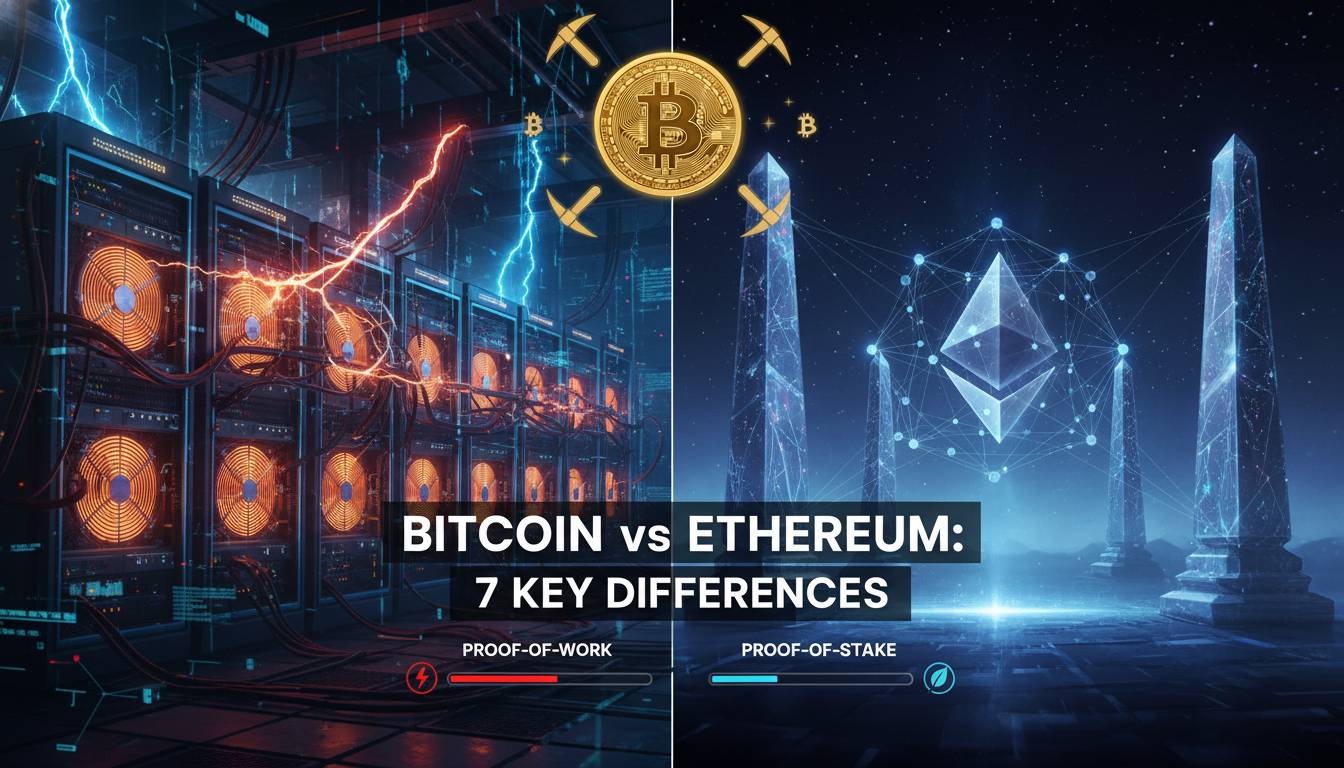
Bitcoin and Ethereum dominate the cryptocurrency landscape, but they serve fundamentally different purposes. While both exist as digital assets on blockchain networks, comparing them is like comparing gold to the internet—each holds distinct value in different ways. Understanding these differences is essential for anyone looking to invest in cryptocurrency or build applications on blockchain technology.
Key Insights
– Bitcoin operates as a decentralized monetary system designed primarily as a store of value, while Ethereum functions as a programmable platform for decentralized applications
– The two blockchains use fundamentally different consensus mechanisms—Bitcoin relies on Proof of Work while Ethereum now uses Proof of Staked validation
– Transaction speeds, supply models, and use cases create distinct investment and development considerations for each platform
– Market capitalizations differ significantly, with Bitcoin maintaining the largest crypto market cap at approximately $1.8 trillion as of late 2024, while Ethereum holds second position around $450 billion
This guide breaks down seven critical differences between Bitcoin and Ethereum, examining technical architecture, economic models, and practical applications to help you understand which aligns with your goals.
Fundamental Origins and Purposes
Bitcoin emerged in 2009 as a response to the 2008 financial crisis, created by the pseudonymous Satoshi Nakamoto with a whitepaper titled “Bitcoin: A Peer-to-Peer Electronic Cash System.” Its explicit purpose was to create a decentralized alternative to traditional fiat currencies—a digital form of money that operates without central bank control.
Ethereum launched in 2015, conceived by Vitalik Buterin and a team of co-founders who envisioned something broader than digital money. While Bitcoin processes transactions on its network, Ethereum created a platform where developers could build decentralized applications (dApps), smart contracts, and entirely new digital ecosystems.
The Core Distinction:
| Aspect | Bitcoin | Ethereum |
|---|---|---|
| Primary Purpose | Digital money, store of value | Platform for applications |
| Creator | Satoshi Nakamoto (2009) | Vitalik Buterin (2015) |
| Origin Motivation | Financial crisis response | Extend blockchain utility |
| Native Asset | BTC | ETH |
This fundamental difference shapes every other aspect of both networks. Bitcoin asks: “How do we create reliable digital money?” Ethereum asks: “How do we use blockchain technology to build new kinds of applications?”
Technical Architecture: How Each Blockchain Works
The technical backbone of each cryptocurrency reveals substantial architectural differences that impact performance, security, and scalability.
Consensus Mechanisms
Bitcoin uses Proof of Work (PoW), requiring miners to solve complex mathematical puzzles to validate transactions and create new blocks. This energy-intensive process has secured Bitcoin since its inception but faces criticism for environmental impact and limited transaction throughput.
Ethereum completed its transition to Proof of Stake (PoS) in September 2022, known as “The Merge.” Instead of miners, validators stake their own ETH as collateral to propose and attest to new blocks. This change reduced Ethereum’s energy consumption by approximately 99.95%, addressing long-standing environmental concerns.
Block Times and Transaction Capacity
Bitcoin produces a new block approximately every 10 minutes, handling around 7 transactions per second on its base layer. Ethereum’s block time averages 12 seconds, enabling roughly 15-30 transactions per second. Ethereum’s layer-2 solutions like Arbitrum and Optimism can process tens of thousands of transactions per second, significantly expanding capacity for high-volume applications.
Programming Languages and Flexibility
Bitcoin uses a scripting language called Script, intentionally limited to prevent complex operations and maintain security. This restriction makes Bitcoin highly reliable but relatively inflexible for building applications beyond simple value transfers.
Ethereum introduced Solidity, a Turing-complete programming language allowing developers to create sophisticated smart contracts and dApps. This flexibility enabled the DeFi (Decentralized Finance) ecosystem, NFT marketplaces, and thousands of other applications—but also introduces more complex attack surfaces that have led to significant exploits.
Economic Models and Supply Dynamics
The economic structures of Bitcoin and Ethereum reflect their different philosophies around scarcity, inflation, and network incentives.
Bitcoin’s Fixed Supply
Bitcoin’s supply is hardcoded at 21 million coins, with the last Bitcoin expected to be mined around the year 2140. New bitcoins enter circulation through block rewards, which halve approximately every four years in events called “halvings.” This decreasing supply schedule creates predictable deflationary pressure, making Bitcoin’s monetary policy more transparent than most fiat currencies.
As of early 2025, over 19.6 million bitcoins have been mined, with approximately 1.4 million remaining in future supply. The halving mechanism means block rewards continue decreasing—from 50 BTC in 2009 to 3.125 BTC per block as of the most recent halving in April 2024.
Ethereum’s Dynamic Supply
Ethereum took a different approach, initially having no fixed supply cap. However, after implementing EIP-1559 in August 2021, the network introduced a base fee burn mechanism that makes ETH deflationary under certain network conditions. When network activity is high, the burned base fees can exceed new ETH issued through block rewards, potentially reducing total supply over time.
Ethereum validators receive ETH rewards for their participation, creating inflationary pressure that is partially offset by the burn mechanism. This dual mechanism creates a more dynamic monetary policy compared to Bitcoin’s predetermined schedule.
Use Cases and Real-World Applications
Understanding what each network actually enables helps clarify why someone might choose one over the other.
Bitcoin’s Primary Functions
Bitcoin excels as a store of value and medium of exchange for those seeking monetary sovereignty. Major institutions including asset managers like BlackRock and Fidelity have launched Bitcoin investment products, recognizing its potential as “digital gold.” Countries like El Salvador have adopted Bitcoin as legal tender, while payment companies including PayPal and Square facilitate Bitcoin transactions for millions of users.
The Lightning Network, Bitcoin’s layer-2 scaling solution, enables faster and cheaper transactions, making micro-payments and daily transactions more practical while maintaining base-layer security.
Ethereum’s Ecosystem
Ethereum hosts the vast majority of decentralized applications in the crypto space. The DeFi ecosystem, with protocols like Uniswap, Aave, and MakerDAO, has billions in total value locked, offering lending, borrowing, and trading without traditional intermediaries. NFT marketplaces, including OpenSea and Foundation, operate primarily on Ethereum, enabling digital ownership and creator economies.
Enterprise adoption includes companies like Microsoft (Azure Blockchain), JPMorgan (Onyx), and numerous logistics firms using Ethereum-based solutions for supply chain tracking and provenance verification.
Transaction Costs and Speed Considerations
For practical usage—whether investing or building applications—transaction costs and confirmation times significantly impact the user experience.
| Metric | Bitcoin | Ethereum |
|---|---|---|
| Average Block Time | ~10 minutes | ~12 seconds |
| Base Layer TPS | ~7 | ~15-30 |
| Average Transaction Fee | $5-30 (varies widely) | $2-50 (varies widely) |
| Fee Structure | Per-byte pricing | Base fee + priority fee |
Bitcoin transaction fees typically spike during periods of high demand, such as during bull markets or when large numbers of users transact simultaneously. The fee market ensures users who pay higher fees get their transactions included faster.
Ethereum’s EIP-1559 introduced base fees that automatically adjust based on network demand, creating more predictable pricing for users. However, during network congestion—common during popular NFT drops or major DeFi events—fees can surge significantly.
Layer-2 solutions on both networks offer dramatically lower fees for users willing to trade some security guarantees for improved throughput.
Security Models and Network Stability
Security represents a critical consideration for any blockchain network, and Bitcoin and Ethereum have taken different approaches to protecting their networks.
Bitcoin’s Battle-Tested Security
Bitcoin’s network has operated continuously since 2009 without a successful hack of its core protocol. The combination of Proof of Work, massive mining decentralization, and a conservative approach to protocol changes has created what many consider the most secure blockchain in existence. The network’s hash rate—the total computational power securing the network—reached all-time highs in 2024, demonstrating continued miner confidence and network strength.
Ethereum’s Security Challenges
Ethereum’s flexibility and smart contract capabilities introduce additional attack vectors. TheDAO hack in 2016 resulted in approximately 3.6 million ETH stolen (worth approximately $70 million at the time), ultimately leading to a controversial hard fork that created Ethereum Classic. Sophisticated exploits continue targeting DeFi protocols built on Ethereum, with billions lost to hacks over the years.
However, Ethereum’s transition to Proof of Stake introduced new security dynamics. The network requires validators to stake ETH, creating economic disincentives against malicious behavior, while “slashing” penalties punish validators who act dishonestly.
Investment Considerations and Volatility Profiles
Both assets have delivered significant returns over their histories, but their price behaviors differ in ways that may matter to different investor types.
Historical Performance
Bitcoin has experienced dramatic price movements throughout its history, including multiple cycles of rapid appreciation followed by corrections exceeding 50%. Its four-year halving cycle has historically preceded bull markets, though past performance does not guarantee future results.
Ethereum has shown even higher volatility than Bitcoin, with larger percentage swings both upward and downward. The 2017-2018 bull market saw ETH rise from under $10 to nearly $1,400 before crashing to around $80—a decline of over 95%.
Correlation and Portfolio Considerations
Bitcoin and Ethereum prices tend to correlate, often moving in similar directions during broader market cycles. However, Ethereum’s more diverse use case exposure means it sometimes decouples from Bitcoin during periods when application-specific demand (like DeFi or NFT booms) drives market sentiment.
Institutional adoption has increased for both assets, with Bitcoin generally viewed as the more conservative crypto allocation and Ethereum offering exposure to application-layer growth.
The Road Ahead: Development and Upgrades
Both networks continue evolving, though their development trajectories reflect their different philosophies.
Bitcoin’s Measured Evolution
Bitcoin’s development prioritizes stability and backward compatibility. Major upgrades like Taproot (2021) have introduced improvements to privacy and smart contract capabilities while maintaining the network’s conservative approach. The focus remains on improving base-layer functionality and second-layer solutions like the Lightning Network.
Controversial debates about block size and scaling continue, but the network’s governance has historically favored gradual, consensus-driven changes that prioritize security over rapid feature development.
Ethereum’s Continuous Innovation
Ethereum maintains a more aggressive roadmap, with ongoing development toward Proto-Danksharding and full Danksharding to improve data availability and reduce layer-2 costs. The Surge phase of Ethereum’s roadmap aims to significantly increase transaction throughput.
Ethereum’s upgrade cadence reflects its platform philosophy—continuously adding capabilities for developers while managing the complexity that comes with a more ambitious technical vision.
Frequently Asked Questions
Which is better for beginners: Bitcoin or Ethereum?
For beginners seeking exposure to cryptocurrency, Bitcoin is generally recommended as the starting point. Its simpler value proposition as “digital gold,” longer track record, and lower technical complexity make it more accessible. Ethereum offers broader functionality but requires understanding smart contracts, gas fees, and ecosystem-specific concepts that add complexity for new users.
Can Bitcoin and Ethereum be mined together?
No, you cannot mine both simultaneously because they use different consensus algorithms. Bitcoin uses Proof of Work with the SHA-256 algorithm, while Ethereum uses Proof of Stake (its PoW era used Ethash). Specialized mining hardware designed for one cannot mine the other.
Should I invest in both Bitcoin and Ethereum?
Many financial advisors suggest including both in a diversified crypto portfolio. Bitcoin serves as a store-of-value anchor, while Ethereum provides exposure to application-layer innovation. The appropriate allocation depends on your risk tolerance, investment goals, and conviction in each asset’s long-term thesis.
What determines Bitcoin and Ethereum prices?
Both assets trade on exchanges where prices are determined by supply and demand. Trading volume is highest on platforms like Coinbase, Binance, and Kraken. Prices reflect factors including investor sentiment, macroeconomic conditions, regulatory developments, network usage metrics, and broader crypto market dynamics.
Can Ethereum overtake Bitcoin in market capitalization?
While technically possible, Ethereum overtaking Bitcoin would require a significant shift in market sentiment and capital allocation. Bitcoin’s brand recognition, institutional adoption, and store-of-value narrative give it unique positioning. However, Ethereum’s application ecosystem and technical capabilities could drive substantial growth. Both assets serve different purposes, and many investors view them as complementary rather than competing investments.
Which network has more developers?
Ethereum has significantly more active developers than Bitcoin, largely due to its application-building platform nature. Developer activity on Ethereum includes those building DeFi protocols, NFT platforms, gaming applications, and infrastructure tools. Bitcoin development focuses more narrowly on protocol improvements and scaling solutions, attracting developers interested in monetary infrastructure rather than application development.
Conclusion
Bitcoin and Ethereum represent two fundamentally different approaches to blockchain technology. Bitcoin prioritizes monetary reliability and security, serving primarily as digital gold and a censorship-resistant store of value. Ethereum functions as a programmable platform enabling innovation across DeFi, NFTs, gaming, and enterprise applications.
Understanding these differences matters whether you’re investing, building applications, or simply learning about cryptocurrency. Neither asset is objectively “better”—they serve different purposes and attract different types of participants. Savvy investors often hold both, allocating based on risk tolerance and conviction in each network’s long-term value proposition.
The cryptocurrency landscape continues evolving, with both networks competing for users, developers, and institutional capital. By understanding their distinct characteristics, you can make more informed decisions aligned with your financial goals and technological interests.









Leave a comment