

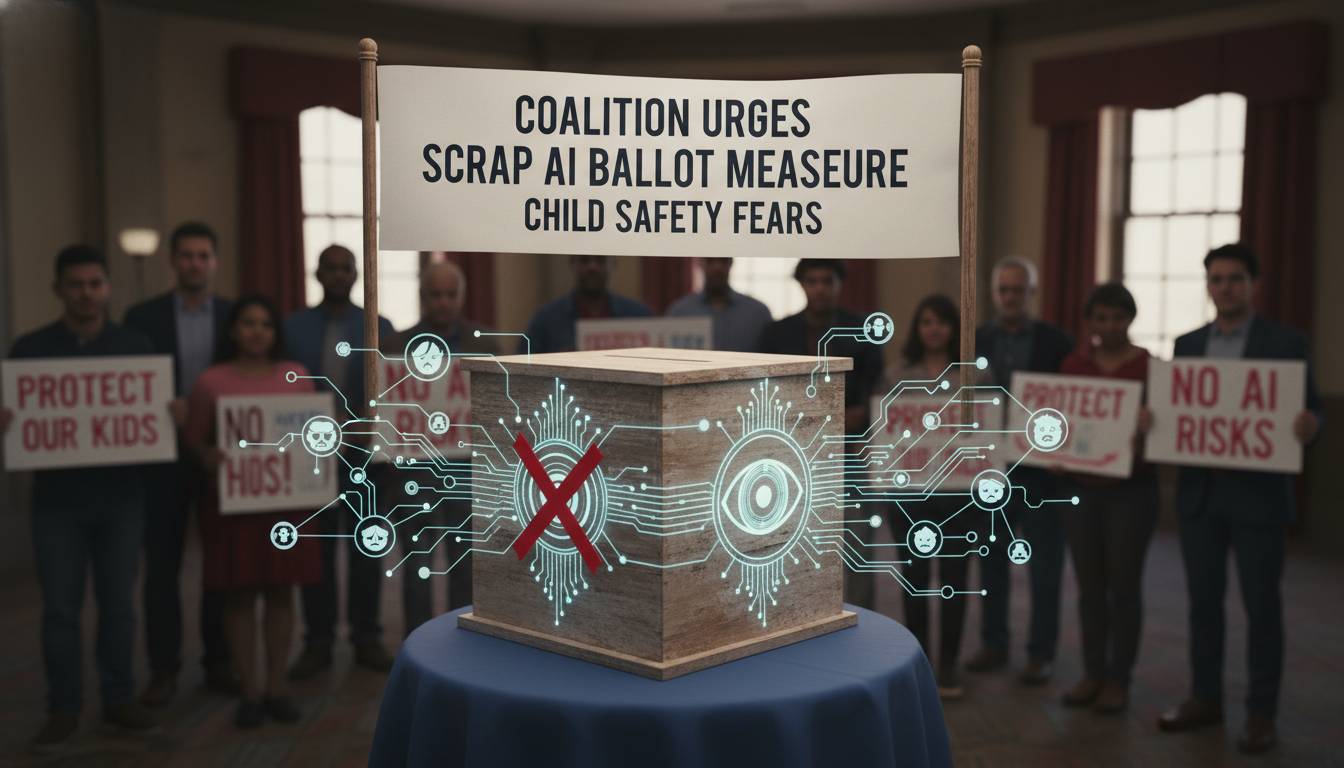
A coalition of advocacy groups escalated its challenge to OpenAI’s California AI ballot proposal on February 25, 2026, arguing that the measure could weaken child protections rather than strengthen them. The dispute matters because the proposal sits at the center of a broader fight over how AI chatbots should be regulated for minors, who should enforce those rules, and whether industry-backed initiatives can set the terms of child safety law in the nation’s largest state.
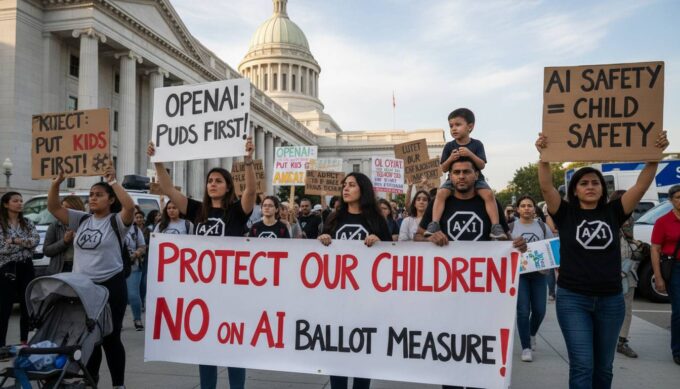
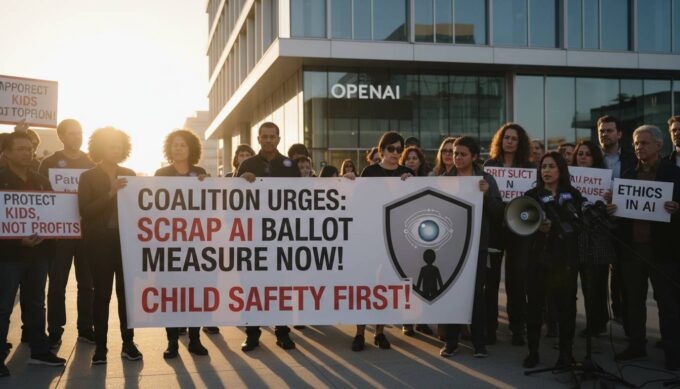
Coalition Urges OpenAI to Scrap AI Ballot Measure Amid Child Safety Fears
OpenAI’s effort to shape California’s rules for AI chatbots is facing organized resistance from watchdog and child-safety advocates. On February 25, 2026, Common Cause’s AI watchdog project CITED published a response warning that OpenAI’s proposed ballot measure poses risks to children’s safety and should not move forward in its current form. The criticism lands after OpenAI and Common Sense Media joined forces in January 2026 on a California ballot initiative aimed at regulating AI chatbots used by minors, according to Axios and CalMatters.
The core dispute is not whether children need protections from AI systems. On that point, there is broad agreement across advocacy groups, state officials, and even the companies involved. The conflict is over the design of those protections: whether the OpenAI-backed measure creates a strong framework with age assurance, audits, and attorney general enforcement, or whether it narrows liability and displaces tougher consumer safeguards already available under California law. KQED reported that critics say the proposal could undermine age and privacy protections by limiting child protections to “severe harms,” a formulation they argue could shield AI companies from accountability for mental-health harms affecting minors.
Key Dates in the OpenAI Ballot Measure Dispute
Jan. 9, 2026
California ballot initiative partnership disclosed by Axios
Feb. 25, 2026
Watchdog group says measure risks child safety
Oct. 13, 2025
AP reported veto of bill restricting minors’ access to chatbots
Sources: Common Cause, Axios, AP
February 25 Challenge Turns a Child-Safety Alliance Into a Regulatory Fight
Common Cause’s February 25 publication is one of the clearest public statements against the OpenAI-backed measure. The group said its AI watchdog arm, CITED, is “sounding the alarm” over the proposal and the risks it poses to children’s safety. While the Common Cause page is brief in the excerpt publicly indexed, it establishes the date of the challenge and the framing: this is not a procedural objection but a substantive warning about the measure’s impact on minors.
KQED’s reporting adds detail to the coalition’s concerns. According to that report, the letter opposing the measure argues that, despite appearing well-intended, the initiative would exempt AI companies from stronger protections already embedded in California law. KQED also reported that critics believe the proposal’s focus on “severe harms” could narrow the scope of liability around children’s mental health, a major issue as lawmakers and attorneys general increasingly scrutinize chatbot interactions involving self-harm, manipulation, and sexual content.
The timing is important. The coalition’s push came roughly seven weeks after OpenAI and Common Sense Media announced they had consolidated competing proposals into what Axios described as the Parents & Kids Safe AI Act. That January 9 announcement presented the initiative as a child-protection measure requiring age assurance, restrictions on targeted advertising, limits on sharing children’s data without parental consent, and independent audits reported to the California attorney general.
⚠️The central policy split is over enforcement and scope.
Supporters describe the measure as a statewide child-safety framework with audits and attorney general oversight. Critics say it could preempt or dilute stronger protections by narrowing what counts as actionable harm. Sources: Axios, KQED, CalMatters, February 2026 and January 2026.
January 9 Proposal Lists Age Assurance, Audits and Data Limits
The OpenAI-Common Sense initiative did not emerge in a vacuum. Axios reported on January 9, 2026, that OpenAI and Common Sense Media joined forces on a California ballot initiative intended to protect children from AI and chatbots. The proposal, as described there, would require age assurance, ban targeted advertising to children, prohibit sharing kids’ data without parental consent, require safeguards against harmful AI content including promotion of self-harm or sexually explicit acts, and mandate independent audits reported to the California attorney general. Enforcement would run through the attorney general and financial penalties rather than a private right of action.
CalMatters reported similar provisions and added more detail. Its coverage said the merged measure would require chatbot developers to estimate a user’s age range and apply protective settings for users predicted to be under 18. It would also require independent audits to identify child-safety risks, ban child-targeted advertising, restrict the sale or sharing of children’s data without parental consent, and prohibit manipulative design features such as promoting isolation from family or friends, simulating romantic relationships with children, or claiming sentience.
Those provisions matter because they show why the initiative initially drew support from some child-safety advocates. Age estimation, parental consent rules, audit requirements, and anti-manipulation provisions are all concrete regulatory tools. In policy terms, they move beyond general safety promises and into operational obligations. That is also why the backlash is notable: critics are not rejecting the idea of regulation, but disputing whether this specific industry-linked framework is strong enough and whether it could crowd out tougher alternatives.
What the OpenAI-Backed California Measure Includes
| Provision | Reported Requirement | Source |
|---|---|---|
| Age assurance | Estimate age range and apply protections for users under 18 | CalMatters, Jan. 2026 |
| Advertising limits | Ban targeted advertising to children | Axios, Jan. 9, 2026 |
| Data restrictions | No sale or sharing of kids’ data without parental consent | Axios, CalMatters |
| Independent audits | Child-safety risk audits reported to California AG | Axios, CalMatters |
| Manipulation limits | Bar emotional dependency and romantic simulation with kids | CalMatters |
Sources: Axios and CalMatters | Reported January 2026
Why Critics Say the Measure Could Weaken Existing California Protections
The strongest criticism is that a ballot initiative backed by a major AI company could set a ceiling rather than a floor for regulation. KQED reported that opponents believe the measure would exempt AI companies from California’s broader consumer-protection framework. In practical terms, that means the fight is not only about what new rules are added, but also about what legal claims or enforcement routes might become harder to use if the initiative passes.
That concern has roots in earlier clashes over AI regulation in California. CalMatters reported that OpenAI filed a competing ballot measure in December 2025 that mirrored a law signed by Governor Gavin Newsom in October 2025, requiring companion chatbot providers to implement a suicidal-ideation protocol and remind users every three hours that they are speaking with AI. Critics described that earlier move as manipulative and designed to block stronger protections for children.
AP’s October 13, 2025 reporting provides the legislative backdrop. Newsom vetoed a bill that would have restricted minors’ access to AI chatbots unless companies could ensure the systems would not engage in sexual conversations or encourage self-harm. He said he supported the goal of protecting minors but argued the bill’s restrictions were so broad they could effectively amount to a total ban on minors’ use of conversational AI. On the same day, AP reported, he signed a separate law requiring platforms to remind minors every three hours that they are interacting with a chatbot rather than a human.
That sequence helps explain the present fight. California has already rejected one broad restriction on minors’ chatbot access while adopting a narrower disclosure-based law. OpenAI’s December 2025 and January 2026 ballot activity appears, based on CalMatters and Axios reporting, to align more closely with the narrower framework. Opponents want stronger obligations and appear wary that an OpenAI-backed initiative could lock in a more limited model of accountability.
42 Attorneys General and Prior OpenAI Scrutiny Add Pressure in 2025 and 2026
The ballot dispute is unfolding against a wider enforcement push. In December 2025, New York Attorney General Letitia James announced that a bipartisan coalition of 41 other attorneys general had sent a letter to 13 companies, including OpenAI, urging them to implement safeguards to protect children and vulnerable users from dangerous chatbot features. The letter cited inappropriate interactions with children and linked chatbot conversations to domestic violence incidents, hospitalizations, murders, and suicides. It also warned that developers could be held accountable under existing state laws.
The National Association of Attorneys General separately said the coalition’s letter underscored a unified commitment to protecting children from harmful AI-generated content. NAAG listed 42 participating attorneys general and territorial officials and said the coalition was prepared to use available legal and regulatory tools to protect children from exploitation and harm. That matters because it shows the child-safety issue is not confined to California politics; it is part of a national regulatory trend with bipartisan backing.
OpenAI has also faced scrutiny over governance and nonprofit oversight. On January 29, 2025, the San Francisco Foundation and LatinoProsperity, alongside a coalition of California-based foundations and nonprofit organizations, asked California Attorney General Rob Bonta to take action to protect OpenAI’s charitable assets amid the company’s restructuring plans. The coalition said OpenAI’s nonprofit assets could be worth as much as $157 billion and argued that any conversion to a for-profit structure should preserve public benefit. While that dispute is separate from the ballot measure, it reinforces a broader pattern: outside groups are increasingly challenging OpenAI not only on product safety, but also on governance, accountability, and public-interest obligations.
How the California AI Child-Safety Fight Developed
San Francisco Foundation and allied groups urge Attorney General Rob Bonta to protect OpenAI’s charitable assets during restructuring.
AP reports California rejects a sweeping restriction on minors’ chatbot access while signing a disclosure law requiring periodic reminders for minors.
CalMatters reports OpenAI proposes a measure modeled on the narrower law signed in October 2025.
Axios reports a joint California ballot initiative with age assurance, audit, and data-protection provisions.
CITED says OpenAI’s proposed ballot measure poses risks to children’s safety.
How the Ballot Measure Debate Connects to Documented Child-Safety Risks
The policy fight is grounded in a growing body of official concern about chatbot harms involving minors. The December 2025 attorneys general letter cited examples including grooming, support for suicide, sexual exploitation, emotional manipulation, suggested drug use, violence, and encouragement for children to hide interactions from parents. Those are not abstract scenarios in the regulatory record; they are the categories of harm state officials are now using to justify intervention.
AP reported in September 2025 that the attorneys general of California and Delaware warned OpenAI they had “serious concerns” about the safety of ChatGPT, especially for children and teens. That warning is significant because California and Delaware have unusual authority over nonprofits, and OpenAI’s governance structure has made state oversight especially relevant.
At the federal level, Time reported in late 2025 on proposed legislation that would prohibit minors from using certain AI chatbots, following Senate scrutiny of chatbot harms. Time said the committee heard testimony from parents of young people who self-harmed or died after interactions with chatbots from OpenAI and Character.AI. The article also described a coalition statement calling for stronger platform-design restrictions rather than narrow definitions. That reporting aligns with the California coalition’s argument that design choices and engagement incentives, not just isolated outputs, should be part of any child-safety law.
In other words, the California ballot fight is a proxy for a larger national question: should AI child-safety regulation focus on disclosures and response protocols, or should it also target product design, emotional dependency features, data practices, and broad liability exposure? The answer will shape not only California law but potentially the template other states use. Axios explicitly framed the January initiative as a response to mounting pressure from regulators and parents demanding accountability for how chatbots interact with minors.
What Happens Next as California Weighs Competing Models for AI Child Safety
As of March 19, 2026, the public record shows a live conflict between supporters of the OpenAI-Common Sense framework and a coalition of groups that want the proposal withdrawn or substantially changed. Common Sense Media has defended the measure. KQED reported that the organization said the proposal would be “the strongest, most comprehensive youth AI safety law in the country,” whether enacted by voters or through the legislature.
That leaves several possible paths. One is legislative negotiation, where ballot language becomes leverage for a statute. Another is a continued ballot campaign if compromise fails. Reporting cited in search results from Politico’s coverage, surfaced via Yahoo, suggested OpenAI’s coalition was looking to work with the Legislature on a framework including age assurance, annual child-safety risk assessments, parental controls, privacy safeguards, independent audits, and attorney general enforcement. While that points to a legislative route, the exact final vehicle remains unsettled in the public reporting reviewed here.
What is clear is that California remains a high-stakes venue for AI regulation. The state has already tested one broad bill, one narrower enacted law, a competing OpenAI proposal, a merged initiative with Common Sense Media, and now a coalition-led backlash. Because California often sets de facto standards for technology policy, the outcome could influence how companies design youth-facing AI systems nationwide and how other states draft their own laws.
For OpenAI, the issue is larger than one ballot measure. The company is confronting simultaneous scrutiny over chatbot safety, child protections, nonprofit governance, and the role of private firms in writing public-interest rules. For advocates, the immediate question is whether an industry-backed initiative can credibly serve as a child-safety law. For California policymakers, the challenge is to decide whether the proposed framework closes regulatory gaps or creates new ones.
Conclusion
The coalition’s call for OpenAI to scrap its AI ballot measure marks a new phase in the battle over child safety and chatbot regulation in California. The dispute is not about whether AI systems can harm minors; state attorneys general, lawmakers, and advocacy groups have already documented that risk. The real fight is over the legal architecture: who writes the rules, how broad the protections are, and whether a company-backed initiative can deliver stronger safeguards than the laws critics say California already has. With the January 9, 2026 alliance between OpenAI and Common Sense Media now under sustained challenge, California’s next move could shape the national standard for youth AI safety.
Frequently Asked Questions
What is the OpenAI ballot measure in California?
It is a California AI chatbot safety proposal backed by OpenAI and Common Sense Media, announced on January 9, 2026. Reported provisions include age assurance, limits on targeted advertising to children, restrictions on sharing kids’ data without parental consent, independent audits, and attorney general enforcement.
Why are advocacy groups opposing the measure?
Opponents say the proposal could weaken existing California protections by narrowing what counts as harm and limiting broader consumer claims. KQED reported critics believe the measure could shield AI companies from liability tied to children’s mental-health harms rather than strengthen accountability.
Did California already pass a law on AI chatbots and minors?
Yes. AP reported that on October 13, 2025, Governor Gavin Newsom signed a law requiring platforms to remind minors every three hours that they are interacting with a chatbot, while vetoing a broader bill that would have more heavily restricted minors’ access to AI chatbots.
What child-safety risks are officials citing?
State attorneys general have cited grooming, support for suicide, sexual exploitation, emotional manipulation, violence, drug-use suggestions, and encouragement for children to hide chatbot interactions from parents. Those concerns were detailed in a December 2025 multistate letter to AI companies that included OpenAI.
Is this only a California issue?
No. A bipartisan coalition of 42 attorneys general and territorial officials has urged AI companies nationwide to strengthen child protections. The California measure matters because the state often sets influential technology policy standards that other jurisdictions later adapt.
What happens next?
Based on the public reporting available as of March 19, 2026, the next step could be legislative negotiation, continued ballot activity, or revisions to the proposal. The outcome depends on whether supporters and critics can agree on stronger child-safety language and enforcement mechanisms.
Disclaimer: This article is for informational purposes only and does not constitute legal, regulatory, or policy advice. Readers should review official filings, legislative text, and statements from relevant agencies for the most current details.







Leave a comment