


Cryptocurrency is a digital currency that operates without banks or governments, using encryption to verify transactions and control the creation of new units. In 2024, over 420 million people worldwide use cryptocurrency, with daily trading volumes exceeding $100 billion. This guide breaks down everything you need to understand this transformative technology—no technical background required.
What Exactly Is Cryptocurrency?
Cryptocurrency is a decentralized digital asset designed to work as a medium of exchange using cryptography for security. Unlike traditional currencies issued by governments (called fiat currencies), cryptocurrencies operate on distributed networks of computers spread across the globe.
The word “crypto” comes from the Greek word for “hidden,” referring to the encryption techniques that protect transactions. However, cryptocurrencies aren’t actually hidden—every transaction is recorded on a public ledger called a blockchain, visible to anyone with an internet connection.
Why Does Cryptocurrency Exist?
Traditional financial systems require intermediaries like banks and payment processors to verify transactions. These institutions:
- Can take 1-3 business days to process international transfers
- Charge fees ranging from 2-5% for cross-border payments
- Control access to financial services for billions of unbanked people
- Operate only during business hours
Cryptocurrency aims to eliminate these limitations by allowing direct peer-to-peer transactions. When you send Bitcoin to someone, the transaction goes directly from your digital wallet to theirs—no bank required, no approval waiting period, and often with lower fees.
Key Characteristics
| Feature | Cryptocurrency | Traditional Currency |
|---|---|---|
| Control | Decentralized (no central authority) | Central banks |
| Supply | Capped by code (most have max limits) | Unlimited printing |
| Hours | 24/7/365 | Business hours only |
| Speed | Minutes to hours | Days for international |
| Access | Anyone with internet | Requires bank account |
How Cryptocurrency Works: The Technology Explained
The Blockchain: A Digital Ledger
At its core, cryptocurrency runs on blockchain technology—a distributed database that records all transactions across a network of computers. Think of it as a shared Google Doc that everyone can read but no one can secretly modify.
Each “block” contains a group of transactions. Once a block fills up, it connects to the previous block, forming a “chain.” This creates an immutable record—once a transaction is confirmed, it cannot be reversed or altered.
Mining: How Transactions Get Verified
Most cryptocurrencies use a process called mining to verify transactions and add them to the blockchain. Miners use powerful computers to solve complex mathematical puzzles. The first to solve the puzzle gets to add the next block and receives cryptocurrency as a reward.
This process serves two purposes:
- Security: Altering historical transactions would require controlling more than 50% of the network’s computing power—a nearly impossible feat for major cryptocurrencies.
- Emission: Mining is how new cryptocurrency units enter circulation, following rules coded into the protocol.
Wallets: Your Digital Pockets
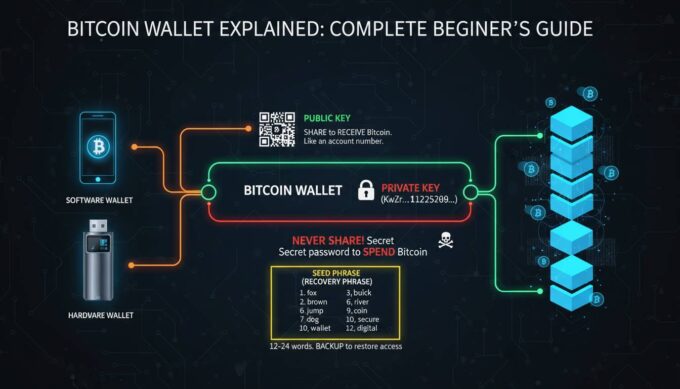
To use cryptocurrency, you need a wallet. Wallets come in two main types:
Hot Wallets (Online): Connected to the internet via apps or exchanges. Convenient for frequent trading but more vulnerable to hacking.
Cold Wallets (Offline): Physical devices that store your keys offline. Like a safe deposit box—extremely secure but less convenient for daily transactions.
Your wallet doesn’t actually store coins. It holds your private keys—the cryptographic passwords that prove you own your cryptocurrency and authorize transactions.
Major Cryptocurrencies: Beyond Bitcoin
While Bitcoin remains the largest and most well-known cryptocurrency, thousands of alternatives exist with different purposes and features.
Bitcoin (BTC)
Created in 2009 by the mysterious Satoshi Nakamoto, Bitcoin was the first cryptocurrency and remains the market leader. It holds approximately 50% of the total cryptocurrency market cap.
- Market Cap: ~$1.2 trillion (as of 2024)
- Primary Use: Digital gold, store of value
- Transaction Speed: ~7 transactions per second
Ethereum (ETH)
Launched in 2015 by Vitalik Buterin, Ethereum introduced smart contracts—self-executing programs that automatically enforce agreements when conditions are met.
- Market Cap: ~$350 billion
- Primary Use: Decentralized apps, DeFi, NFTs
- Transaction Speed: ~15-30 transactions per second
Other Notable Cryptocurrencies
| Crypto | Market Cap | Primary Use | Distinction |
|---|---|---|---|
| BNB | ~$90B | Exchange token | Powers Binance ecosystem |
| Solana | ~$60B | Fast transactions | Up to 65,000 TPS |
| XRP | ~$30B | Cross-border payments | Bank partnerships |
| Cardano | ~$15B | Smart contracts | Academic peer-review |
| Dogecoin | ~$10B | Payments | Community-driven meme coin |
How to Buy and Store Cryptocurrency
Step 1: Choose an Exchange
Cryptocurrency exchanges are platforms where you can buy, sell, and trade digital assets. Major US-based exchanges include:
- Coinbase: Best for beginners, user-friendly interface
- Kraken: Lower fees, more advanced features
- Binance.us: Wide variety of cryptocurrencies
- Gemini: Strong security, regulated
When choosing an exchange, consider: security track record, fees, supported cryptocurrencies, and whether it’s licensed in your jurisdiction.
Step 2: Secure Your Account
Enable two-factor authentication (2FA) using an authenticator app rather than SMS, which can be SIM-swapped by hackers. Use a strong, unique password and consider using a password manager.
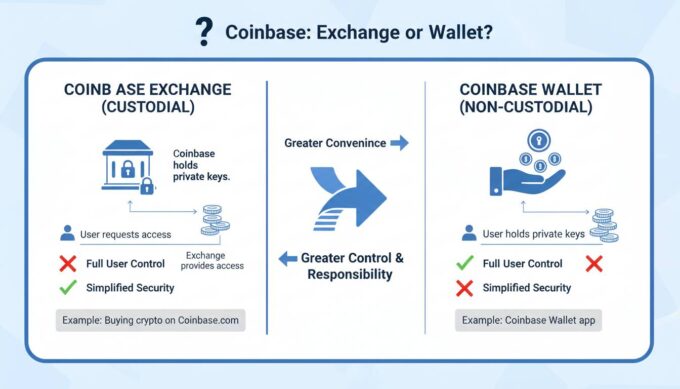
Step 3: Transfer to Personal Wallet (For Large Holdings)
If holding significant cryptocurrency value, transfer holdings to a personal wallet. This gives you full control rather than leaving funds on an exchange (which effectively means trusting a third party with your assets).
Hardware wallets like Ledger and Trezor cost $50-200 but provide bank-level security. They’re essential if holding more than a few hundred dollars in cryptocurrency.
Is Cryptocurrency Safe? Understanding the Risks
Market Volatility
Cryptocurrency prices can swing dramatically. Bitcoin has experienced drops of 50% or more multiple times in its history. In 2022, the total crypto market lost approximately $2 trillion in value as prices crashed and several major firms collapsed.
Never invest more than you can afford to lose. Financial experts typically recommend keeping cryptocurrency allocations small (1-5% of diversified portfolios) given its speculative nature.
Security Threats
Exchange Hacks: Despite improved security, exchanges remain targets. Mt. Gox, once the largest Bitcoin exchange, lost 850,000 BTC (worth billions today) in a 2014 hack.
Scams: Cryptocurrency’s pseudonymous nature attracts fraud. Common scams include:
- Phishing attacks impersonating exchanges or wallet providers
- Ponzi schemes promising guaranteed returns
- Fake initial coin offerings (ICOs)
- Rug pulls where developers abandon projects after collecting investment
Regulatory Uncertainty
Cryptocurrency regulations vary by country and continue evolving. In the US, the Securities and Exchange Commission (SEC) has increased enforcement actions against crypto firms, while the Commodity Futures Trading Commission (CFTC) regulates derivatives. This regulatory uncertainty creates additional risk for investors.
The Future of Cryptocurrency
Institutional Adoption
Major financial institutions have embraced cryptocurrency:
- BlackRock, Fidelity, and other asset managers offer Bitcoin funds
- PayPal and Square enable cryptocurrency purchases
- Banks like JPMorgan and Goldman Sachs provide crypto services to clients
- Tesla, MicroStrategy, and corporations hold Bitcoin on balance sheets
This institutional involvement brings legitimacy and could stabilize markets long-term.
Technological Evolution
The cryptocurrency ecosystem continues advancing:
- Layer 2 Solutions: Technologies like Bitcoin’s Lightning Network and Ethereum’s rollups increase transaction speed and reduce costs
- Interoperability: Bridges connecting different blockchains enable asset transfers between networks
- Central Bank Digital Currencies (CBDCs): Over 130 countries are exploring government-issued digital currencies, potentially integrating cryptocurrency technology into traditional finance
Web3 and Decentralization
Cryptocurrency forms the foundation of Web3—a vision for an internet where users own their data and digital assets rather than relying on tech giants. Decentralized finance (DeFi) applications aim to replicate traditional financial services like lending and borrowing without banks.
Conclusion
Cryptocurrency represents a fundamental shift in how we think about money and financial systems. While Bitcoin serves primarily as a digital store of value, Ethereum and other platforms enable entirely new applications—from decentralized finance to digital collectibles.
For beginners, approach cryptocurrency with caution and education. Start by understanding the technology, only invest amounts you can afford to lose, prioritize security, and consider starting with established currencies like Bitcoin and Ethereum before exploring riskier alternatives.
The cryptocurrency space evolves rapidly—what’s true today may change tomorrow. Stay informed, question promises of guaranteed returns, and remember that this remains a highly speculative market despite growing mainstream adoption.
Frequently Asked Questions
Is cryptocurrency legal in the United States?
Yes, cryptocurrency is legal in the United States. You can legally buy, sell, hold, and use cryptocurrency for transactions. However, the IRS treats cryptocurrency as property for tax purposes, meaning you must report capital gains and losses on your tax returns. Several federal agencies regulate different aspects of cryptocurrency, including the SEC, CFTC, and FinCEN.
How do I start investing in cryptocurrency safely?
Start by researching exchanges and choosing a reputable, regulated platform. Begin with a small investment—only what you’re comfortable potentially losing entirely. Enable two-factor authentication on your accounts. Consider starting with major cryptocurrencies like Bitcoin or Ethereum rather than newer, riskier coins. For significant holdings, transfer assets to a personal hardware wallet rather than keeping them on exchanges.
Can cryptocurrency make you rich?
While some early adopters have become wealthy through cryptocurrency investments, the vast majority of investors do not achieve outsized returns. Cryptocurrency is highly volatile, and prices can drop dramatically. Many investors lose money. There’s no guaranteed path to wealth, and anyone promising guaranteed returns is likely running a scam. Approach cryptocurrency as a speculative investment, not a get-rich-quick scheme.
What’s the difference between Bitcoin and Ethereum?
Bitcoin was created as a digital currency and store of value, often called “digital gold.” Its primary purpose is transferring value without intermediaries. Ethereum is a platform for building decentralized applications and smart contracts, enabling uses beyond simple transactions—including DeFi protocols, NFTs, and decentralized organizations. Both serve different purposes and have different technical characteristics.
Is cryptocurrency environmentally friendly?
Cryptocurrency’s environmental impact varies significantly by network. Bitcoin’s proof-of-work consensus uses substantial energy (comparable to some small countries), though many mining operations now use renewable energy. Ethereum transitioned to proof-of-stake in 2022, reducing energy consumption by approximately 99.95%. Newer cryptocurrencies often use more energy-efficient consensus mechanisms. Environmental concerns remain a valid criticism of some networks.
What happens if I lose my cryptocurrency wallet?
If you lose access to your wallet without a backup of your private keys or recovery phrase, your cryptocurrency is effectively lost forever. There’s no customer service to call, no password reset option. This is by design—decentralization means you, and only you, control your assets. This underscores the critical importance of securely backing up recovery phrases and considering inheritance planning for cryptocurrency holdings.







Leave a comment