

The cryptocurrency market presents extraordinary opportunities, but it also attracts sophisticated threats. In 2023 alone, hackers stole approximately $1.7 billion worth of cryptocurrency through various attacks, while investment fraud schemes cost victims billions more. These aren’t just numbers—they represent real people who lost their life savings to preventable security failures.
Key Insights
– Cryptocurrency hacks and fraud caused over $5 billion in losses globally in 2023
– Over 80% of crypto theft targets involve centralized exchanges and DeFi protocols
– 95% of individual crypto losses stem from user error, not sophisticated attacks
– Cold wallet storage reduces hack vulnerability by 99% compared to hot wallets
Securing your cryptocurrency investments isn’t optional—it’s the foundation upon which all other investment decisions rest. This guide walks you through every critical layer of protection, from fundamental practices to advanced strategies used by institutional investors.
Understanding the Cryptocurrency Security Landscape
Cryptocurrency operates on a fundamentally different security model than traditional finance. When you hold dollars in a bank, federal insurance protects your funds. When you own crypto, you are your own bank—and that means you bear complete responsibility for security.
The threats you face fall into four primary categories. Custodial failures occur when exchanges or platforms holding your assets get hacked, collapse, or freeze withdrawals—as happened with FTX in 2022, leaving customers unable to access billions in funds. Direct theft involves hackers gaining access to your wallets or exchange accounts through vulnerabilities, malware, or credential theft. Social engineering encompasses phishing attacks, SIM swapping, and impersonation schemes designed to trick you into revealing keys or sending funds to attackers. Finally, user error includes lost seed phrases, sending funds to wrong addresses, or accidentally exposing private keys.
The harsh reality is that blockchain transactions are irreversible. Unlike credit card chargebacks, once cryptocurrency leaves your wallet to a scammer’s address, recovery is nearly impossible. This permanence makes prevention your only viable strategy.
Wallet Security: Hot Wallets vs. Cold Wallets
Your choice of wallet fundamentally determines your security posture. Understanding the trade-offs between hot and cold storage is essential.
Hot Wallets: Convenience with Calculated Risk
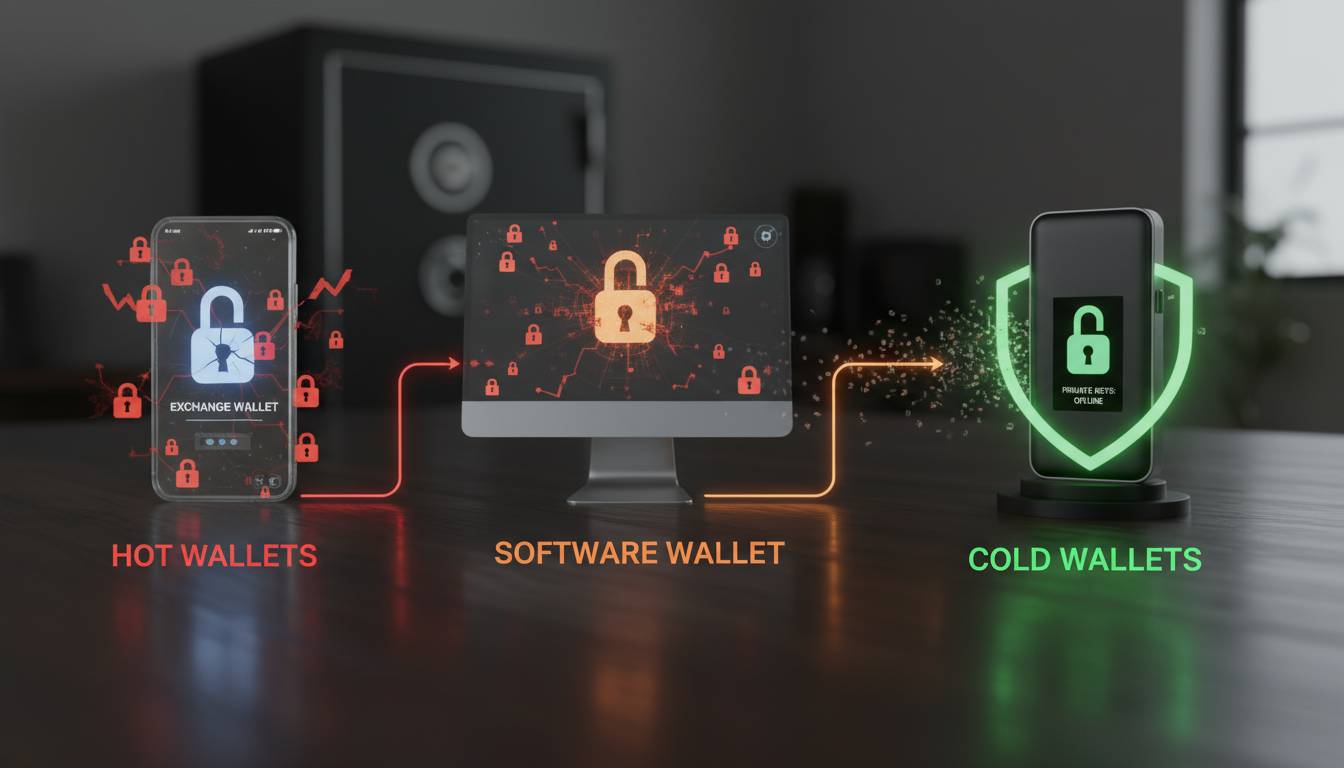
Hot wallets remain connected to the internet, enabling quick transactions but exposing you to constant online threats. These include browser extensions, mobile apps, and exchange wallets. If you hold any amount you might need to access quickly—trading capital, active positions, or amounts you’d need in an emergency—hot wallets serve that function.
Best practices for hot wallet security:
- Limit hot wallet holdings to what you actively trade (generally no more than 5-10% of your total crypto portfolio)
- Enable withdrawal whitelisting, allowing transfers only to pre-approved addresses
- Use separate wallets for different purposes, isolating risk
- Never keep large portfolios in hot storage
Reputable hot wallet options include MetaMask for Ethereum and EVM-compatible chains, Phantom for Solana, and Trust Wallet for multi-chain support. These provide reasonable security when combined with other practices.
Cold Wallets: The Gold Standard
Cold wallets store your private keys offline, completely disconnected from the internet. This isolation makes remote hacking essentially impossible. Industry data shows that properly secured cold wallet holdings have never been compromised through digital attacks.
Hardware wallets represent the most popular cold storage solution. Leading options include Ledger devices (Ledger Nano X, Ledger Nano S Plus) and Trezor models (Trezor Model One, Trezor Model T). These devices cost $80-300 but provide military-grade security for your assets.
Paper wallets offer the simplest cold storage method—you generate a paper document containing your public address and private key, then store it securely. While functional, paper wallets require careful handling to avoid physical damage, loss, or deterioration over time.
Steel wallets like Cryptosteel or Billfodr protect paper backups from fire, water, and physical degradation. These are worth considering for long-term holdings you want to preserve across decades.
For cold wallet setup, always purchase hardware directly from the manufacturer—never from third-party sellers on Amazon or eBay, where tampered devices have been documented. Verify the device’s integrity by checking serial numbers against manufacturer records.
Exchange Security: Protecting Your Trading Accounts
Centralized exchanges remain the primary target for hackers because they hold customer funds in bulk. Your account security on these platforms matters enormously.
Critical exchange security measures:
Two-factor authentication (2FA) is non-negotiable—but not all 2FA methods provide equal protection. SMS-based 2FA is vulnerable to SIM swapping attacks, where attackers transfer your phone number to their device. Instead, use authenticator apps (Google Authenticator, Authy) or hardware security keys (YubiKey). For maximum security, hardware keys like YubiKey provide protection even if your computer is compromised.
Strong, unique passwords prevent credential stuffing attacks, where hackers test username/password combinations stolen from other data breaches. Use a password manager to generate and store complex, unique passwords for every exchange. Never reuse passwords across platforms.
Withdrawal whitelisting limits where you can send funds. Enable this feature on any exchange that offers it—once activated, withdrawals go only to addresses you’ve pre-approved. This protection remains effective even if attackers obtain your login credentials.
Anti-phishing codes appear on legitimate communications from major exchanges. Enable this feature if available—it helps you identify fake emails designed to steal your credentials.
Account alerts notify you of login attempts, withdrawals, or security changes. Enable all available notification types and respond immediately to any unexpected activity.
Protecting Against Phishing and Social Engineering
Social engineering attacks now cause more cryptocurrency losses than technical exploits. Attackers exploit human psychology rather than software vulnerabilities.
Recognizing Phishing Attempts
Phishing emails, messages, and websites impersonate legitimate services to steal credentials or trick you into sending crypto. Watch for these warning signs:
- Urgent action requests (“Your account will be frozen in 24 hours”)
- Slightly misspelled domains (binance-support.net instead of binance.com)
- Requests for seed phrases or private keys (legitimate services never ask for these)
- Attachments or links in unexpected emails
- Offers that seem too good to be true
Defensive measures:
- Never click links in emails—navigate directly to exchange websites by typing the URL
- Verify all URLs carefully before entering credentials
- Use browser-based ad blockers, which often filter malicious links
- Enable anti-phishing codes on exchanges that support them
- Verify sender email addresses, checking for subtle misspellings
SIM Swapping Defense
SIM swapping occurs when attackers convince your mobile carrier to transfer your phone number to their SIM card. With control of your number, they can intercept 2FA codes and reset passwords.
Protection strategies:
- Request a SIM swap pin from your mobile carrier
- Use authenticator app 2FA instead of SMS whenever possible
- Consider a dedicated phone number used only for financial accounts
- Add a passcode or note to your carrier account requiring in-person verification for changes
- Report suspicious activity immediately if you lose cell service unexpectedly
Social Media and Community Awareness
Fake support accounts, fraudulent giveaways, and impersonation scams proliferate on Twitter, Discord, and Telegram. Official teams will never DM you first offering help, ask for your seed phrase, or promise free crypto. Treat every unsolicited message as potentially malicious.
Diversification and Risk Management
Security extends beyond technical measures to portfolio strategy. Even with excellent security practices, diversification provides protection against catastrophic loss.
Exchange diversification means not keeping all holdings on a single platform. If one exchange fails—through hack, insolvency, or regulatory action—you lose only a portion of your portfolio. Spread across 2-3 reputable exchanges plus cold storage.
Asset diversification matters even within crypto. Holding only one cryptocurrency exposes you to total loss if that specific asset fails. Diversification across different chains, sectors (DeFi, storage, payment), and risk profiles provides resilience.
Geographic diversification of your backup seeds adds protection against fire, theft, or natural disaster affecting one location. Store copies in secure locations—safe deposit boxes, trusted family homes in different cities.
Insurance considerations remain limited but evolving. Some exchanges offer limited insurance on holdings. Specialized crypto insurance policies exist but often exclude certain attack types. Research current options based on your holdings and risk tolerance.
Recovery Planning and Backup Strategies
Your security is meaningless if you lose access to your funds and have no recovery path. Planning for recovery protects against both theft and accident.
Seed Phrase Management
Your recovery seed phrase (usually 12 or 24 words) represents complete access to your funds. Treat it with extreme care:
- Never store digitally — never photograph, screenshot, or save seed phrases on computers or phones
- Physical redundancy — create multiple copies stored in separate secure locations
- Steel backup — consider fireproof steel plates for permanent storage
- Never share — no legitimate service, support person, or website needs your seed phrase
Write seed phrases legibly in permanent ink. Verify each word against your wallet’s word list to ensure accuracy. A single error makes your backup useless.
Estate Planning
Cryptocurrency holdings often become unretrievable when owners die unexpectedly. For significant holdings, create clear instructions for heirs:
- Document all holdings, including wallet types, exchange accounts, and seed phrase locations
- Provide instructions for accessing password managers
- Consider legal arrangements recognizing cryptocurrency as part of your estate
- Ensure trusted individuals understand your wishes and can access information if needed
Implementing Your Security Strategy
Building comprehensive security requires systematic implementation rather than ad-hoc additions.
Start with a security audit: List all your cryptocurrency holdings, where they’re stored, and what security measures protect each. Identify gaps.
Prioritize based on holdings: Your highest-value assets deserve the strongest protection. Cold storage for anything beyond your active trading needs.
Layer your defenses: No single measure is perfect. Combine hardware wallets, strong passwords, 2FA, withdrawal whitelisting, and vigilance.
Test your backups: Verify you can actually recover your wallets from seed phrases. Practice the recovery process with small amounts first.
Stay current: Security threats evolve constantly. Follow reliable sources (official exchange blogs, recognized security researchers) for emerging threats and new protective measures.
Frequently Asked Questions
What is the safest way to store cryptocurrency for long-term holding?
Hardware wallets (cold storage) provide the safest long-term storage. These devices keep your private keys offline, making remote attacks virtually impossible. Purchase directly from the manufacturer, set up in a secure environment, and store your seed phrase properly.
Should I keep my crypto on exchanges or move to personal wallets?
For active trading, keeping funds on reputable exchanges is practical. However, never store more than you can afford to lose on any single platform. Move long-term holdings and significant amounts to personal cold wallets you control.
How do I know if a cryptocurrency exchange is secure?
Look for: strong 2FA requirements, withdrawal whitelisting, cold storage for customer funds, proof of reserves, regulatory compliance, insurance offerings, and a track record without major hacks. Research the exchange’s security history thoroughly before depositing funds.
Can I recover my crypto if my wallet is hacked or I lose my device?
If you have your seed phrase backed up securely, you can recover your crypto on any compatible wallet. Without the seed phrase, recovery is essentially impossible. This permanence is fundamental to cryptocurrency—it’s both a feature and a risk.
Is cryptocurrency insurance worth it?
Cryptocurrency insurance remains limited and expensive. Most policies exclude certain attack types and have coverage caps. For most users, proper security practices provide better protection than insurance. Consider insurance primarily for institutional-scale holdings.
How often should I review and update my security measures?
Review your security setup quarterly, and immediately after any major security event in the industry. Update passwords periodically, verify backup storage remains intact, and stay informed about new threats. Security is an ongoing practice, not a one-time setup.
Conclusion
Securing cryptocurrency investments requires understanding that you are your own bank. The permanence of blockchain transactions means prevention is your only defense. By implementing layered security—hardware wallets for significant holdings, strong authentication on all accounts, vigilant practices against social engineering, and proper backup planning—you can substantially reduce your vulnerability to the threats that have cost investors billions.
Start with the most critical gap in your current setup. For most people, that’s moving holdings out of exchange hot wallets into personal cold storage. Build from there systematically. The time you invest in security now could save you from catastrophic loss later.
The cryptocurrency market rewards those who stay engaged, informed, and secure. Protect your assets first—the returns will matter only if you can actually keep them.




Leave a comment