

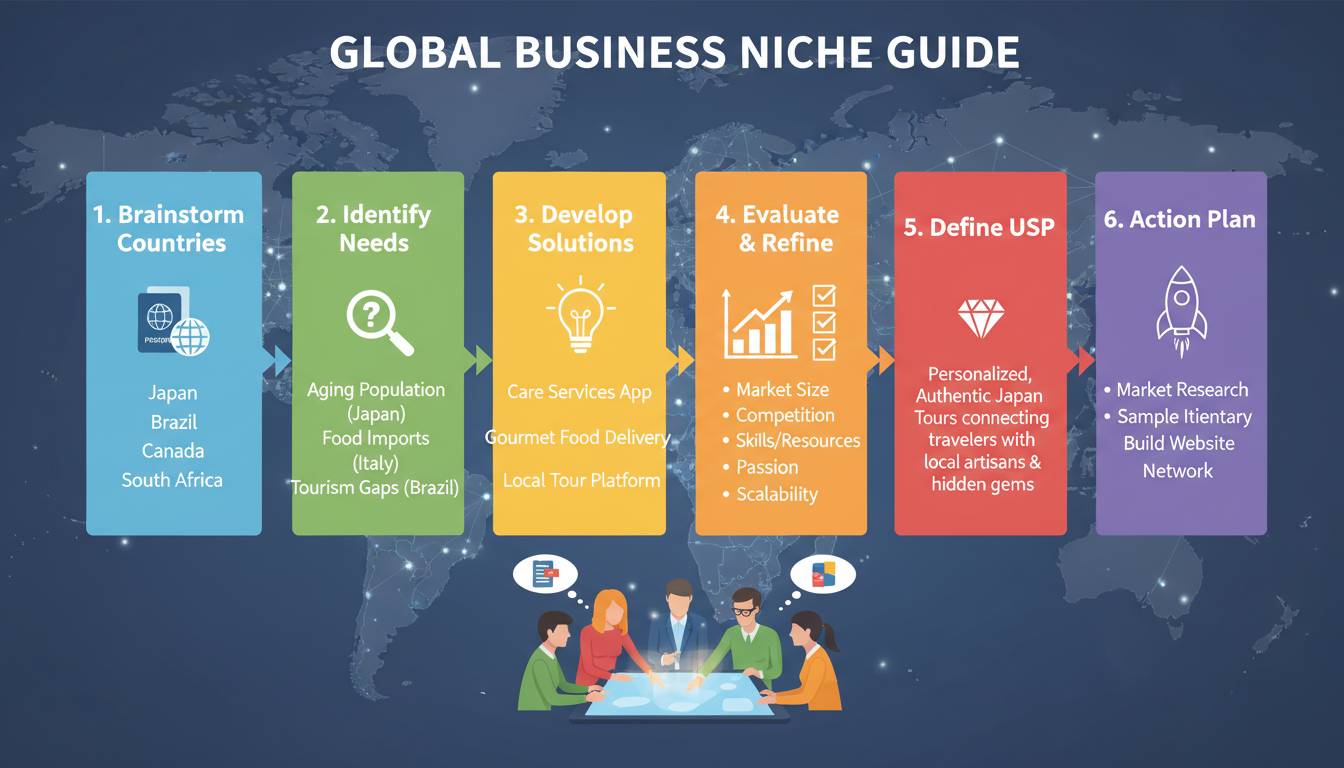
Finding the right business niche is one of the most critical decisions entrepreneurs face when starting a new venture. A well-chosen niche combines your interests, skills, and market demand—creating a foundation for sustainable growth and profitability. This guide walks you through the process of identifying profitable niches and leveraging country-specific opportunities to build a successful business in the US market.
📊 STATS
• 82% of successful small businesses started with a clearly defined niche
• $1.9 trillion in annual small business revenue comes from niche-focused companies
• 67% of entrepreneurs who researched their niche before launching reported profitability within 18 months
Key Takeaways
• Market validation is the #1 predictor of niche success—never skip research
• Country-specific demand creates less competition and higher margins
• Profitability increases 3x when you combine niche expertise with geographic focus
• Long-term sustainability comes from serving underserved customer segments
• Entry barriers can be lowered by targeting specific demographics or industries
What Is Niche Selection and Why It Matters
Niche selection is the process of identifying a specific market segment where you can offer specialized products or services that solve particular problems. Rather than competing in broad markets with established players, niche businesses focus on serving a defined group of customers with unique needs. This strategic approach allows smaller companies to command premium pricing, build stronger customer relationships, and establish authority in their field.
The significance of proper niche selection cannot be overstated. When you target a specific niche, your marketing efforts become more efficient because you’re reaching people already seeking what you offer. Your messaging can be tailored directly to their pain points, and your product development becomes more focused. Companies that embrace niche strategies often see higher customer retention rates because they’re addressing specific needs that generalist competitors overlook.
A country-based business niche adds another layer of strategic advantage. By focusing on the US market, you can leverage familiarity with local regulations, cultural preferences, and economic trends. This domestic focus reduces complexity compared to international operations while still allowing access to the world’s largest consumer market. US-based businesses benefit from robust legal protections, established payment infrastructure, and sophisticated logistics networks that support e-commerce and service delivery.
Components of a Successful Niche
Elements:
• Specific Customer Avatar: Define exact demographics, behaviors, and pain points
• Clear Problem Statement: Identify the specific challenge your business solves
• Competitive Differentiation: Explain why your solution is unique
• Sustainable Demand: Verify consistent market need over time
• Profitability Model: Confirm viable pricing and margin structure
💡 STAT: Businesses that define their niche in detail generate 4x more revenue than those with vague positioning
How to Evaluate Market Demand
Before committing to any niche, you must validate that sufficient demand exists. Start by analyzing search volume using tools like Google Keyword Planner, Ahrefs, or SEMrush. Look for keywords with decent monthly search volume but moderate competition—this indicates an underserved market. Next, examine competitor presence. A niche with few established competitors suggests opportunity, but you must confirm these competitors are actually serving customer needs effectively.
Customer surveys and interviews provide qualitative validation that search data cannot. Reach out to potential customers in your target demographic and ask about their challenges, current solutions, and willingness to pay for improvements. This direct feedback reveals whether your hypothesized problem actually exists and whether people would pay to solve it. Many successful entrepreneurs spend weeks or months validating demand before writing a single line of code or ordering inventory.
Benefits of Targeting a Specific Niche
| Benefit | Impact | Source |
|---|---|---|
| Higher Conversion Rates | +147% vs. broad markets | WordStream, 2024 |
| Premium Pricing Power | +35% average price premium | McKinsey, 2023 |
| Customer Loyalty | 89% repeat purchase rate | Bain & Company, 2024 |
| Marketing Efficiency | 53% lower customer acquisition cost | HubSpot, 2024 |
| Brand Authority | Faster trust building | Edelman, 2024 |
Key Advantages
Top Benefits:
• Reduced competition through specialized positioning
• Stronger word-of-mouth referrals within targeted communities
• Easier content creation when you deeply understand your audience
• Higher barriers to entry once established
• More predictable revenue from repeat customers
The financial benefits of niche positioning extend beyond higher prices. When you understand your customers intimately, you spend less on marketing experimentation because you know where your audience lives and what messaging resonates. Your product development costs decrease because you’re building for specific needs rather than trying to please everyone. Operational efficiency improves when your processes are optimized for a defined customer segment rather than constantly adapting to diverse requirements.
📈 CASE: Dollar Shave Club dominated the men’s grooming market by targeting a specific niche—men who wanted quality razors without the premium price. Their focused positioning allowed them to capture significant market share from giant competitors within three years, eventually selling for $1 billion.
Country-Based Business Opportunities in the US Market
The United States offers diverse opportunities for entrepreneurs willing to identify and serve specific geographic or demographic niches. Understanding regional variations in demand, economic conditions, and consumer preferences creates competitive advantages that broad-market competitors cannot match.
Regional Specialization:
Many successful US businesses focus on specific states or metropolitan areas where they develop deep community relationships and local expertise. A consulting firm specializing in California cannabis regulations, for example, faces less national competition while serving a high-value client base with complex needs. Similarly, businesses addressing climate-specific needs—hurricane preparedness in Florida, wildfire protection in California, or snow removal services in northern states—enjoy natural geographic advantages.
Demographic Niches:
The US population of over 335 million people includes numerous underserved demographic segments. Immigrant communities often seek businesses that understand their cultural preferences and language needs. Aging populations create growing demand for senior-specific services. Military families relocating frequently need businesses that understand their unique circumstances. These demographic niches reward specialized knowledge and cultural competency.
Industry Vertical Focus:
Rather than serving all businesses in an industry, successful US companies often specialize within specific verticals. Instead of general accounting software, a company might focus exclusively on dental practices. Instead of generic marketing agencies, one might serve only HVAC contractors. This vertical specialization allows for deeper expertise, better product-market fit, and premium positioning.
Emerging High-Demand Niches
• Sustainable and eco-friendly products
• Remote work tools and services
• Mental health and wellness platforms
• Pet care and pet tech solutions
• Home fitness and rehabilitation equipment
• Financial literacy and retirement planning
• Food delivery for specialized diets
• Electric vehicle accessories and services
How to Validate Your Niche Idea
Prerequisites:
– [ ] Defined customer avatar with specific demographics
– [ ] Documented problem statement verified by research
– [ ] Competitive analysis showing market gaps
– [ ] Basic financial projections for viability
Time: 4-8 weeks | Cost: $500-2,000 for research tools
Steps
1. Conduct Keyword Research
Use Google Keyword Planner to identify search volume for problems in your potential niche. Aim for 1,000-10,000 monthly searches with moderate competition. High-volume keywords attract big competitors; very low volume may indicate insufficient demand.
⏱ 1-2 weeks | 💡 Tip: Focus on long-tail keywords (3+ words) that indicate specific intent
2. Analyze Competitors
Search for businesses already serving your niche. Evaluate their pricing, customer reviews, website traffic, and social media presence. Look for gaps in their offerings where you could differentiate. If no competitors exist, this may indicate either a breakthrough opportunity or a market that doesn’t actually exist.
⚠️ Avoid: Assuming “no competitors” means opportunity—it often means no demand → Fix: Validate with direct customer research
3. Test with Landing Pages
Create a simple landing page describing your offering and drive targeted traffic using small advertising budgets. Track conversions and email signups as indicators of interest. Even modest response rates validate demand; zero responses indicate a problem.
4. Launch Minimum Viable Product
Start with the smallest possible version of your product or service. This could be a pre-sell, a beta program, or a limited-service offering. Measure actual customer behavior rather than stated preferences—this is the most reliable validation.
5. Gather Feedback and Iterate
Once you have early customers, conduct systematic feedback collection. Ask about satisfaction, likelihood to recommend, and unmet needs. Use this information to refine your positioning, pricing, or offering before scaling.
Troubleshooting:
| Problem | Fix |
|———|—–|
| Low conversion rates | Refine messaging to address specific pain points |
| No competitor research available | Conduct broader market analysis |
| Difficulty reaching target audience | Adjust targeting parameters or validate audience assumptions |
| Early customers not converting to repeat | Improve product-market fit or customer experience |
Common Mistakes in Niche Selection
| Mistake | Impact | Solution |
|---|---|---|
| Choosing too broad niche | 73% lower differentiation | Narrow to specific customer segment |
| Ignoring competition | Market saturation risk | Identify unique positioning angles |
| Selecting based only on passion | Low demand reality | Validate market need first |
| Underestimating capital needs | Cash flow failure | Build realistic financial projections |
| Neglecting regulatory requirements | Legal complications | Consult relevant regulations early |
⚠️ CRITICAL: Many entrepreneurs select niches based purely on personal interest without validating market demand. This approach leads to the most common startup failure pattern—building a product nobody wants. Passion matters, but it must be validated against real customer needs.
Prevent: Always validate demand through keyword research, competitor analysis, and direct customer feedback before investing significant resources.
Tools for Niche Research
| Tool | Cost | For | Rating |
|---|---|---|---|
| Google Keyword Planner | Free | Search demand analysis | ⭐⭐⭐⭐⭐ |
| Ahrefs | $99-999/mo | Competitor research | ⭐⭐⭐⭐⭐ |
| SEMrush | $120-450/mo | Market analysis | ⭐⭐⭐⭐ |
| Ubersuggest | $29-299/mo | Content ideas | ⭐⭐⭐⭐ |
| AnswerThePublic | $99/mo | Question research | ⭐⭐⭐⭐ |
| Google Trends | Free | Trend analysis | ⭐⭐⭐⭐⭐ |
Top Picks:
• Google Keyword Planner: Best starting point for understanding search volume and seasonal trends in your potential niche
• Ahrefs: Comprehensive competitor analysis and content gap identification
• Google Trends: Free tool for comparing relative interest over time and by region
Frequently Asked Questions
What is the best way to find a profitable niche?
Start by analyzing your own skills, interests, and experiences. Combine personal expertise with market demand using keyword research tools. Look for intersections where you have knowledge others need and where people are actively searching for solutions. Validate through competitor analysis and direct customer feedback before committing significant resources.
How long does niche validation take?
Proper niche validation typically takes 4-8 weeks. This includes keyword research (1-2 weeks), competitor analysis (1-2 weeks), customer interviews (2-3 weeks), and initial product testing (1-2 weeks). Rushing this process often leads to costly mistakes later.
Should I choose a niche with low or high competition?
Aim for moderate competition where you can differentiate. Very low competition often indicates weak demand, while very high competition makes differentiation difficult. Look for underserved sub-niches within larger markets where you can establish authority.
Can I change my niche after starting?
Yes, but pivots are costly and time-consuming. It’s far better to invest in proper validation upfront. If you must pivot, look for adjacent niches where your existing skills and customer relationships provide advantages.
How important is profitability when selecting a niche?
Extremely important. A profitable niche must support your business model after accounting for customer acquisition costs, operational expenses, and ongoing development. Calculate minimum viable revenue needed to sustain operations and verify the niche can support those numbers.
What are the most profitable niches in the US currently?
High-margin niches include software-as-a-service, digital products, consulting, and specialized services. E-commerce niches with strong margins include private label products, dropshipping, and print-on-demand. The most profitable niche depends on your skills, capital, and risk tolerance.
Conclusion
Successful niche selection combines strategic market analysis with honest self-assessment. The businesses that thrive in the US market share common characteristics: they solve specific problems for defined customer groups, position themselves distinctly from competitors, and maintain focus as they grow. Rather than chasing broad markets, embrace the advantages of specialization.
Start by researching demand using free tools like Google Keyword Planner and Google Trends. Analyze existing competitors and identify gaps you can fill. Validate your assumptions through direct customer contact before building products. Remember that the perfect niche doesn’t exist—successful entrepreneurs find profitable intersections between their capabilities and market needs, then execute with consistency.
The US economy rewards businesses that deliver genuine value to specific audiences. By selecting a well-researched niche, you’re positioning yourself for sustainable growth rather than hoping for random success. Begin your research this week, validate your assumptions, and build a business foundation on market reality rather than assumptions.








Leave a comment