


A private key in cryptocurrency is a sophisticated digital code—a 256-bit string of characters—that grants exclusive ownership and control over your crypto assets. Think of it as the master password that unlocks your blockchain wallet, allowing you to sign transactions and prove ownership of your digital funds. Without your private key, you cannot access your cryptocurrency, regardless of whether you remember which exchange or wallet holds your assets.
Key Insights
– Private keys are 256-bit numbers, making them virtually impossible to brute-force
– Over $3 billion in Bitcoin has been permanently lost due to lost private keys
– The private key mathematically generates your public key and wallet address
– Anyone with your private key has complete control over your funds
– Private keys must be kept secret at all times
Understanding the Basics of Private Keys
A private key is essentially a randomly generated number that serves as the cryptographic foundation for your cryptocurrency holdings. When you create a new wallet—whether on a hardware device, software application, or paper wallet—the system generates a private key using cryptographically secure random number generators. This isn’t a password you choose; it’s a mathematically produced string that the software creates.
📊 KEY STATS
– A private key is a 256-bit number, giving you approximately 10^77 possible combinations
– The first Bitcoin private key ever generated began with “5J” (Wallet import format)
– Modern private keys are typically represented as 64 hexadecimal characters
– It would take a supercomputer longer than the age of the universe to crack a single private key through brute force
The private key operates within the framework of asymmetric cryptography, also known as public-key cryptography. This system uses mathematical functions that are easy to compute in one direction but extremely difficult to reverse. When you have a private key, you can easily generate its corresponding public key and wallet address, but the reverse process—deriving a private key from a public key or address—is computationally infeasible.
Private keys can be represented in several formats, including hexadecimal (64 characters), wallet import format (WIF), and QR codes for easy scanning. Each format represents the same underlying 256-bit number, just encoded differently for various use cases.
How Private Keys Work: The Cryptographic Foundation
When you initiate a cryptocurrency transaction, your private key signs the transaction digitally. This signature proves that you are the legitimate owner of the funds without revealing your private key itself. The blockchain network verifies this signature using your public key, confirming that the transaction was authorized by the holder of the corresponding private key.
👤 Andreas Antonopoulos, Bitcoin Author and Educator
“The private key is the only thing that proves you own your Bitcoin. If you don’t control the private key, you don’t own the Bitcoin—you just have a promise from a third party.”
This process works through elliptic curve cryptography (ECC), specifically the secp256k1 curve used by Bitcoin and most other cryptocurrencies. The mathematics behind this system are genuinely elegant: your private key is multiplied by a predetermined point on the elliptic curve, producing your public key. This operation is one-way—you cannot reverse the calculation to discover the private key from the public key.
Here’s what happens when you send cryptocurrency:
- Transaction Creation: You specify how much crypto to send and the recipient’s address
- Signing: Your wallet uses your private key to create a digital signature
- Broadcasting: The signed transaction is sent to the blockchain network
- Verification: Nodes use your public key to verify the signature is valid
- Confirmation: Once verified, the transaction is added to the blockchain
The signature is mathematically tied to both the specific transaction data and your private key. This means the signature is unique for each transaction—you cannot copy a signature from one transaction and apply it to another.
Private Keys vs Public Keys: Understanding the Relationship
Many newcomers confuse private keys with public keys or wallet addresses. While these three elements are mathematically connected, they serve distinct purposes in the cryptocurrency ecosystem.
| Component | Purpose | Visibility | Can Be Shared? |
|---|---|---|---|
| Private Key | Signs transactions, proves ownership | Secret | ❌ NEVER |
| Public Key | Verifies signatures, receives funds | Public | ✅ Yes |
| Wallet Address | Identifies where to send funds | Public | ✅ Yes |
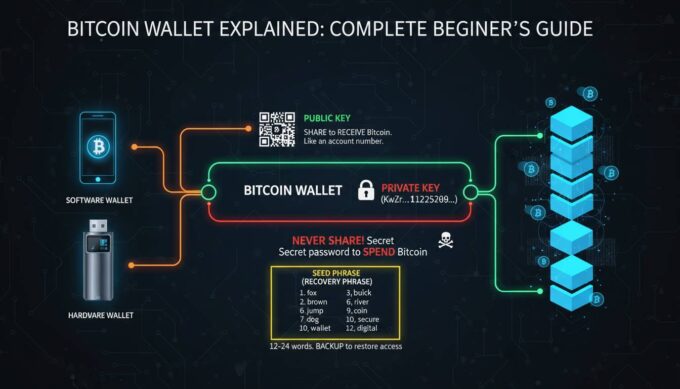
The relationship flows in one direction: private key → public key → wallet address. Your private key generates your public key, and your public key is processed through a hashing function to create your wallet address. This one-way relationship is fundamental to cryptocurrency security.
Your wallet address is what you share with others to receive cryptocurrency—it’s similar to sharing your bank account number. Your public key is less commonly shared but safe to give out—it’s like sharing your name. Your private key, however, is like your Social Security number combined with your PIN: you should never, under any circumstances, share it with anyone.
⚠️ CRITICAL SECURITY NOTE
If someone gains access to your private key, they have complete, irreversible control over your funds. There is no customer support to call, no chargeback possible, and no way to recover your cryptocurrency. This is by design—it’s what makes cryptocurrency truly decentralized.
Types of Private Key Storage Solutions
Where and how you store your private key determines the security level of your cryptocurrency holdings. Understanding the different storage options helps you make informed decisions based on your security needs and technical comfort level.
Hardware Wallets (Cold Storage)
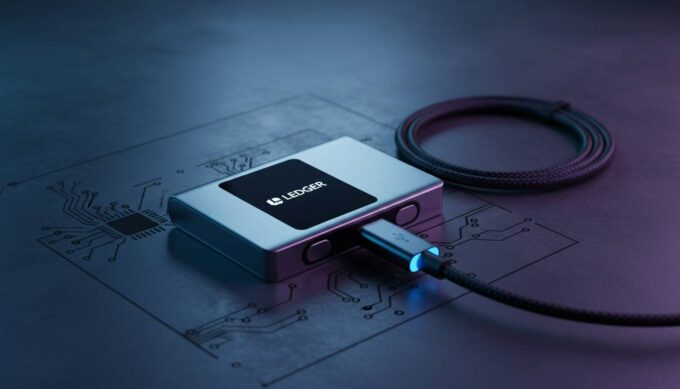
Hardware wallets are specialized physical devices that store private keys offline. These devices never expose your private key to your computer or the internet, making them resistant to malware and hacking attempts.
| Feature | Ledger | Trezor | Coldcard |
|---|---|---|---|
| Starting Price | $79 | $69 | $169 |
| Security Rating | High | High | Highest |
| Open Source | Partial | Yes | Yes |
| Screen | Yes | Yes | Yes |
| Air-Gapped Option | No | No | Yes |
Best for: Long-term holders, significant investments, maximum security
Hardware wallets like Ledger, Trezor, and Coldcard represent the gold standard for cryptocurrency security. When you set up a hardware wallet, the private key is generated inside the device and never leaves it. Every transaction must be confirmed physically on the device, providing an additional layer of security.
Software Wallets (Hot Storage)
Software wallets are applications that run on your computer or smartphone. While convenient, they store private keys on internet-connected devices, making them more vulnerable to attacks.
- Desktop Wallets: Downloaded software that runs on your computer (Exodus, Electrum)
- Mobile Wallets: Smartphone applications (Coinbase Wallet, Trust Wallet)
- Web Wallets: Browser-based wallets hosted by third parties (exchange wallets)
📈 CASE: In 2021, approximately $1.3 billion in cryptocurrency was stolen through various attacks on hot wallets and DeFi protocols . While not all these thefts involved private key compromise, the vulnerability of internet-connected devices remains a significant concern.
Best for: Small amounts, frequent trading, beginners learning the ecosystem
Paper Wallets
A paper wallet is a physical document containing your private key (and often your public key/address) printed as QR codes or text. Because it’s entirely offline, it’s immune to digital attacks—assuming you store it securely.
Considerations:
– Must be stored in a secure, waterproof, fireproof location
– Can be damaged, lost, or stolen physically
– Difficult to use for regular transactions
– Should be generated offline using trusted tools
Best for: Cold storage, extremely paranoid security, gift-giving
Custodial Solutions
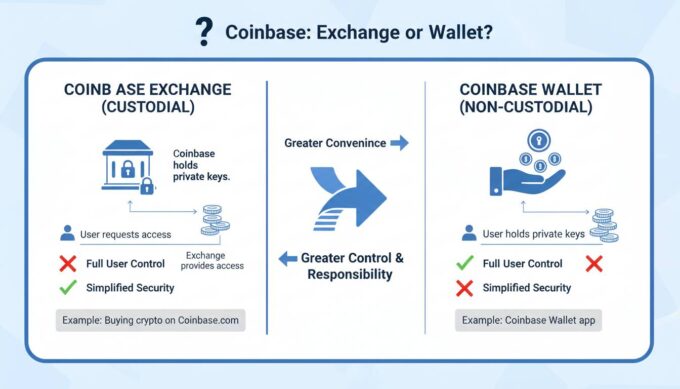
When you keep cryptocurrency on an exchange, the exchange holds the private keys on your behalf. This means you don’t directly control your keys—you have an account balance that represents your claim to funds.
| Aspect | Custodial (Exchange) | Non-Custodial (Self-Hosted) |
|---|---|---|
| Control | Third party | You |
| Security Responsibility | Exchange | You |
| Convenience | High | Medium |
| Risk | Exchange hack, bankruptcy | Lost keys, theft |
| Recovery Options | Password reset possible | Impossible if keys lost |
Best for: Beginners, small amounts, frequent traders who need quick access
Security Best Practices for Private Key Management
Proper private key management is non-negotiable for anyone holding cryptocurrency. The irreversible nature of blockchain transactions means that mistakes cannot be undone.
Essential Security Measures
- Never Share Your Private Key
- No legitimate service will ever ask for your private key
- Customer support will never need your private key
-
Anyone asking for your private key is attempting to steal your funds
-
Use Hardware Wallets for Significant Holdings
- Anything over $1,000 probably warrants a hardware wallet
-
The $50-150 investment is worth the security
-
Create Backups Properly
- Write down your seed phrase (recovery phrase) on paper
- Store copies in multiple secure locations
-
Consider metal backups that are fireproof
-
Verify Before Confirming Transactions
- Always double-check recipient addresses on your hardware wallet screen
- Confirm the exact amount before signing
-
Be wary of transaction replacement attacks
-
Keep Software Updated
- Update wallet software when new versions release
- Firmware updates for hardware wallets often contain security patches
- Only download from official sources
Recovery Phrases: Your Backup Plan
Most modern wallets generate a 12 or 24-word recovery phrase (also called a seed phrase) during setup. This phrase is a human-readable representation of your private key. If your device is lost, damaged, or stolen, you can recover your funds using this phrase.
⚠️ IMPORTANT:
– Store your recovery phrase separately from your hardware wallet
– Never store it digitally (no photos, no cloud storage, no computer)
– Don’t tell anyone your recovery phrase
– Consider using a metal backup like Billfodl or Cryptosteel
Common Mistakes That Lead to Lost Funds
Understanding what goes wrong helps you avoid the same mistakes. Thousands of people lose cryptocurrency every year through preventable errors.
| Mistake | Impact | Solution |
|---|---|---|
| Losing recovery phrase | Permanent loss of funds | Store securely in multiple locations |
| Sending to wrong address | Irreversible transaction | Always verify address character by character |
| Phishing attacks | Complete wallet drain | Never enter seed phrase online |
| Not updating firmware | Vulnerable to known exploits | Regular updates from official sources |
| Sharing private key | Instant theft | Never share with anyone, ever |
The “Password Reset” Myth
Unlike traditional bank accounts, cryptocurrency wallets do not have password reset functionality. If you lose your private key or recovery phrase, there is no customer support representative who can help you. The decentralized nature of cryptocurrency means that nobody—including the original developers—can access your funds without your private key.
This is a feature, not a bug. It ensures that no central authority can freeze your funds or reverse transactions. But it also means you bear 100% of the responsibility for your security.
Frequently Asked Questions
What happens if I lose my private key?
If you lose your private key and don’t have a backup of your recovery phrase, your cryptocurrency is permanently inaccessible. There is no way to recover it—no customer support, no “forgot password” option, no magic solution. This is why securely storing your recovery phrase is absolutely critical.
Can someone hack my private key?
In practical terms, no. Private keys are 256-bit numbers with approximately 10^77 possible combinations. Even using all the computing power on Earth, it would take longer than the age of the universe to brute-force a single private key. The real threat is not hacking—it’s phishing, social engineering, and user error.
Should I share my private key with a “support” person who messages me first?
Absolutely never. No legitimate cryptocurrency service or support team will ever ask for your private key or recovery phrase. Anyone who messages you claiming to be support and asking for this information is attempting to scam you. Delete the message and block the contact.
Is it safe to store my recovery phrase digitally?
No. Never store your recovery phrase in any digital format—no photos, no cloud storage, no password managers, no screenshots. Digital storage creates vulnerabilities that hackers can exploit. Write it on paper or use a metal backup solution, then store it physically in a secure location.
What’s the difference between a private key and a recovery phrase?
A private key is the actual cryptographic key—a 256-bit number—that allows you to sign transactions. A recovery phrase (or seed phrase) is a 12 or 24-word list that represents your private key in a human-readable format. The seed phrase can regenerate your private key, so it’s functionally equivalent in terms of security. Both must be kept absolutely secret.
Can I change my private key?
Your private key cannot be changed after your wallet is created. However, you can create a new wallet with a new private key and transfer your funds to it. This is sometimes recommended for security purposes or when migrating to a new wallet application.
Conclusion
Your private key is the foundation of your sovereignty in the cryptocurrency ecosystem. It represents absolute control over your digital assets—and absolute responsibility for their security. Unlike traditional financial systems where banks can reverse fraudulent transactions or help you recover forgotten passwords, cryptocurrency operates on a paradigm of personal accountability.
The security of your private key determines whether your cryptocurrency remains yours or becomes another cautionary tale in crypto’s history. The best approach combines appropriate technology (hardware wallets for significant holdings), sound practices (secure backup of recovery phrases), and constant vigilance (never sharing your key with anyone).
Remember: not your keys, not your crypto. Whether you hold $100 or $1 million in cryptocurrency, understanding and properly managing your private keys is the single most important skill for any crypto holder. Take the time to implement proper security measures now—because there’s no second chance with private keys.






Leave a comment